
The Corvette Assembly Plant Has 10 Truckloads of 2020 Corvettes Ready to Ship


A member of the MidEngineCorvetteForum.com is offering even more proof that Corvette production has returned pretty much back to normal by sharing Saturdays shipping manifests of new 2020 Corvette Stingrays headed to dealerships. Each Jack Cooper Transporter can hold a maximum of 10 new C8 Corvettes and so this batch of 10 transports contains just under 100 cars which is nearly identical to one shift’s production totals.
From the printouts we see the VIN sequence numbers range from #805 to #4126 which was just completed last week. The cars are sorted by destination and the trucks will soon be headed to Texas, Oklahoma, Florida, South Carolina, and Maryland. The NCM is receiving two trucks and one load will be headed north to Canada.


There are going to be some very happy Corvette owners next week! If one of these is yours, let us know in the comments below!
To find the shipping status of your 2020 Corvette, go to https://www.palsapp.com/, then click on the search icon on the top right of the page (looks like a magnifying glass). Enter your VIN and click the search icon to the right of the input field.
Source:
MidEngineCorvetteForum.com
General Motors, Honda Producing 12,000 Gallons Of Hand Sanitizer


Sponsored Links
General Motors and Honda have announced they will produce around 12,000 gallons of hand sanitizer that will be provided to workers at their respective production facilities.
The hand sanitizer is being produced by both companies through their joint Fuel Cell System Manufacturing (FCSM) partnership. The hand sanitizer is being made at the Brownstown, Michigan facility where the GM-Honda FCSM team has been working on to develop fuel-cell fuel stacks for the next generation of hydrogen-powered road cars. Honda says the sanitizer is made using an “apparatus designed to manufacture the electrodes used in the fuel cells,” that was repurposed.

“It is inspiring to see how the automotive industry continues to find new and innovative ways to help society during this crisis,” said Honda North America general counsel Cathy McEvilly. “The commitment shown by Honda associates and their counterparts at GM is a source of pride to us and we are happy to provide something to help the brave health care professionals fighting this pandemic every day.”

Honda also said it will donate 75 percent of the hand sanitizer to healthcare facilities and other places that may be in need of it and will keep 25 percent for Honda North America workers. It has already sent some bottles of the sanitizer to ProMedica Toledo Hospital in Toledo, Ohio, Memorial Health in Marysville, Ohio, and the DMC Children’s Hospital of Michigan in Detroit, Michigan.

GM and Honda formed the FCSM partnership back in 2013 and, more recently, announced a collaboration on electric vehicles as well. Under the new EV partnership, Honda will use GM’s new BEV3 electric vehicle platform an Ultium battery technology in its future line of EVs and will also incorporate other GM technology such as OnStar and Super Cruise.
“This collaboration will put together the strength of both companies, while combined scale and manufacturing efficiencies will ultimately provide greater value to customers,” executive vice president of American Honda, Rick Schostek, said in a statement previously.
Subscribe to GM Authority for Honda-related GM news, GM-related COVID-19 news and ongoing GM news coverage.
SAM MCEACHERN for GM Authority
Composites-intensive masterwork: 2020 Corvette, Part 1

Eighth-generation vehicle sports more composites, and features parts produced using unique materials and processes.
#weaving #discontinuousfiber #outofautoclave
here and in Part 2 next month.
here and in Part 2 next month.
New engine configuration changes everything
GM engineering went into preliminary design knowing they’d be working on a mid-engine vehicle — the first production Corvette in eight generations to sport that configuration. “We evolved the front-engine architecture as far as we could for performance, so shifting to a mid-engine design was the next logical step to improve an already great car and be the segment leader,” explains GM’s Tadge Juechter, executive chief engineer-Global Corvette. Equipped with the Z51 performance package, the 2020 Corvette Stingray can accelerate 0-60 mph (0-97 kmh) in 2.9 seconds and reach top speeds of 194 mph (312 kmh). Pushing the engine toward the vehicle’s rear affected many things, including the car’s center of gravity, the relative position of occupants, transmission location and design of underbody panels and trunk storage. The mid-engine design also introduced higher operating temperatures and noise to new areas of the car.
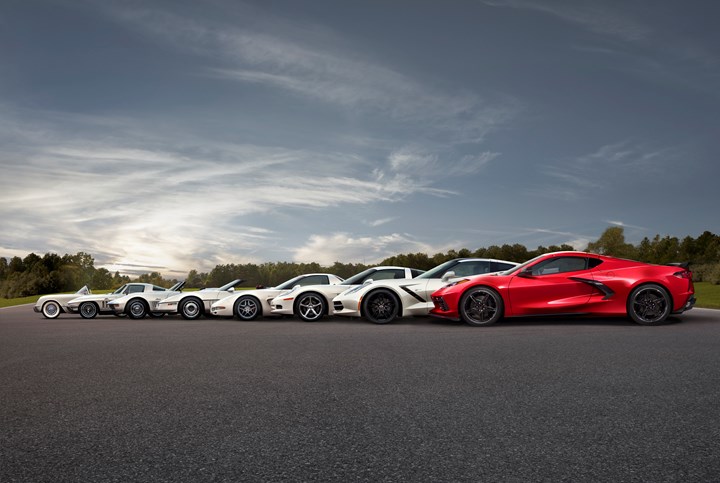
The eighth-generation Chevrolet Corvette — all eight generations (C1-C8) shown above, left to right respectively — from General Motors Co. started production earlier this year. This mid-engine sports car is not only impressively fast, and the most composites-intensive Corvette yet, but it features an array of genuinely innovative composites applications. Source | General Motors Co.
“Because of the mid-engine, we had to do things differently,” explains Ed Moss, Corvette body structure engineering group manager. “From the start, we had so many discussions about how to lay out the body structure. At one point, everything was on the table as we discussed the best way to design and build each system. For example, we debated metallic versus composite for wheelhouses. If we’d kept the C7’s composite wheelhouses, we’d have to bond to the hinge pillar [A pillar], which is immediately adjacent to the front wheel in a mid-engine vehicle, leaving very little package space. We went with metal there. We even briefly discussed metal versus composite body panels. However, it would’ve been economically infeasible to create the C8’s styling lines in metallics.”
“A real challenge we faced was how to handle air induction,” recalls Chris Basela, Corvette body structure lead engineer, explaining the need for a different method to funnel cooling air into and across the naturally aspirated, 495-horsepower, 6.2-liter V8 engine, which generates 470 foot-pounds (637 Newton-meters) of torque. “We tried all kinds of designs that forced air to take really torturous paths, creating eddies and flows we didn’t want. It took lots of iterative work with the powertrain team to develop the best path for airflow because the car needs to breathe freely with no restriction. We also needed access to the air box and had to work around rear trunk space. Another issue was heat and engine noise in the passenger compartment, because occupants no longer sit behind the engine but are positioned directly in front of it. And we were especially conscious of cabin air quality as laws had changed in Europe and elsewhere since the C7, so we worked really hard to reduce VOCs [volatile organic compounds].”
“Even working out how to assemble the car was a challenge,” adds Moss. “With a front-engine design, you have a long hood and large engine compartment, providing operators plenty of room to build the car from inside the compartment, even with the front bumper beam already welded on. On the mid-engine Corvette, with its very short front clip, we keep the front of the car open as the vehicle is built out, then bolt on the front bumper.”
“It was quite a balancing act to get the proper shapes, while ensuring our suppliers could produce the parts and our team in Bowling Green [GM’s Kentucky-based Corvette assembly plant] could assemble them,” continues Basela. “In the end, there was only one carryover composite from the C7’s body to the C8.” This was tough Class A, 1.2 specific gravity (SG) sheet molding compound (SMC) developed for the 2016 Corvette and used in a variety of exterior closures on the new vehicle.
Vehicle architecture
For four generations (C5-C8), Corvettes have featured a three-layer, multi-material body structure: the frame, usually a mix of aluminum or steel — this time with a carbon fiber-reinforced composite (CFRP) part; the body structure, which is largely bonded composite to capitalize on design and manufacturing flexibility; plus bolt-on closeouts (body panels), which have been composite since Covette’s June 1953 debut. This layered hybrid structure not only provides affordable lightweighting in high production volumes — particularly for cars of this performance class — but also permits multiple vehicle variants to be produced at low tooling investment. In fact, for the current C8, GM managed to produce all Class A composite body panels (bonded inners and outers) on both the base model coupé and convertible using just 20 tools.
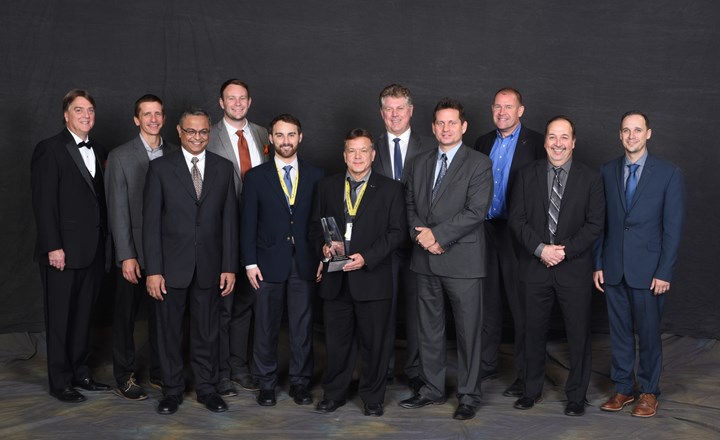
GM and its suppliers have already won many awards for innovative composites use on the 2020 Corvette Stingray. Among those standing above are key GM engineering team members at last November’s 49th annual Automotive Innovation Awards Gala, where GM won SPE Automotive Div.’s Vehicle Engineering Team Award. A number of composite parts on the vehicle also were finalists or category winners at the event. Source | SPE Automotive Div.
In addition, Corvettes have always been engineered with an open-roof architecture, regardless of whether they are actually convertibles or coupés with fixed or removable roof panels. Because open-roof vehicles are generally less stiff than those with fixed roofs, an important focus for each Corvette’s engineering is always to create the stiffest foundation possible to improve suspension and steering. Historically, tunnels(housing transmissions and driveshafts on front-engine vehicles) have dominated Corvette body structures and have been key enablers for achieving high torsional rigidity. In the case of the new Corvette, GM achieved even higher rigidity. With the roof removed, the C8 body is 53.78% stiffer than a benchmark high-performance mid-engine competitor, 29.27% stiffer than a second high-performance mid-engine competitor, and 13.79% stiffer than the C7. Two composite parts made important contributions to vehicle stiffness—one directly attached to the frame structure (rear bumper beam) and another attached to the underbody (lower tunnel closeout).
Frame structure
The C8’s frame is largely aluminum alloy with one CFRP part developed to meet GM’s stringent dollar-per-kilogram targets. In contrast, the C7 frame was all-aluminum and the C6 was mostly steel.
The only composite part directly mounted to the frame that travels with the body-in-white (BIW) through the electrophoretic rust-coat process (which GM calls ELPO), is a unique CFRP rear bumper beam. This part helps stiffen the frame and contributes to rear-impact performance. Its curved shape — possible thanks to a novel process called radius pultrusion developed by Thomas GmbH + Co. Technik + Innovation KG (TTI, Bremervörde, Germany) — enables it to match rear styling cues and fit in limited package space while maintaining dimensional integrity close to engine-bay heat. As the auto industry’s first curved pultruded part (see our full feature on this part in the CW May 2020 issue), the hollow, two-chambered beam was produced by Shape Corp. (Grand Haven, Mich., U.S.) on equipment developed and built by TTI. The beam weighs just 1.3 kilograms and features a bonded/bolted tow-hook eye capable of 25 kilonewtons of pull-out force.
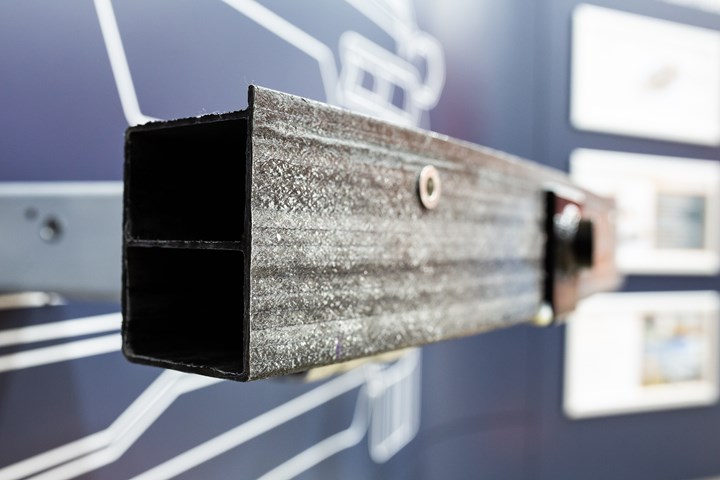
An auto industry first, the 2020 Corvette sports a curved rear bumper beam in pultruded carbon fiber composite produced with 87 individual carbon tows and eight carbon fiber non-crimp fabrics (NCFs) impregnated with polyurethane-acrylate resin. The hollow, two-chambered beam is 66% lighter than the outgoing aluminum beam and met GM’s demanding dollar-per-kilogram targets. Source | Shape Corp.
Body Structure: part A
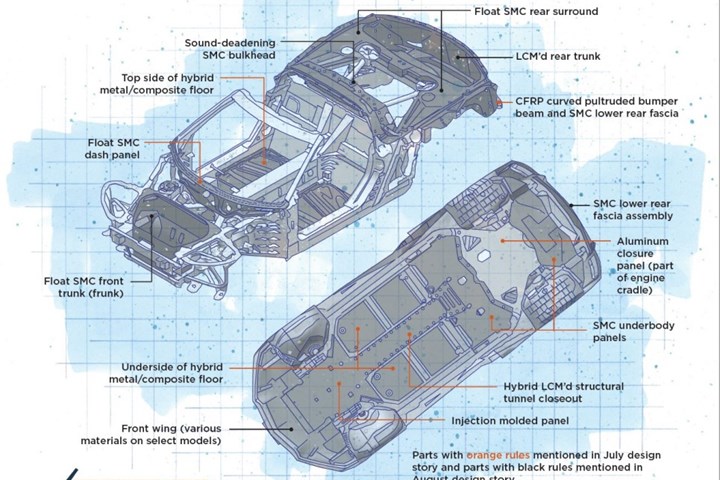
Virtually all of the C8’s body structure components are composite and are bonded and/or bolted to the frame after the latter undergoes ELPO. Notable composite parts at this level include structural underbody closures and the floor — which we’ll cover in this issue — and front and rear trunks, induction ducts and the rear surround and bulkhead — which we’ll cover, along with body panels and trim, next month.
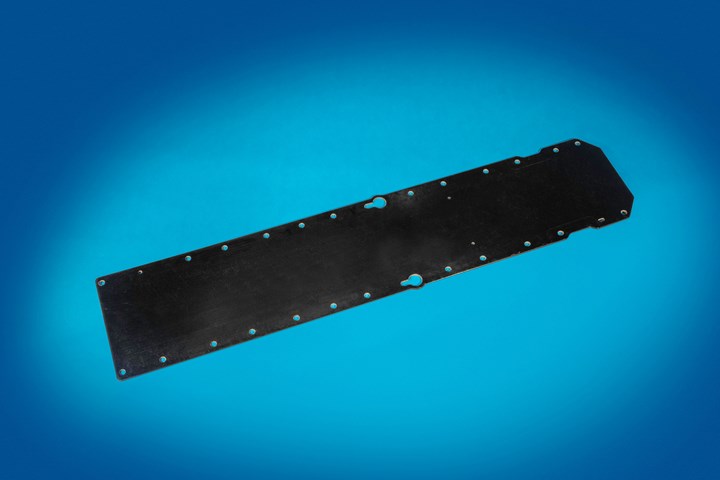
This hybrid-composite, lower-tunnel closeout is produced using a variant of liquid compression molding. It eliminated secondary attachments, lowered mass by 3 kilograms and reduced labor, tooling and capital costs vs. aluminum. Source | SPE Automotive Div.
The removable lower-tunnel structural closeout on the C8, which acts as an access door, contributes more than 10% of the vehicle’s torsional rigidity and acts as a primary load path during a crash. This hybrid-composite panel consists of three layers of glass fiber preform. These consist of continuous/woven and chopped/random fibers at 38% fiber volume fraction (FVF), with veils added to top and bottom face layers on each stack for improved surface finish. Glass preforms are interleaved with two layers of preforms made using Toray (Tokyo, Japan) T700 12K standard-modulus carbon fiber in the form of NCF biaxial fabric at 21% FVF and a vinyl ester (VE) matrix. The closeout is produced by Molded Fiber Glass Co. (MFG, Ashtabula, Ohio, U.S.) using its proprietary PRiME (Prepositioned Reinforcement ensuring Manufacturing Excellence) process, a type of liquid compression molding (LCM).
Aside from a single aluminum closeout near the rear wheels that is part of the engine cradle, the remaining underbody panels consist of either compression molded SMC or injection molded thermoplastics. Among other benefits, these panels reduce underbody turbulence and drag, improve fuel efficiency and keep moisture, dust and stones out of the vehicle’s engine and driveline. Further, they provide the dimensional foundation for multiple exterior and interior interfaces.
The low-density but structural SMC panels feature new formulations (in this case, 40% FVF chopped fiberglass/unsaturated polyester (UP) resin) developed by MFG. The material is called “float” SMC because each panel’s density is less than 1.0 (average SG=0.97) and thus can float in water. MFG produced all structural SMC and LCM’d parts on the car.
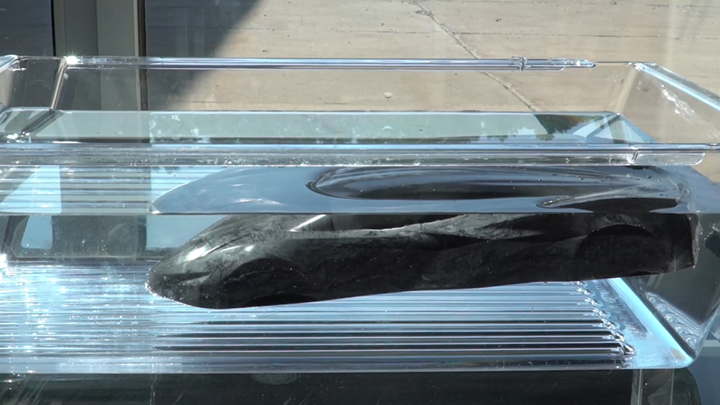
An important contributor to vehicle lightweighting on the C8 is the extensive use of “float” SMC. With specific gravity values less than 1.0, this low-density but structural SMC developed by MFG is used in a variety of non-Class A parts, including underbody panels, the dash panel, air-induction ductwork and the front trunk. Source | Molded Fiber Glass Co.
The vehicle also sports a hybrid floor optimized for torsional bending and side-pole impact protection (engaging the rocker panels and tunnel, to which it is joined). Floor panels feature cabin-facing stamped aluminum bonded to sheets of road-facing 1.5-SG composite (60 wt-% continuous and woven glass fiber/VE) produced via the PRiME process. Before heat-bonding both layers with Pliogrip 9100 polyurethane structural adhesive from Ashland Global Holdings Inc. (Wilmington, Del., U.S.), MFG cleans and preps the materials.
All composite parts directly bonded to the C8 frame are first subjected to laser ablation, a process developed by GM, MFG and Adapt Laser Systems LLC (Kansas City, Mo., U.S.) for the 2016 Corvette, and adapted from a composites industry method for mold cleaning. Laser ablation replaces hand sanding and reduces labor, time and cost, eliminates dust and improves repeatability. Laser path, angle of attack and energy level are customizable for each part’s material and geometry. To maximize manufacturing flexibility, the entire underbody, including the floor, is connected to the frame and itself via bonding and screws.
In the August issue of CW, we’ll continue covering composites innovation on the new Corvette, resuming with additional components at the body structures level and finishing with exterior closures (body panels), plus additional trim and upgrades.
Peggy Malnati for Composites World
Dale Earnhardt Jr. headlines NASCAR Hall of Fame Class of 2021


Dale Earnhardt Jr. spent his whole life chasing meaningful rewards.
He waited for a pat on the back from his famous father, worked diligently to generate compliments from crew members and other drivers, and reveled in the roar of his fans — those he inherited from his father and the new ones he brought along for the ride.
NASCAR’s longtime fan favorite received the sport’s biggest honor Tuesday, when he was selected to join his father in the series’ Hall of Fame. Earnhardt will be inducted in Charlotte, North Carolina, along with the late Mike Stefanik and 87-year-old Red Farmer, who is planning to race on Talladega’s dirt track this weekend. Ralph Seagraves was named the Landmark Award winner for his contributions to the sport.
Despite never winning a series championship, Earnhardt received 76% of the votes cast on the modern era ballot.
“Just talking about it, it’s really emotional because I feed off affirmation,” he said wistfully. “It’s such a great feeling to know people think I made an impact. I know what my numbers are, and I feel like I was chosen because of that, but also for the impact I made off the track, being an ambassador for the sport.”
Junior’s grandfather, Ralph, went into the International Motorsports Hall of Fame in 1997 and was named one of NASCAR’s 50 Greatest Drivers in 1998. Junior’s father, The Intimidator, also made the list, even before finishing his career with 76 wins and a record-tying seven Cup titles.
The team-owning father gave Dale Jr. his first big break: a full-time ride in the Busch Series in 1998. It didn’t take long for Junior to prove he was a natural — on and off the track.
He won Busch championships in each of his first two seasons and two races as a rookie Cup driver in 2000.
When the elder Earnhardt was killed during the 2001 Daytona 500, Junior suddenly found himself in a place he never imagined.
“I knew when Dad died, I was going to assume most if not all of his fan base, and I feel like I took care of that,” he said. “I didn’t squander that, I didn’t ruin that, and I also introduced myself to a lot of people who never heard of Dale Earnhardt.”
Suddenly, the brash, 26-year-old Earnhardt emerged as the face of the sport and started adding his chapter to the family legacy. He won 26 races — including two Daytona 500s and the 2001 Pepsi 400, the first Cup race held at Daytona after his father’s death — before retiring as a full-time Cup driver following the 2017 season.
Fans watched to see if he could replicate the fearless style that made his father so popular. But Junior never tried to compete with that image.
“There was a point in my career where I started to think I’m not going to win seven championships; I might not even win one. I’m not going to win 100 races; I might not even win 40,” he said. “There were a lot of people that wanted me to be as successful as he was and be as aggressive as he was and spin people out or whatever. So I started to think about what I could do outside of that and what else I could do to help the sport.”
Junior introduced new fans to stock car racing through different news outlets, social media and podcasts. The result: 15 consecutive Most Popular Driver awards.

Stefanik won seven titles in NASCAR’s modified series and two more in the Busch North series. His nine total championships are tied with that of Richie Evans for the most in NASCAR history, and Stefanik was named the second-greatest driver in modified history in 2003.
Stefanik, who died from injuries sustained in a plane crash in September in Connecticut at age 61, edged Ricky Rudd for the second spot on the ballot with 49% of the vote.
“Phenomenal when you think about what he did. Nine championships,” Kyle Petty said during NBCSN’s announcement show. “Phenomenal record, phenomenal amount of wins.”
Farmer, one of the three original “Alabama Gang” drivers, with brothers Bobby Allison and Donnie Allison, beat Hershel McGriff by earning
The 87-year-old Farmer won four Late Model Sportsman season titles and an estimated 700 to 900 races. He was a member of NASCAR’s 50 Greatest Drivers and became a member of the International Motorsports Hall of Fame in 2004. This week, with the big series returning to Talladega, he’s scrambling to put together a car for two nights of racing on the dirt track across the street.
“I had a little fender bender in a 40-lapper last weekend,” he said. “They had a three- or four-car pileup right in front of me, and I slid into it and messed up the nose pretty good. So I’m getting my backup car ready.”
An executive with R.J. Reynolds Tobacco, Seagraves helped spearhead Winston’s decision to sponsor NASCAR’s premier series from 1971 to 2003. Winston’s financial support allowed many tracks to upgrade their facilities, and the season-long points fund bolstered purses for drivers and teams.
The Associated Press contributed to this report.
2020 Corvettes are Now Shipping from the Corvette Assembly Plant (Again!)


Thanks to our friends at the MidEngineCorvetteForum.com, we’ve got two different confirmations that newly completed 2020 Corvettes are once again shipping from the Corvette Assembly Plant in Bowling Green
The shipping confirmation comes from the Jack Cooper Transport website. Owners can post their VIN into the search box and it returns the shipping manifest.
Yesterday, the National Corvette Museum received four new 2020 Corvettes while another shipping manifest shows 2020 Corvettes with VINs ranging from 2814 to 3354 heading to multiple Chevy dealers in the midwest.

Thanks to some of the sleuths on the MECF, we also see a few CTF Convertibles heading up to the Detroit area:

This is great news for customers who have been “patiently” waiting for shipping of the new 2020 C8 Corvettes for the first time since the Corvette Assembly Plant reopened on May 26th after being closed for two months due to the coronavirus.
How to Track Your 2020 Corvette
CorvetteBlogger contributor Jeremy Welborn previously wrote this post on how to Track the Shipping of your C8 Corvette via Jack Cooper. To find the shipping status of your 2020 Corvette, go to https://www.palsapp.com/, then click on the search icon on the top right of the page (looks like a magnifying glass). Enter your VIN and click the search icon to the right of the input field.
Source:
MidEngineCorvetteForum.com
Watch A Corvette C8 Hunt Down A Dodge Viper ACR

It seems comfortable at the limit.
The C8 Corvette is Chevrolet’s first stab at building a true mid-engine supercar. While much faster versions will follow, the C8 Stingray in base form can hold its own against more exotic and more powerful machinery. We recently wrote about a C8 Stingray demolishing the quarter-mile, but now we shift our focus to the Laguna Seca Raceway, where a C8 goes up against one of the meanest American performance cars out there: the Dodge Viper ACR.
The C8 is clearly at home on a track as we can see in the video. This Torch Red Corvette gets pushed to its limits and comes out as an unexpected hero.


The 2020 C8 Chevrolet Corvette is no wimp when it comes to numbers: powered by a naturally aspirated 6.2-liter V8, this car produces 490 horsepower and 470 lb-ft of torque. That’s enough to launch it to sixty in only 2.9 seconds when fitted with the Z51 package. This translates into a car that is deceptively fast, especially when compared to big dogs such as the Viper ACR.
In the video, we can see the Vette slowly warming up to the track conditions, with that naturally-aspirated engine filling the cabin with the best noise you could imagine. It is clear that the driver is trying to find his comfort zone.


After a short sprint, the driver and car seem to be clicking, and the pace increases. In the distance, you can see some cars getting closer and closer: it turns out that it’s a Porsche 911 GT3. The action starts at around the 3:15 mark, but you’ll have to wait until the 6:40 mark to see the battle between the Viper and C8.
We have no doubt that in the hands of an experienced driver the Viper would be the faster car, but getting the most out of the downforce capability of this car takes a serious driver and it’ss clear to see that the C8 Corvette is an easier car to drive at the limit. If this is what the Stingray is capable of, we can’t wait to see what faster versions will do.
Michael Butler for CarBuzz
Time Is Running Out To Buy A 2019 Chevrolet Corvette C7

With demand for the C8 outstripping supply, it’s a great time to buy a nearly new C7.
Last year saw the introduction of a mid-engined Chevrolet Corvette Stingray for the first time when the C8 took over from the front-engined C7. It marked a major departure for any Corvette, but thankfully, the C8 has retained the unmatched bang-for-buck performance and power that made the C7 so impressive.
For customers who still want to purchase a 2019 C7, time is running out. According to a report by Corvette Forum, there are now fewer than 300 examples of the 2019 C7 for sale in the country. That said, it may still be easier to get hold of one than the 2020 C8, of which only a few are on sale at dramatically marked-up prices.


As of June 4, there were 289 C7s listed for sale based on information from a Chevy dealership in Pennsylvania. With zero-percent APR financing over 72 months along with a rebate of $3,250, the incentives are attractive and in stark contrast to the 2020 C8s, with many examples of the new car selling for over $100,000.
The 2019 C7 inventory includes 62 Z06s, 44 of the Z51 variants, and just four examples of the crazy ZR1. Of course, the latter was the ultimate C7 with its 755-horsepower supercharged V8 engine sending it to 60 mph in less than three seconds. State availability of C7s varies significantly, with 28 models in New Hampshire and 22 in Illinois, but nothing at all in Kansas, Maine, Alaska, and South Dakota.Most Extreme Brabus Creations EverMcLaren Special Operations Finest Creations


With the current sky-high demand for the C8, purchasing a nearly new C7 could be the perfect solution until the C8 increases in availability. Plus, you’ll save a lot of money. Around three weeks ago, car rental company Hertz was selling 100th Anniversary Editions of the C7 (based on the Z06) for as little as $57,000. Although that’s close to the base C8’s starting price, it’s just about impossible to find a C8 in this spec at the moment.
Besides, whether the engine is midship or in front, the Corvette offers as much driving enjoyment at the price as anything else out there. The new C8 may have moved the game on, but the C7 is far from disgraced and remains a cracking sports car.


Karl Furlong for Carbuzz
Watch a C8 Mid-Engine Corvette Hit 173 MPH on a Dry Lake Bed

Even off the pavement, the new ‘Vette is a rocket ship.
The 2020 C8 Chevy Corvette is a fast car. In base form, it can hit a staggering 194 mph flat-out. Even with the drag-inducing Z51 performance package, the car can still do 184. Hennessey Performance took theirs to 182 mph with ease before they turbocharged it to oblivion. Now, there’s another C8 top-speed run on the internet, and this time, it takes place on a dry lake bed.
Popular YouTube TheStradman took his new Z51-equipped Corvette to a dry lake bed in Utah to test out the top speed of the car. He managed to hit an impressive 173 mph before slowing down—not bad considering the uneven and bumpy surface. It helps that there’s absolutely nothing for miles in either direction. In fact, from inside the cabin, it looks a bit uneventful. Here’s a perspective from outside the car to give you a sense of how fast 173 mph is:
If the base Corvette is this quick right out of the box, we’re curious to see how the upcoming Z06 stacks up. Considering the last-gen car could hit 200 mph, we’re expecting big things.
Source: Brian Silvestro; for RoadandTrack
Mid-Engined Chevy Corvette Video Analyses The 2LT Interior

The Goldilocks zone of Corvette C8 interiors?
By now, you should know that Chevrolet has started deliveries of the mid-engine 2020 Corvette. Lucky owners of the ‘Vette C8 are starting to receive their newest toy and most likely you’ve already seen one on the streets – that’s if the state you’re in is not affected by the coronavirus lockdown.
If you’re among those who are planning to purchase the new Corvette but are undecided with the trim level to choose, this video might be able to help you – especially if you’re particular with a car’s interior.
The Corvette C8 comes with three trim levels: 1LT, 2LT, and 3LT. The differences lie mainly in the features offered on each trim level, which defines that the cabin will look and feel like. That’s pretty important, considering that we spend so much time inside the car rather than staring at our investment from a distance. So, here’s a little guide.


The base 1LT trim isn’t really basic. With the entry-level trim, you already get the GT1 seats wrapped in mulan leather, a customizable 12-inch gauge cluster, push-button ignition and keyless entry, and an 8-inch Chevy MyLink infotainment system with Apple CarPlay and Android Auto, 4G LTE Wi-Fi, and 10-speaker Bose sound system. The Corvette 1LT trim is available in three color options: black, gray, or red.
Going up the 2LT trim gives you more interior color options plus features like a rearview camera mirror, a colored head-up display, heated/cooled seats, heated steering wheel, advanced blind-spot monitor, and rear cross-traffic warning. The infotainment gets upgraded as well with a wireless charger and a 14-speaker Boss audio system.
Finally, the 3LT trim dials up the ante by adding a premium Nappa leather with suede microfiber accents – all in combination with the GT2 seats that have more bolsters. These seem not a lot but the range-topping trim adds luxury to the sports coupe.
If you’re still undecided, watch the 2LT interior review on top of this page to check whether you need to take it down a notch to 1LT or go all out on the top-level 3LT.
Source: HorsePower Obsessed
2020 Chevrolet Corvette vs. 2020 Ford Mustang Shelby GT500 at the Drag Strip

Did you see the two race on YouTube? We’ve tested them, too; here’s why the results were no surprise.

- We have tested both the 2020 Chevrolet Corvette (11.2 seconds at 122 mph) and the 2020 Ford Mustang Shelby GT500 (11.4 seconds at 132 mph) in the quarter-mile.
- A video on YouTube, however, shows flipped results: 11.5 seconds at 120 mph for the Corvette and 10.8 seconds at 132 mph for the GT500.
- As always, the driver and track conditions are critical, and our two-run average is far more repeatable than any one-off run at a drag strip.
When we tested Ford’s new 2020 Mustang Shelby GT500 against the top-dog 2020 Chevrolet Camaro ZL1 1LE, the Mustang came out on top on the drag strip. But how does the front-engine Shelby stack up against the other, now mid-engine, threat from Chevy?
Greg PajoCar and Driver

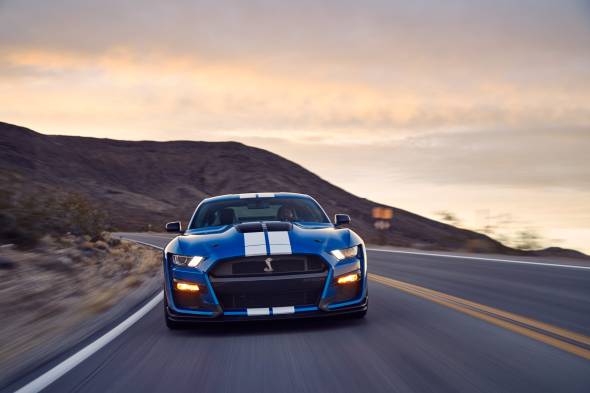
During our testing, the GT500 hurtled through the quarter-mile in 11.4 seconds at 132 mph. But that was on a regular street-like surface, not a sticky, prepped drag strip. We struggled mightily with traction at launch, and our best run was with the launch control set to the lowest rpm allowed (1200 rpm) to prevent igniting a rear-tire fire. However, no surprise: with more traction far, better numbers are possible, and we’ve seen numbers below 11 seconds at drag strips, including this kid, who ran a 10.665 shortly after he acquired the car.’Murica Which Ultimate Pony Car Is the 1/4-Mile King?This Kid Ran a 10.66 Quarter Mile In His GT500
On the other hand, the 2020 Corvette has far fewer launch struggles, as it benefits from its newly acquired mid-engine layout and rear weight bias. Moving the weight distribution rearward improves launch traction, helping it jump off the line much quicker. During our testing, and despite far less horsepower, the mid-engine Vette outaccelerated the GT500 through the quarter-mile by two tenths of a second, reaching it in 11.2 seconds at 122 mph.Advertisement – Continue Reading Below
We’re starting to see other people’s numbers from both of these cars, though, as customers are starting to take deliveries of their C8 Corvettes and GT500s. Contrary to our test results, there’s a video circulating on YouTube that shows the new GT500 beating the C8 Corvette through the quarter-mile by seven-tenths of a second. It raced to the quarter-mile in 10.8 seconds while the Corvette reached it in 11.5 seconds.
Keep in mind that the driver and conditions are huge factors in quarter-mile and acceleration results. We suspect that here, the Corvette likely got bogged down on the high-grip surface, as the launch control isn’t optimized for those conditions, and the 760-hp Mustang benefited from the extra traction on the track.
Connor Hoffman for CarandDriver
Chevy Camaro Mid-Engine Rendering Could Be Corvette’s Cool Sidekick


It’s not such a crazy idea.
The Chevrolet Corvette went mid-engine, so why not the Camaro? That’s the question this particular rendering from Carlifestyle on Facebook asks, figuratively and literally in the post. Sometimes, these oddball renderings can go off the rails but if we’re honest, this one has our interest … in a good way.
It’s not hard to see shades of the Lamborghini Huracan in this design, presumably because that’s the car this rendering is based upon. The side intake and lower rocker trim is a dead giveaway, but beyond that, this car definitely looks like a proper good ol’ Camaro.
And what are the attributes of this, dare we say, Lamaro? As with all things mid-engine, the nose is short and the hips are wide to accommodate an engine behind the driver. From this angle, it’s quite impressive how well the pony car adapts to life as a mid-engine supercar. Of course, this is also an exceptionally well-done rendering that could pass for something real if we didn’t know otherwise.
Here’s a radical thought. The Corvette and Camaro were a stout one-two punch for Chevrolet as front-engine performance machines from America. Camaro sales have fallen sharply in recent years, and the Corvette has transitioned to its new mid-engine form. Maybe creating a mid-engine Camaro could be the pony car’s salvation. Keep the one-two Bowtie punch, just move both the ‘Vette and ‘Maro to the mid-engine world. The Camaro certainly wouldn’t have any domestic competition in such form, and we wouldn’t have even a teeny problem driving the car you see here – be it a V6, V8, or even a neat hybrid.
Alas, Chevrolet already had the guts to build the C8 Corvette with its engine behind the driver. As such we suspect that absorbed all of GM’s gambling chips so the Camaro’s future will likely be far less interesting. The car is expected to disappear in the next couple of years as the current generation winds down, fading into the annuls of automotive history for a second time.
Christopher Smith for Motor1
2020 Chevrolet Corvette C8: Top 10 Reasons To Buy


All-new 2020 Chevrolet Corvette is now on sale, and buyers are lining up
With deliveries of the all-new 2020 Chevrolet Corvette beginning this month we know there are a lot of very excited Corvette buyers out there who are just now getting familiar with Chevrolet’s newest sports car. What drove those shoppers to the new eighth generation Corvette C8, and what are they likely discovering as their ownership experience begins?
We’ve been fortunate to drive the new Corvette on multiple occasions, on both public roads and at a closed course race facility. This has given us sufficient seat time to understand the 2020 Chevrolet Corvette’s upgraded design cues and capabilities. We could make a nearly endless list of why people want the new Corvette, but here are the top 10 reasons we think new, and prospective, Corvette buyers are lining up to sample Chevrolet’s latest supercar.
- Zero-to-60 Performance: The 2020 Chevrolet Corvette’s “base” 6.2-liter V8 engine makes 490 horsepower and 465 pound-feet of torque. That’s enough power and twisting force to catapult the Corvette to 60 mph in 3 second flat. Spring for the $5,000 Z51 performance package, with 495 hp and 470 lb-ft, plus more effective engine cooling, more advanced brake and suspension components, stickier Michelin Pilot Sport 4S tires, along with aerodynamic enhancements, and the Corvette can hit 60 mph in 2.8 seconds.
- Exceptional Value: The 2020 Corvette starts at a meager $59,995, including delivery charges. Once again, that price includes a zero-to-60 time of 3 seconds flat, making the new Corvette not only one of the quickest street-legal cars you can buy, but one of only a very few cars capable of hitting those numbers for less than $100,000. The Corvette has always offered exceptional “bang-for-the-buck” performance specs. The C8 takes this longstanding Corvette tradition to new dimension.
- Top Speed=194 MPH: Not that we endorse going almost 200 mph in any vehicle, and certainly never on a public road. But – IF you have a safe, closed course facility to do it – the Corvette can indeed hit 194 mph. That’s in base form, at the $59,995 starting price. Pro tip: ordering the Z51 performance package actually reduces the car’s top speed even at it improves the Corvette’s zero-to-60 time. The Z51’s aggressive aerodynamics increase downforce, but the added drag reduces top speed to “just” 184 mph.
- 8-Speed Dual Clutch Transmission: Unlike a traditional manual transmission (which is not offered on the new Chevrolet Corvette), a dual-clutch transmission (DCT) has the benefit of keeping the rear wheels connected to the engine, even while shifting The “dual” in dual clutch means the incoming gear is engaged even before the outgoing gear is disengaged. This makes for shifts in under 100 milliseconds, far quicker than a human. The transmission’s design and placement also lowers the Corvette’s center of gravity.
- Magnetic Selective Ride Control: General Motors perfected this advanced active suspension technology years ago. How perfect? Ferrari licenses the use of this tech from GM for its own cars. When buyers equip the new Corvette with the FE4 $1,895 option they’ll have multiple driving modes, including Tour, Sport and Track. This enables a smooth, comfortable ride during relaxed driving conditions or track-ready stiffness when driving a 2020 Corvette on a closed course. It’s the definition of the “best of both worlds”.
- Cargo Capacity: A sports car with functional cargo capacity is relatively rare, and a 3-second sports car with 13 cubic feet of cargo capacity is unheard of…until now. The new Corvette has adequate space behind the engine to fit two full sets of golf clubs, while a front trunk, under the hood, can swallow a large carry-on bag with room leftover. We’re not sure how often Corvette owners actually pick up a buddy to hit the links, but for those that do, the 2020 Corvette is ready and willing, with cargo space to spare.
- Fuel Efficiency: Yet another longstanding Corvette character trait that continues in the new Corvette. Between the car’s slippery shape, torque-laden engine and 8-speed transmission there’s the potential for very little energy expenditure while cruising at a steady highway speed…assuming the driver’s goes light on the throttle. If he does, the new Corvette can deliver between 25 and 30 mpg.
- Driver-Focused Cabin: Everything from the squared-off steering wheel to the 12-inch, reconfigurable gauge cluster to the driver-angled 8-inch touchscreen confirms the Corvette’s performance-oriented purpose. The smaller front-end provides excellent forward visibility, which adds to driver confidence when navigating corners, and all three seats options provide excellent lateral support while remaining comfortable for long drives. The days of disappointing Corvette cabins are finally in the rearview mirror.
- Open Air Cruising: The new Corvette comes as a coupe or convertible, but even in coupe form the Corvette’s roof panel is easily removed and securely stored in the rear cargo area. The convertible uses a retractable hardtop design, the first in Corvette history, that folds away in 16 seconds at speeds up to 30 mph. Powered by electric motors, the Corvette convertible offers the same coefficient of drag as the coupe, with two cool nacelles behind each seat to smooth airflow at higher speeds.
- So Many Options: Almost as exciting as the new Corvette’s performance and value is the car’s range of personalization. The option list long, and can’t be remotely covered in this top 10 list. So head over to the Corvette Configurator and play with exterior colors, interior colors, stripe designs, seat designs, wheel designs, performance upgrades and exterior accents to your heart’s desire. But be prepared to spend quite a long time there. And don’t say we didn’t warn you.
Karl Brauer for Forbes
C8 Corvette Secrets: The 2020 Corvette Has a Flying Car Mode


As we continue to digest all the new information that came out of last week’s First Drive Event with the 2020 Corvette Stingrays in Las Vegas, there is a new “Mode” to discuss that most Corvette enthusiasts have never heard of.
The 2020 Corvette Stingray has several “modes” that help drivers get the most out of their cars. We are already familiar with the regular driving modes that feature settings for Weather, Touring, Sport and Track, as well as the two customizable modes called MyMode and Z-Mode. But what you may not be aware of is that the 2020 Corvette Stingray’s equipped with Magnetic Ride Control also features a “Flying Car” mode.
Well, it is the 21st century after all!
Corvette’s Vehicle Performance Manager Alex MacDonald is responsible for the chassis tuning of the new Corvette and he was tasked with explaining much of the on-track performance capabilities of the new Corvette to those at Spring Mountain last week.
For the C8 Corvette, engineers have rolled out version 4.0 of Magnetic Ride Control with the biggest change to the system is the use of accelerometers rather than position sensors that measured wheel height. Here is the slide that was offered on the new Mag Ride for the C8 Corvette:

The Magnetic Ride Control is tied into the Corvette’s Performance Traction Management system and that’s where the Flying Car Mode comes into play.
When your crest an incline and the Corvette’s wheels are off the ground, they will spin faster like they are on ice or another slippery surface because there is no resistance. The performance traction control senses that and sends commands to slow the wheels. But that’s not the best reaction when on the track. The system now senses when the car’s front wheels leave the ground (and assumes that the rears will be leaving as well), and the system tells the performance traction control to ignore it because it knows that it’s temporary and that all four wheels will be back on the ground momentarily.
Here is Alex talking about the Flying Car Mode:
“The other interesting note about MR is that it communicates with the performance traction system and it tells that performance traction system that if the front wheels have just gone over a big crest that we know that one wheel-base later the rear is about to go over that same crest, we can adapt the traction control to work in that situation and we call that Flying Car Mode, which is a cool name for it, because it does detect when the car is airborne and we can alter the chassis controls to deal what happens when the car lands.”
Source:
Video by Keith Cornett
Church and Williamson finish 19th in two-man bobsled World Championships


ALTENBERG, Germany (Feb. 23, 2020)– Hunter Church (Cadyville, N.Y.) and Josh Williamson (Lake Mary, Fla.) gained a spot to finish 19th in the two-man bobsled World Championship finale in Altenberg today. It rained throughout the night, creating wet and frosty conditions for today’s final two heats.
“It was a much different day, the ice was much slower from the rain,” Church said. “Overall I’m happy to be able to clean up some things from yesterday, and I’m feeling better heading into four-man. It’s good that I’m experiencing these challenges now, and hopefully I can continue to get better.”
Church and Williamson posted start times of 5.38 and 5.35 seconds today for runs of 57.17 and 56.57 seconds, respectively. His third run was 16th best of the heat, and his final run was 10th fastest. Church and Williamson edged closer to the field and finished 19th with a four-run combined time of 3:44.49.
“Today was a good note to end on in two-man,” said USA Bobsled Head Coach Mike Kohn. “Hunter has the same championship mentality as Kaillie Humphries. He’s 23 years old and this is only his second world championship. He’s doing great.”
Germany’s Francesco Friedrich won his sixth consecutive two-man World Championship today with Thorsten Margis. The duo was dominant, and won by 1.65 seconds with a total time of 3:40.44. Johannes Lochner and Christopher Weber from Germany moved into silver medal position with an aggregate time of 3:42.09. Oskars Kibermanis and Matiss Miknis from Latvia denied the Germans a sweep of the medals. The Latvians moved up from fifth to claim the bronze medal with a cumulative time of 3:42.23. Germans Nico Walther and Eric Franke dropped back into fourth.
The 2020 World Championships will continue next week with the women’s and men’s skeleton races, a mixed skeleton team event, and the four-man bobsled competition. Raced pick up again on Thursday, Feb. 27, and will conclude on Sunday, March 1.
NBC Sports and the Olympic Channel will have broadcast and digital streaming coverage. Fans can catch all the action in spectacular high definition via NBC Sports online at NBCSports.com/Live, or through the NBC Sports app. Additional coverage will be available on OlympicChannel.com and the Olympic Channel app.
Please contact USABS Marketing & Communications Director Amanda Bird at 518-354-2250, or amanda.bird@usabs.com, with media inquiries.
Results
1. Francesco Friedrich and Thorsten Margis (GER) 3:40.44 (54.00, 54.09, 55.98, 56.37);
2. Johannes Lochner and Christopher Weber (GER) 3:42.09 (54.59, 54.59, 56.36, 56.55);
3. Oskars Kibermanis and Matiss Miknis (LAT) 3:42.23 (54.49, 54.72, 56.35, 56.67);
19. Hunter Church and Josh Williamson (USA) 3:44.49 (55.25, 55.50, 57.17, 56.57);
About USA Bobsled & Skeleton
USA Bobsled & Skeleton (USABS), based in Lake Placid, N.Y., is the national governing body for the sports of bobsled and skeleton in the United States. USABS would like to thank its sponsors, suppliers and contributors for their support: BMW of North America, Under Armour, Omaze, Kampgrounds of America, Snap Fitness, Boomerang Carnets, Machintek, deBotech and Carpenter. For more information, please visit the USABS website at www.usabs.com.
Humphries and Gibbs lead women’s bobsled World Championships after first two heats

Photo credit: IBSF
ALTENBERG, Germany (Feb. 21, 2020)– Kaillie Humphries (Carlsbad, Calif.) and Lauren Gibbs (Los Angeles, Calif.) currently lead the women’s bobsled World Championships after the first day of racing in Altenberg, Germany. The Americans have a lead of 0.21 seconds, but Humphries isn’t celebrating yet.
“There are still two more runs tomorrow and a lot can happen and change,” Humphries said. “I’m going to treat tomorrow like another race. I’ll debrief with the coaches to go over what worked and what didn’t, and we’ll come back tomorrow with our best.”
Humphries and Gibbs matched Germans Stephanie Schneider and Leonie Fiebig at the start with the fastest push time of 5.63 seconds in the opening heat. Humphries guided the Omaze branded sled to the finish in 56.47 seconds to pull away from the Germans by 0.03 seconds.
Germany’s Kim Kalicki and Kira Lipperheide put pressure on the field in the second heat with a run of 56.45 seconds, which moved them ahead of Schneider and Fiebig by a large margin of 0.33 seconds. Humphries and Gibbs responded with a blistering start time of 5.62 and downtime of 56.33 seconds to pull away even further from the field. The U.S. pair has a two-run total of 1:52.80 to give them a lead of 0.21 seconds heading into tomorrow’s final heats.
“It’s great having coach Shauna Rohbock here to go over lines at the finish, because we could debrief right away after each run to make a plan for the next run,” Humphries said. “I’ve been through four heat races before, and it’s not time to get excited yet. There’s still a lot racing left.”
Rohbock is an expert driver to gain advice from, and today is the 14-year anniversary of Rohbock’s silver medal finish at the 2006 Winter Olympic Games.
Kalicki, who won her first career World Cup medals earlier this season in Lake Placid, N.Y., and Lipperheide and currently in second place with a total time of 1:53.01. Schneider and Fiebig are in third with an aggregate time of 1:53.34. Reigning Olympic champions Mariama Jamanka and Annika Drazek from Germany are also in the medal hunt in fourth position with a cumulative time of 1:53.44.
The deciding heats for the women’s bobsled competition will take place tomorrow at 3:30 p.m. local time, following the opening heats of the men’s two-man bobsled event at 11:30 a.m.
NBC Sports and the Olympic Channel will have broadcast and digital streaming coverage. Fans can catch all the action in spectacular high definition via NBC Sports online at NBCSports.com/Live, or through the NBC Sports app. Additional coverage will be available on OlympicChannel.com and the Olympic Channel app.
Please contact USABS Marketing & Communications Director Amanda Bird at 518-354-2250, or amanda.bird@usabs.com, with media inquiries.
Results
1. Kaillie Humphries and Lauren Gibbs (USA) 1:52.80 (56.47, 56.33);
2. Kim Kalicki and Kira Lipperheide (GER) 1:53.01 (56.56, 56.45);
3. Stephanie Schneider and Leonie Fiebig (GER) 1:53.34 (56.50, 56.84);
About USA Bobsled & Skeleton
USA Bobsled & Skeleton (USABS), based in Lake Placid, N.Y., is the national governing body for the sports of bobsled and skeleton in the United States. USABS would like to thank its sponsors, suppliers and contributors for their support: BMW of North America, Under Armour, Omaze, Kampgrounds of America, Snap Fitness, Boomerang Carnets, Machintek, deBotech and Carpenter. For more information, please visit the USABS website at www.usabs.com.
Tech We Would Like to See on the C8 Corvette: Active Aero


With the highest performance versions of the seventh generation Corvette, customers were forced to make a choice. Did they want their car to have the highest possible top speed, or did they want to sacrifice some of that by bolting a slew of aerodynamic aids to their car for maximum cornering ability?
We would love for Chevrolet to take that decision out of the ordering equation for buyers of the upcoming Z models and the Grand Sport. They could give buyers the best of both worlds with the incorporation of Active Aerodynamics.
Active Aerodynamics can take many forms, from grille vents that close at high speeds to streamline a car, to suspension that lowers at speed to reduce lift. We know that the Corvette team would build a fully functional system that integrates several of these technologies into a cohesive package, just like they did on the C7 ZR1’s chassis-mounted wing and innovative balancing front underwing, but what we mostly want to focus on here is the most visible piece of such a system, the rear wing.
This unit would elevate both the performance and even the prestige of GM’s looming halo car. There are several benefits of an active rear wing that accompany their off-the-charts cool factor.
1. An active rear wing can be lowered, causing it, for all intents and purposes, to disappear, along with any drag that it was creating. Top-end General Motors Products have become so fast that the most track-worthy editions have suffered at the dragstrip because of massive fixed wings. The effects of the C7 Z06/Z07’s wickerbill spoiler have been well documented. Chevrolet officially listed the top speed of ZR1’s with the “big-wing” ZTK package as 10 MPH lower than their stock counterparts, and the Camaro ZL1 with the 1LE package has proven slower than the car it is based on, even in distances as short as a quarter-mile. Allowing these serious track performers to retract their wing, and the ZTK/Z07/1LE models become the best version of their respective model-line with no excuses or asterisks, which is what buyers that dole out more funds expect.

Photo Credit: https://www.sciencelearn.org.nz
2. Just as these wings can retract to reduce drag and improve top speed, they can be “actively” placed in full “attack mode” for maximum downforce in the corners. This increases cornering speed, stability, and driver confidence which can lead to drastically lower lap times.
3. Upon hard braking, an active wing can also go vertical, transforming into an air brake. This assists the actual brakes, resulting in shorter stopping distances. It also keeps more weight in the rear of the car, again helping with stability and, especially in a rear-wheel drive car, improved corner exit speeds.

Photo Credit: Car Magazine (UK)
All three of these traits brought to the table by an active wing radically assist the driver and make the car faster in all aspects. The coolest thing is that, with the right programming, the wing does all three automatically with seamless transitions, and, did we mention how awesome they also look?
There has been speculation about Active Aero coming to the Corvette for several years now. These rumors were fueled by GM’s own patent filings which showed a sketch of a C7 fitted with advanced aerodynamic trickery. We think the top dog mid-engine offerings are the perfect place for the General to finally deploy this technology that can already be found on the majority of the world’s supercars.
Watch These Multiple C8 Corvettes Utilize Launch Control

For the last two days we’ve been in Corvette Heaven as we were invited by Chevrolet to come out to Las Vegas and test drive the 2020 Corvette Stingray. The test consisted of two parts that included a route through the Valley of Fire state park and then today we drove the new mid-engine sports cars at Spring Mountain Motor Resort & Country Club.
Today’s driving session culminated with the very talented instructors from the Ron Fellows Performance Driving School offering hot laps around the track. Each driver gave their passenger a demonstration of the capabilities of the new Corvette and those two fast laps started with engaging launch control as each car took to the track.
With 60% of the weight of the 2020 Corvette residing over the back wheels, the Launch Control demonstration shows just how quick these cars are able to put power to the pavement as those Michelin Pilot Sport 4S summer tires quickly hook up to send the car on the track.
We will be traveling from Las Vegas to home in Tampa on Wednesday, but keep checking back as we got a lot of great photos and videos from our 2020 Corvette drive on deck!
Source:
Video by Keith Cornett
D’Arpino collects silver and bronze medals in Park City’s women’s monobob event


PARK CITY, Utah (Feb. 17, 2020)– Vanessa D’Arpino (Grants Pass, Ore.) claimed silver and bronze medals in Park City’s two-day women’s monobob event over the weekend to lead the U.S. team. Shelby Williamson (Colorado Springs, Colo.) and Lake Kwaza (Sycamore, Ill.) also posted strong performances for Team USA, each finishing in the top six both days.
This is D’Arpino’s debut season, and she’s only raced once before this week; she finished 12th in the Lake Placid monobob race in November.
“This season I came in with low expectations, and I didn’t know where I’d end up in the sport,” D’Arpino said. “Starting with rookie camp and push champs for bobsled, to sliding skeleton for a couple weeks, it was a process figuring out where I was going to do. However, I knew bobsled was for me and I was thankful when coach Mike Dionne got me in the driver’s seat. So far I have loved it.”
D’Arpino was close to qualifying for the 2020 Olympic Team as a track athlete, but she fell just short of her goal. The setback turned into an opportunity when USABS Director of Athlete Development Mike Dionne sent her a direct message on Twitter asking if she wanted to consider trying out for the bobsled team.
D’Arpino admits that she initially thought it was “weird,” but after speaking with Dionne on the phone about the opportunity, she decided to give it a try.
“My goal for this year was to learn as much as I could and stay as involved as much as possible,” D’Arpino said. “We discussed a few monobob races early into training, and being the competitive person I am, I joked about reaching the podium after only a couple weeks of driving. Coming into Park City with more confidence and training, I told coach Dionne I was getting that podium, and he was fully supportive. It’s awesome to actually reach that goal.”
The former University of Oregon sprinter was the fastest athlete off the start block in race one with push times of 5.63 and 5.64 seconds. D’Arpino crossed the finish line in 54.89 seconds, which was second best of the heat, and 55.58 seconds to secure the bronze medal in 1:50.47.
Karlien Sleper from the Netherlands was race one’s winner in 1:49.20, while Ashleigh Werner from Great Britain was second in 1:50.38.
Williamson was just off her teammates pace in fourth place with a combined time of 1:51.00 after posting runs of 55.42 and 55.58 seconds. Kwaza, who is easing back into bobsled after joining the Army’s World Class Athlete Program, finished sixth with a combined time of 1:51.38.
“It is so good to be back on ice,” Kwaza said. “I joined the Army right after last season in May. I spent all summer doing Army training and got back on November 1st and right into a sled.”
Kwaza is no stranger to success on the ice. She has four World Cup medals, all won as a push athlete for Elana Meyers Taylor. Since returning to the ice after her Army training, Kwaza has jumped from the back of the sled into the driver’s seat.
“So far I have been extremely frustrated because, like anything new, it takes time and I have a hard time waiting,” Kwaza said. “But the time I’ve spent being in the front seat has been extremely valuable and I’m excited to continue with this path.”
D’Arpino was back on the podium in race two, earning the silver medal with a combined time of 1:58.99 after clocking runs of 57.99 and 1:01.00. Sleper was again victorious, this time with a two-run total of 1:56.63. Marina Silva Tuono from Brazil claimed bronze in 1:59.39.
Kwaza moved up into fifth place in race two after posting runs of 58.67 and 1:01.11 for a total time of 1:59.78. Williamson was sixth in 2:00.29 to place all Team USA competitors in the top six in both races.
Kwaza said she’s been able to use her veteran teammates as extra coaches as she learns in her new role as a driver.
“The drivers that we have on the team are just amazing human beings and are all about Team USA being successful,” Kwaza said. “Not one of them have declined helping me out in any way. No matter what stage I’m at, I have always felt like I’ve had the entire team behind me. Coach Dionne has also been so patient and helpful.”
“I have the best teammates around, and we’re constantly supporting each other,” D’Arpino said. “Lake Kwaza and I have been paired up since day one in the process of learning how to drive and I am her biggest fan. It’s going to be fun to progress as drivers together.”
There are two monobob events remaining this season; in La Plagne, France from March 2-8, and Lake Placid, N.Y. from March 30-April 3.
Please contact USABS Marketing & Communications Director Amanda Bird at 518-354-2250, or amanda.bird@usabs.com, with media inquiries.
Results
Race #1
1. Karlien Sleper (NED) 1:49.20 (54.73, 54.47);
2. Ashleigh Werner (GBR) 1:50.38 (55.30, 55.08);
3. Vanessa D’Arpino (USA) 1:50.47 (54.89, 55.58);
4. Shelby Williamson (USA) 1:51.00 (55.42, 55.58);
6. Lake Kwaza (USA) 1:51.38 (55.67, 55.71);
Race #2
1. Karlien Sleper (NED) 1:56.63 (57.36, 59.27);
2. Vanessa D’Arpino (USA) 1:58.99 (57.99, 1:01.00);
3. Marina Silva Tuono (BRA) 1:59.39 (58.44, 1:00.95);
5. Lake Kwaza (USA) 1:59.78 (58.67, 1:01.11);
6. Shelby Williamson (USA) 2:00.29 (59.48, 1:00.81);
About USA Bobsled & Skeleton
USA Bobsled & Skeleton (USABS), based in Lake Placid, N.Y., is the national governing body for the sports of bobsled and skeleton in the United States. USABS would like to thank its sponsors, suppliers and contributors for their support: BMW of North America, Under Armour, Omaze, Kampgrounds of America, BiPro, Boomerang Carnets, Hudl, Tesa Tape, PVS International, Ferris Mfg. Corp, Machintek, deBotech and Carpenter. For more information, please visit the USABS website at www.usabs.com.
Source: TeamUSA
Sigulda to host World Cup season finale this weekend


SIGULDA, Latvia (Feb. 12, 2020)– The 2019-2020 World Cup season will come to a close this weekend in Sigulda, Latvia. USA Skeleton will field three women’s and three men’s athletes in the finale. USA Bobsled athletes will not be racing this weekend, opting instead to spend time in Altenberg, Germany to prepare for the upcoming 2020 World Championships.
The competition schedule for the skeleton races is as follows, with all times listed in local time:
Saturday, Feb. 15
12 p.m.: Men’s skeleton run #1
1:45 p.m.: Men’s skeleton run #2
Sunday, Feb. 16
10 a.m.: Women’s skeleton run #1
11:30 a.m.: Women’s skeleton run #2
Fans can watch the action live and on demand. NBC Sports and Olympic Channel will have broadcast and digital streaming coverage of the IBSF Bobsled & Skeleton World Cup in Sigulda. Fans can catch all the action in spectacular high definition via NBC Sports online at NBCSports.com/Live, or through the NBC Sports app, which is available on the Apple App Store, Google Play, Windows Store, Roku Channel Store, Apple TV and Amazon Fire. Additional coverage will be available on OlympicChannel.com and the Olympic Channel app.
Savannah Graybill (Denver, Pa.), Megan Henry (Roxbury, Conn.) and Kendall Wesenberg (Modesto, Calif.) will compete for Team USA in the women’s field, while Andrew Blaser (Meridian, Idaho), Austin Florian (Southington, Conn.) and Alex Ivanov (Carlisle, Mass.) will represent the red, white, and blue in the men’s race.
Henry, Blaser, and Ivanov will be racing on the Latvian track for the first time in their young careers. Wesenberg and Graybill competed in the December 2018 World Cup in Sigulda, finishing 11th and 14th, respectively. Florian has also raced in Sigulda once before when he competed in the 2017 Junior World Championships.
Please contact USABS Marketing & Communications Director Amanda Bird at 518-354-2250, or amanda.bird@usabs.com, with media inquiries.
About USA Bobsled & Skeleton
USA Bobsled & Skeleton (USABS), based in Lake Placid, N.Y., is the national governing body for the sports of bobsled and skeleton in the United States. USABS would like to thank its sponsors, suppliers and contributors for their support: BMW of North America, Under Armour, Omaze, Kampgrounds of America, Snap Fitness, BiPro, Boomerang Carnets, Qwixskinz, Hudl, Tesa Tape, PVS International, Ferris Mfg. Corp, Machintek, deBotech and Carpenter. For more information, please visit the USABS website at www.usabs.com.
Source: TeamUSA
The B-21 Bomber Is the Coolest Plane We’ve Never Seen

The B-21 Raider will be the service’s first new bomber in more than 30 years.
 NORTHROP GRUMMAN
- The U.S. Air Force and Northrop Grumman released the first new images of the B-21 Raider in nearly four years.
- The bomber is similar to the B-2A Spirit but subtle differences hint at some major changes.
- The B-21 Raider is expected to fly for the first time sometime in 2022.
The U.S. Air Force and Northrop Grumman have released the first new image of the B-21 Raider bomber in nearly four years. The image, designed to show the plane in hangars at air bases across the country, shows a few more details of the stealthy bomber. According to aviation experts, the new plane looks like the B-2 bomber with some key differences.
The images were shared by Northrop Grumman, the prime contractor on the B-21 Raider program. The three images show the plane sitting in hangars at Ellsworth Air Force Base in South Dakota, Whiteman Air Force Base in Missouri, and Dyess Air Force Base in Texas. Ellsworth and Dyess are currently home to B-1B Lancer bombers while Whiteman is home to America’s fleet of B-2A Spirit bombers. The B-21 Raider will eventually replace both types.

The first image of the B-21 Raider unveiled in 2016. Some details, such as the prominent nose or beak, were not as apparent as they are in the new images.U.S. AIR FORCE
The B-21 Raider is the first new Air Force bomber since 1988, the year the B-2A Spirit was unveiled. Named after “Doolittle’s Raiders,” the force of B-25 Mitchell bombers that bombed Tokyo in the Spring of 1942, the B-21 is designed to overcome modern air defense threats, including such systems as the Russian S-400 surface-to-air missile system and Chinese J-20 stealth fighter to penetrate enemy airspace. The B-21 will be capable of carrying precision-guided conventional missions and nuclear weapons.
The B-21 will be a flying wing design, a specialty of Northrop Grumman’s since the end of World War II. The blending of the fuselage and wing, combined with the lack of horizontal and vertical stabilizers in the rear, is generally thought of as the best shape possible to avoid enemy radars from all directions. A bomber penetrating deeply into enemy territory will likely have radar waves bouncing off it from multiple angles, making all-around stealth a necessity.ADVERTISEMENT – CONTINUE READING BELOW
The new images sparked some conversation, as reporters and aviation enthusiasts discussed the new plane’s features. Here’s a sketch of the B-21 with notes by reporters from Aviation Week & Space Technology:Guy Norris@AvWeekGuy
@TheDEWLine and I take a stab at likely design changes on B-21 v B-2 after @northropgrumman @usairforce release new rendition. https://aviationweek.com/defense-space/new-b-21a-renderings-reveal-diminutive-size-compared-b-2a … and here’s our 1st version…
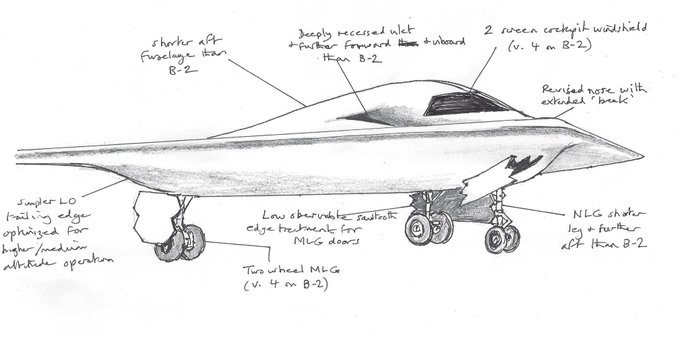
The aviation blog The Aviationist also took a stab at analysis of the photos, which you can see here.
Overall, the trend for the B-21 is a refinement of the B-2A’s original flying wing shape. The leading edge shape of the B-21 is simpler than the B-2A’s sawtooth trailing edge. The cleaner, simpler trailing edge is probably how the original stealth bomber was supposed to look, but in the 1980s a last-minute demand by the Air Force that the Spirit be capable of low-altitude flight necessitated an expensive design change. As a result, as Aviation Week’s analysts point out, the plane is likely optimized for medium- and high-altitude flight.

The B-2’s trailing edge is more pronounced than the B-21’s, as a result of a need to strengthen the plane against the stresses of low-altitude flight.JEROD HARRISGETTY IMAGES
Experts believe the B-21 will be smaller than the B-2A, running about two-thirds the size and weight of the older bomber. This is reflected in the fact that the B-21 rendering features fewer main landing gear wheels. The aircraft simply needs fewer landing wheels to support a lighter airplane. Aviation Week points out that the rendering displays a shorter fuselage and air inlets farther forward than the older bomber. This is all to increase internal volume for crew life support, fuel, sensors, and weapons. As a stealthy airplane, the B-21 must store all weapons, sensors, fuel, and other items internally, so space is at a premium.
The U.S. Air Force plans to buy at least 100 B-21 Raiders for $550 million each in 2012 dollars, or about $654 million in 2020 dollars. Ideally, the service would like 200 or more. The aircraft is currently under development at Northrop Grumman’s facilities in Palmdale, California, with the first demonstrator aircraft in the construction phase. The bomber was originally supposed to fly in late 2021, but that date will likely slide into early 2022.
Source: Kyle Mizokami Aviation Week and The Aviationist
Rare drawings, documents reveal secret history of mid engine Corvette

From an acclaimed concept car John DeLorean reportedly dismissed because he wanted something “smaller and more European,” to the design that ended a feud between a pair of GM giants — but may have set the Corvette back decades — a trove of unique documents, sketches and models tells a secret history of the 60-year quest to build a mid engine Chevrolet Corvette.
The story begins in the late 1950s with legendary Corvette chief engineer Zora Arkus-Duntov and came to fruition when the first mid engine 2020 Corvette Stingray sold for $3 million at auction in January.
Titled “The Vision Realized: 60 Years of Mid engine Corvette Design” and created by GM Design Archive & Collections, the exhibit included 19 original sketches by designers including Larry Shinoda and Tom Peters, the massive 4-Rotor rotary engine from the 1973 Aerovette engineering, a wood wind-tunnel model, even letters from Arkus-Duntov’s personal files.
“The story of the mid engine Corvette is incredibly complicated, full of fits and starts,” said Christo Datini, manager of the GM Design Archive & Collections. 
Cristo Datini at the General Motors Warren Technical Center in Warren, Michigan on Friday, January, 31, 2020 (Photo: Eric Seals, Detroit Free Press)
A mid engine Corvette was a dream shared by GM designers and engineers. The layout, in which the engine is behind the passenger compartment and immediately over the rear wheels, improves acceleration and handling. It’s been a mainstay at Ferrari for decades, and inspired repeated design and engineering projects at GM. None of them made it to production till now, largely because the Corvette’s original front-engine layout was so successful.
“Why would we change the Corvette?” GM chairman and CEO Richard Gerstenberg said to Arkus-Duntov before both men retired in the mid-1970s. “We sell every one we can make.”
‘Design without limit’
A generation of GM designers and engineers had already fought that attitude toward the sports car that debuted in 1953 model, and a couple more would before the midengine eighth-generation C8 Corvette Stingray debuted last year.
The exhibition included dozens of sketches, models, photos and documents.
“Our mission is to preserve the heritage of GM Design and educate our designers on GM’s prominence in the world of design,” Datini said. The archive also is working with the Detroit Institute of Arts on a massive exhibition dedicated to automotive design that opens this summer.
The Corvette exhibition closed at the end of January, but elements of it are likely to be displayed at other events and locations, possibly including the National Corvette Museum in Bowling Green, Kentucky, which provided materials for the collection.
Original magazines with drawings of what Corvettes could have looked like on display at the General Motors Warren Technical Center in Warren, Michigan on Friday, January, 31, 2020 (Photo: Eric Seals, Detroit Free Press)
Chevrolet Engineering Research Vehicle I, Also called SERV I and XP-708, was the beginning. A running model that debuted in 1960, the car had the looks of an Indy car and a chassis that tested what a midengine layout could do. It was “a design without limit” and an “admirable tool” to help Chevy figure out “what to put in Corvette,” said Duntov, himself a former driver in the 24 Hours of Le Mans sports car race.
CERV I was used as a test vehicle for years. Larry Shinoda, who would go on to be known as the father of the ’63 Corvette Stingray and the Mako Shark concept car, tweaked its design repeatedly as engineers tested it with seven different power trains.
GM eventually retired CERV I, selling it to the Briggs Cunningham Automotive Museum for $1. When the museum failed in the 1980s, GM bought it back for “somewhat more,” Datini said.
A model of the 1968 Chevrolet mid-engine Corvette Roadster that is one of many items for General Motors workers to see at the Corvette design display at the General Motors Warren Technical Center in Warren, Michigan on Friday, January, 31, 2020 (Photo: Eric Seals, Detroit Free Press)
Corvettes the world never saw
Shortly thereafter, Duntov heard rumors Ford was developing a Le Mans racer to challenge Ferrari and launched work on CERV II. GM decided not to race, Ford and Carroll Shelby built the GT40 that inspired “Ford vs. Ferrari,” and the CERV II was used as an engineering test bed at secret proving grounds and never seen by the public during its active lifetime. Built in 1964, CERV II had a 500-horsepower V8, 210-mph top speed and 2.8-second 0-60 mph time.
A picture of the CERV II Corvette. The sports car never went into production but it was influential in the design of the C5 production Corvette. (Photo: Eric Seals, Detroit Free Press)
“By that time, engineers and designers knew a midengine chassis was necessary” to get maximum performance from the ‘Vette, Datini said. Putting the engine behind the passenger compartment puts the car’s weight over the rear wheels to put down more power without spinning. Shifting balance from the production ‘Vette’s nose-heavy weight distribution would also improve handling.
Also in 1964, the XP-819 experimental car was being tested. Designed by Shinoda, it bore a strong resemblance to 1970 Corvettes, but Duntov hated it, calling it an “ugly duckling” at least in part because he wished his engineering team got some of the budget allotted to designing the car. It had a 327 cubic-inch V8 and pop-up headlights.
Like many concept and engineering vehicles, XP-819 was destroyed, chopped up. Years later, the pieces were found in NASCAR designer and mechanic Smokey Yunick’s garage.
Half Corvette, half Porsche
With a name GM would later recycle on a minivan, the Astro II XP-880 was never publicly identified as a Corvette, but it was one, intended for production in 1970, but never got there. It debuted at the New York auto show, featuring a nose, front fenders and Firefrost Blue paint that that foreshadowed 1970s production cars.
DeLorean, then Chevrolet general manager, asked for a rush program to create a different midengine design to match the midengine Pantera Ford was developing with Italian sports car maker De Tomaso to debut at the 1970 New York auto show. The XP-882 had a tapering body with dramatic fender flares and a louvered rear window like the Mako Shark II concept car. Like so many midengine ‘Vettes before and after, GM brass decided to stick with the tried and true front-engine layout.
Also in the 1970s GM president Ed Cole — another legendary engineer who led the development of the small block V8 and catalytic converter, among other achievements — became enamored with the Wankel rotary engine. Duntov built two midengine experimental ‘Vettes with rotary engines, glad for Cole’s support despite not sharing his enthusiasm for the engine.
Sketching and notes about the Corvette, one of the many originals on display for workers to see at the General Motors Warren Technical Center in Warren, Michigan on Friday, January, 31, 2020 (Photo: Eric Seals, Detroit Free Press)
The 1973 Corvette 2-Rotor XP-987GT was a smaller, European-scale sports car with a rotary engine. The body was all Corvette, but its chassis came from a Porsche 914. Italian design house Pininfarina built its body. GM displayed the 2-Rotor at auto shows in Frankfurt and Paris before the car disappeared, probably sold to a collector.
Bill Mitchell’s most beautiful car
At the same time, Duntov wanted to develop a bigger midengine Corvette. He and Cole hadn’t been on speaking terms since Duntov refused an annual bonus he thought was insultingly small. They made up, at least in part because Duntov wanted a budget to develop what would become the Corvette 4-Rotor Aerovette, an iconic, gull wing design. Duntov believed it was the most beautiful vehicle GM design chief Bill Mitchell oversaw in a career that included the ’57 Chevy Bel Air and ’66 Buick Riviera.
Duntov recycled the XP-882’s chassis for the Aerovette, which featured silver leather interior trim.
A picture of the Aerovette featuring bi-fold gulping doors in the sports car that was never made. It is one of many photographs, drawings and sketches on display on all things Corvette design inside the General Motors Warren Technical Center in Warren, Michigan on Friday, January, 31, 2020 (Photo: Eric Seals, Detroit Free Press)
Despite the car’s striking appearance, Duntov would come to believe his agreement to use a rotary engine was a nail in the midengine ‘Vette’s coffin.
Despite that, another midengine engineering car arrived in 1974. The XP-895 began its life with a steel body. Intrigued by the idea of lightweight materials, DeLorean asked Reynolds Aluminum to create an aluminum body. That cut the car’s weight by nearly 40%, but DeLorean pulled the plug on the project because he wanted a smaller, more European design.
That never happened, and design work on midengine ‘Vettes came to a halt for more than a decade, as GM struggled meeting the challenge of higher fuel prices.
Closing the deal
By 1986, the quest for a midengine Corvette was ready to create another giant figure, and it got one when a young designer named Tom Peters began work on the Corvette Indy concept car. Peters went on to become the chief designer of the sixth- and seventh-generation C6 and C7 Corvettes and play a key role in starting work on the 2020 C8.
With a radically short hood compared to production ‘Vettes and cutting-edge technologies including four-wheel steering, traction control and active suspension, the Indy — so named because it used a 2.65L V8 Chevy developed for Indy Car racing — kept dreams of the midengine ‘Vette alive
The 1990 CERV III — this time the C stood for “Corporate,” not Chevrolet Engineering Research Vehicle — was the next step. Datini’s research convinced him it was an attempt at a production version of the Indy.
CERV III had scissors doors and was built of Kevlar, carbon fiber and aluminum. With a 650-hp twin-turbo 5.7L V8, GM predicted a top speed of 225 mph. It debuted at the 1990 North American International Auto Show in Detroit.
After that, work on the midengine Corvette went undercover for two decades. Photos of disguised prototypes at test tracks surfaced from time to time, but the car seemed to be as much myth as metal. There are whispers the Great Recession halted work on one, setting development back years.
A display of Zora Arkus-Duntov known as “The Godfather of the Corvette” at the General Motors Warren Technical Center in Warren, Michigan on Friday, January, 31, 2020. (Photo: Eric Seals, Detroit Free Press)
Development of the 2020 Corvette Stingray began around eight years ago, a long time for most projects, but the blink of an eye when it’s the last chapter of a 60-year story.
Mark Phelan for Detroit Free Press
Chevy does a deep dive on mid-engine 2020 Corvette Stingray development in new documentary


Revolution, as the documentary is titled, will air in two parts and goes deep behind the scenes of the biggest ever change to the Corvette.
If there’s one word that describes the 2020 Chevrolet Corvette Stingray pretty darn well, it’s probably “Revolutionary.” It’s the first time in the nameplate’s history that the engine resides behind the driver, as Chevy elevates its long-running sports car to battle the world’s best.
Naturally, curious minds have to wonder what went on behind the scenes to make this car come together. Chevy has good news for you. Revolution, a two-part documentary detailing the C8-generation Corvette’s development, is set to air in the coming months, the brand said Monday.
Chevy told Roadshow the documentary will air on the Corvette’s homepage here, but for now, the quick trailer embedded above will give fans a taste of what the upcoming feature holds. There’s plenty of first-hand knowledge on display — the team that put the latest car together gets plenty of camera time. Numerous people in the mid-engine Corvette program spill how it felt to take an icon and reinvent it.
The documentary announcement comes just after Chevy announced that the production of the 2020 Corvette Stingray kicked off on Monday. With the C7-generation car in the rearview mirror, and all necessary retooling done for the mid-engine car, the workforce in Bowling Green, Kentucky is solely focused on the new Corvette.
Chevy didn’t have an exact timeline for when the first part of the documentary will air, but it should give fans eagerly awaiting their cars something to pass the time as deliveries begin in early March at the latest. Hopefully by this summer, we’ll see plenty of 2020 Corvettes on the road as the plant ships them out to their new homes.
Kaillie Humphries Wins Fourth Bobsled World Cup Of The Season In St. Moritz


Can anybody catch Kaillie Humphries? As the world cup season in bobsled approaches its end, the answer is a more and more definitive no.
Humphries clocked her fourth victory of the world cup season in St. Moritz, Switzerland, further extending her lead in the overall IBSF World Cup standings. The two-time Olympic gold medalist and her 2018 Olympic silver medalist brakewoman Lauren Gibbs tied for the best push (5.5 seconds) on their first run on the Celerina Olympia Bobrun course to secure the lead halfway through the competition with a time of 1 minute. 8.24 seconds.
Though they recorded only the fifth-best second run in 1:08.94, their overall time of 2:17.18 was enough for the win, edging Germany’s Mariana Jamanka and Kira Lipperheide by 0.16 seconds. The most consistent pair of the day, Germany’s Stephanie Schneider and Leonie Fiebig completed the podium 0.01 behind their teammates.
Download the Team USA app today to keep up with bobsled and all your favorite sports, plus access to videos, Olympic and Paralympic team bios, and more.
Thirty-four-year-old Humphries, who competed for Canada and has only been representing the United States since November, has already proven herself a valuable asset to Team USA. She and Gibbs began their 2020 season with a pair of wins in Lake Placid, New York, and Humphries drove with Sylvia Hoffman in last week’s victory in Koenigssee, Germany. Humphries also has a bronze medal from Innsbruck, Austria, to her name this season.
The U.S. will be absent from the final world cup competition over Valentine’s Day weekend in Sigulda, Latvia, in order to prepare for the world championships in Altenberg, Germany at the end of February.
With Saturday’s results taken into account, Humphries has accumulated 1,484 points in the world cup standings, extending her lead ahead of Stephanie Schneider, who holds second place with 1,411. 2019 world cup titlist Jamanka is currently third with 1,381.
Source: Blythe Lawrence, Team USA
A Le Mans Winner Ripped The C8 Corvette Around The Nürburgring In 7 Minutes 29.9 Seconds

When you’re Chevrolet and you have access to five-time Le Mans winner Oliver Gavin, it’s a smart idea to shove him behind the wheel of a new C8 Corvette with the Z51 performance package and point him out for a flying lap of the Nordschleife. These lap times are largely irrelevant as they absolutely do not correlate to driving enjoyment or real-world usable performance, but it’s a slightly abstract way to compare the relative abilities of sports cars.
With ideal conditions and an incredibly capable driver, Chevrolet managed a lap time of 7 minutes and 29.9 seconds. That’s quicker than a recent independent test Porsche 992 time, and Chevrolet’s own high-powered Camaro ZL1. That said, it’s 16 seconds off the pace of the C7-generation Corvette Z06. Interesting? Maybe.
Chevrolet confirmed to RoadShow that this was the lap time, as hidden (below) in a teaser video for its upcoming documentary on the development of the C8.

Are you and I capable of this lap time? Hell no. But the car is capable of it in the right hands, and I guess that has bragging rights of some kind.
Obviously this is still just the base model Corvette with its 495 horsepower V8 mounted in the middle. The Z51 pack adds aero bits, better tires, better suspension, and better cooling for the entire car. There will be more powerful, better, and faster Corvettes coming, but for now you can rest assured knowing a C8 Corvette is slightly faster around the ‘ring than the big bad supercharged Camaro. That is, unless the ZL1 was of the 1LE variety (which ran a 7:16.04).
Bradley Brownell for Jalopnik