
2020 Chevy Corvette Changes Its Latitude

Kids have been hanging out of car windows screaming, grown adults stopping in my driveway to take photos, and minions asking lists of questions at gas stations. Any number of fellow drivers waved their hands for me to roll down my window. “Is that the new Corvette,” they screamed. When I confirmed it was, the overwhelming sentiment was, “I thought it was, but it didn’t look right.” That’s because the engine has changed its latitude from front to behind the driver. The rest of the car is just as dramatic.
Paint To Light The Night
It flares its presence with Sebring orange metallic paint and Carbon Flash black accents that include 19-inch/20-inch wheels front/rear. It’s all good, but moving the engine location changes proportions, shortening the nose and lengthening the rear roofline that ends in a high wide deck. Peaked fenders, pointy nose, and quad taillamps all whisper “Corvette” while the rear window becomes a viewing platform for the engine. It’s all familiar, but oh so different.
Hallmarks of previous generation Corvettes have been their roomy interiors, generous cargo space, and all-day comfort. Unlike most supercars, Corvettes could be driven to work with ease. Even drivers of advancing years and generous proportions fit inside. Mid-engine cars tend to be cramped and uncomfortable. Designers knew they would have to overcome those deficiencies to meet Corvette enthusiasts’ expectations.

Drivers feel like they’re commanding a warp-speed starship when facing the reconfigurable flatscreen instrument cluster, heated squircle steering wheel, and flatscreen infotainment system. A large head-up display changes configuration with the drive modes. Climate controls are housed in a thin panel running from dash to console. Tech includes a 14-speaker Bose Performance series audio system, wireless phone charging, Apple CarPlay, Android Auto, and 4G Wi-Fi hotspot. Seeing out was bound to be more difficult, but a rearview camera mirror, front camera, rear parking sensors, crosspath detection, and blind zone alert alieve any concerns.
Passengers sit further forward in the chassis than in previous generations, but there’s still ample space. Drivers get wide footwells with a proper dead pedal. Heated and ventilated seats feature power side bolsters and lumbar while a roomy trunk behind the engine and deep frunk in the nose provide nearly as much cargo space as the C7. The roof panel still fits in the trunk. So does a set of golf clubs.

Fastest Vette Yet
Fully exposed, the engine is one potent device. The 6.2-liter V8 spins out 495 horsepower and 470 lb. ft. of torque. It all gets to the rear wheels through an 8-speed dual clutch automatic transmission. There’s no manual option, so pat the paddles to shift yourself. If you want a selfie, click quick as the fastest ever Vette evaporates 0-60 mph in under three seconds and terminates just shy of 200 mph. Fuel economy rates 15/27-MPG city/highway.
So why, after nearly 70 years, did engineers move the engine from front to middle? Well, they kept adding power to the front-engine cars, but could not get them to go appreciably faster. They just couldn’t get weight to transfer to the rear wheels. This one hooks up and is far better balanced on the track.
Shred curvy backroads and you can almost think it through. It’s an easier car to drive, especially with Tour, Sport, and Track modes that change the steering weight, throttle sensitivity, and transmission shift points. The Z51 package adds performance brakes, suspension, exhaust, and electronic limited slip differential. There’s a slight hesitation before unholy acceleration as the e-diff sorts itself, but after that, bliss. Even with the stiffer suspension, it’s not brutal. I’d drive it anywhere.
Chevrolet could have served up another very competent front-engine Corvette, but instead delivered a car that’s still clearly a Corvette, but one that causes teenage boys to swoon and little girls to scream. Continuing another Corvette tradition, the C8 is one a heck of a deal. Base models start at $58,900, but rose to $79,315 as tested. That’s a pittance compared to the Porsche Boxster, Acura NSX, and Ford GT.
2020 Chevrolet Corvette Z51
- Two-passenger, RWD Coupe
- Powertrain: 6.2-liter V8, 10-spd trans
- Output: 495hp/470 lb.-ft. torque
- Suspension f/r: Ind/Ind
- Wheels f/r: 19”/20” alloy
- Brakes f/r: disc/disc
- Must-have features: Comfort, Performance
- 0-60 mph: 2.9s
- Fuel economy: 15/27 mpg city/hwy
- Assembly: Bowling Green, KY
- Base/As-tested price: $58,900/$79,315
Casey Willams – WFYI
What Does the Z-Mode Button Do in the 2020 Chevrolet Corvette?


From its exterior design to its driving experience, there are so many remarkable new qualities of the 2020 Chevrolet Corvette compared to its predecessor. We’ve already given GM’s iconic sports car the full review treatment and have covered what it’s like in everyday driving, but a new steering-wheel button in the 2020 Vette caught my eye during a recent test drive.
Positioned to the left of the horn pad is a silver-colored button with a lone letter Z on it. At first glance, it looks like the Z logo from Nissan’s famed sports car, but it actually pays homage to the Corvette’s long history with the letter Z; the letter has appeared over the years in the form of high-powered versions (ZR1 and Z06) and performance option packages (Z51).

Pressing the button activates Z-Mode, one of two new driver-configurable modes on the 2020 Corvette (the other new mode is dubbed MyMode). Like the M buttons on some BMW models, the Corvette’s Z button lets drivers instantly select their preferred performance settings.
While the MyMode, Weather, Tour, Sport and Track modes are selected using a knob on the center console, Z-Mode is only accessible from the steering wheel. In addition to the exhaust sound, steering, suspension (when equipped with Magnetic Ride Control) and braking settings that are configurable within MyMode, Z-Mode also includes a powertrain setting that controls gas pedal, transmission and engine response.
The inclusion of new customizable drive modes are welcome additions for a car like the Corvette, but how the driver controls these modes is just as important. Combining the Corvette’s configurable features into one button with Z-Mode is smart, and putting it on the steering wheel where it’s easy to activate is doubly so.
Mike Hanley for Cars.com
The Chevy C8 Corvette: Everything We Know About the Powerful Mid-Engine Beast

From design to specs and pricing, here’s what you should know about the iconic American sports car as it enters its second year as a mid-engine speedster.
 Chevrolet
Overview
Is there a more American car than the Chevrolet Corvette? The Ford Mustang fan base may quibble with the thought, but there’s no denying that countless enthusiasts believe it to be true. And because of that, each new iteration of the sports car stokes excitement among Chevy loyalists. But it had been decades since the announcement of a new ‘Vette garnered as much anticipation as the unveiling of the eighth-generation model last year.
That’s because, after years of rumors and speculation, the 2020 C8 Corvette Stingray was the first iteration of the model to feature a mid-engine layout. For Corvette diehards, that news was momentous. After all, moving the engine back would almost certainly allow the car to compete more directly with its high-performance European peers. Yet, it would also likely alter its signature look—a mid-engine placement would mean a new frame. Indeed, Chevy took the opportunity to completely reimagine the Corvette’s design, discarding more than a few signature features for the new C8, including the elongated nose of its predecessors. The result is a sports car that looks primed to compete for attention, not only with American devotees, but with collectors of European supercars as well.
The 2020 C8 Corvette Stingray Chevrolet
Engine, Specs and Performance
Any discussion about the C8 Corvette can only begin in one place: the engine. After 67 years of commitment to a front-engine configuration for the Corvette, Chevrolet decided to kick off the new decade by repositioning the car’s powerhouse behind the driver and passenger seats. And this isn’t just any old engine—it’s a brand-new, naturally aspirated 6.2-liter LT2 V-8.
While that base motor, which is mated to an 8-speed dual-clutch automatic transmission, isn’t all that different from the one featured in the C7, it is more powerful, bringing a solid 490 hp of grunt and 465 ft lbs of torque. The new power train enables the car to rocket from zero to 60 mph in less than three seconds. The C8 can also complete the quarter-mile in just over 11 seconds and reach a top speed of 184 mph. And if that’s not enough for you, a Z51 performance package will boost the horsepower and torque figures to 495 hp and 470 ft lbs, respectively, giving all other performance numbers a lift as well. One thing to note: There is only one transmission option, something that has caused consternation among the faithful.
To help manage all that power, the C8 Corvette has a Driver Mode Selector that allows you to pick from six driving modes, including Tour, Sport, Track, Weather, MyMode and Z Mode (the latter two of which are customizable). It’s also equipped with a four-wheel anti-lock brake system, with disc brakes and four-piston calipers on each wheel. The Z51 package also includes an electronic limited-slip differential, new final drive ratio, improved cooling system for the brakes, an enhanced suspension and a performance exhaust.
A New Exterior
Like any other vehicle, the iconic sports car has seen its shape and design shift since it was introduced in 1953. But from generation to generation, no design overhaul has been as jarring as the C8’s. For that last 25 years or so—about the time the C5 debuted in the mid ’90s—we’ve been able to see the previous generation of ‘Vettes within the new iteration’s design. That stops with the C8.
Chevrolet used the change in layout as a chance to alter the ‘Vette’s profile, discarding some of its trademark features. Gone is the long, signature nose and slightly squared-off back. The front still comes to a peak, but the rest of the lines and angles are sharper and the cockpit has been moved forward. That shift rids the car of the slinky elegance that’s been a part of its shape since the ’60s but gives its a new boldness. This is a vehicle designed for speed, and it looks like it. The new design, which is available as both a coupe and convertible, gives the American vehicle a decidedly more European aesthetic.
Inside the C8 Corvette Chevrolet
Interior, Infotainment and Cargo
But it’s not just the car’s exterior that’s been given a makeover. Open up the C8’s doors and you’ll find a cabin that actually looks like the cockpit of a futuristic fighter jet. Sit down in the low-slung driver seat and you’re met with a rectangular steering wheel, which includes two large paddle shifters. Behind that is a 12-inch digital instrument cluster, which includes a new tachometer, to help keep track of your vehicle and its performance as you drive.
Embedded into the center console is an 8-inch infotainment screen that’s angled toward the driver. It’s equipped with Chevy’s Infotainment 3 Plus system, which features Bluetooth connectivity, a 4G mobile hotspot and both Apple CarPlay and Android Auto compatibility. The vehicle is also equipped with a high-performance, 14-speaker Bose audio system that is sure to be music to any audiophile’s ears. You’ll also have three different styles of bucket seats to choose from, as well as a variety of color and material options, including Napa leather and suede microfiber. And for those worried about cargo space due to the design changes, the C8 offers a front compartment and rear trunk that still has room for two sets of golf clubs.
The C8 Corvette’s Infotainment 3 Plus system Chevrolet
First-Drive Impressions
Like anyone else interested in high-performance vehicles, we were excited to get behind the wheel of the 2020 Corvette. But that test-drive through Nevada made one thing abundantly clear: While definitely a step in the right direction—and an incredible vehicle for its price—the new C8 wasn’t fully ready to shine. This is a car, after all, that wants to be mentioned in the same breath as Lamborghinis and McLarens, but it simply didn’t feel fully refined yet. From our “First Drive” write-up earlier this year:
“The new ‘Vette is a remarkable achievement for something starting under $60,000, but it’ll be a while before the C8 matures into the outstanding machine I’m confident it can be. Maybe that machine is the forthcoming Stingray convertible. Maybe it’s an eventual higher-powered Corvette variant. Either way, I feel the magic looming.”
Of course, it’s important to remember that the 2020 model is the very first installment of the C8. On average, different ‘Vette generations have managed to stick around for more than eight years. That gives the brand some time to improve the car—and find that magic.
Pricing: Is the Corvette C8 Worth It?
When Chevrolet first announced the mid-engine C8 Corvette, they promised it would start at less than $60,000. As far-fetched as that sounded at the time, the automaker delivered on that promise. Just like last year, the ‘Vette starts at $59,995 for the coupe and $67,495 for the convertible. Of course, with a near-endless list of options and trim levels, its price can quickly climb skywards, with a fully loaded convertible available for north of $100,000. Still, when you consider the kind of vehicles that the C8 is competing with, even the most expensive version seems like a bargain in comparison.
Chevrolet
What’s Next: More Ways to Customize
As promising as the C8 Corvette may be, its first year has gone anything but smoothly. First, the United Auto Workers strikes delayed production of the eagerly anticipated vehicle, then the coronavirus pandemic brought the entire world to a standstill Chevy has responded by offering more standard features and a raft of exciting new options for the car’s second go-around.
Apple CarPlay and Android Auto now come standard with the C8, as does a redesigned digital cluster and GM’s Buckle to Drive safety tech. As for the new options, there are two exterior finishes to choose from (Red Mist Tintcoat and Silver Flare Metallic), two new interior color schemes (Sky Cool Grey and Yellow Strike) and you can add racing or stinger stripes. Most exciting of all, though, is that the Magnetic Ride Control from the Z51 performance package is now available as a stand-alone option.
If none of that sounds sexy enough for you, don’t worry. Rumors are swirling that a high-performance Z06 variant packing a 600 hp, DOHC 32-valve 5.5-liter V-8 could arrive as soon as next year.
Corvette C8 Visualizer Lets You See What’s New For 2021


Get to know the 2021 Corvette before you order one.
The Corvette C8 is among the hottest commodities of 2020. Despite the on-going pandemic, fans and enthusiasts were crazy for the mid-engine sports car, which keeps Chevrolet so busy producing and fulfilling the orders for the rest of the year. So much so, in fact, that the 2021 model year is already underway.

If you’re unaware of the new things to see on the 2021 Corvette, Chevy puts its visualizer out there so you can, ugh, visualize what to expect for the next model year for both the coupe and convertible versions. We’ve configured our own coupe with these updates, which you can see below.

Notice what’s new? If not, here’s a rundown. For the 2021 model year, Chevy adds two new exterior body colors – the Silver Flare Metallic (seen above) and Red Mist Metallic Tintcoat. Both colors will replace similar hues from the outgoing model year. The Stinger Stripe gets three new colors as well, which will be Carbon Flash/Edge Red, Carbon Flash/Edge Yellow, and Carbon Flash/Midnight Silver. For those who like a set of full-length stripes, Blue, Orange, Red, and Yellow will be available as options.

Inside, there are only a few things added, led by the new Sky Cool Gray/Yellow Strike interior color. The infotainment system also gets wireless Apple CarPlay/Android Auto capabilities, which will be standard across the range.


The updates aren’t all aesthetics for the 2021 model year. The Magnetic Selective Ride Control suspension can now be ordered even outside the Z51 package. A Buckle To Drive safety feature will also be standard. This feature won’t allow you to shift from Park if you haven’t buckled up for more than 20 seconds.


There won’t be any price change for the 2021 Chevy Corvette, at least for the base model, but there are reports that options and higher trims will cost higher. More importantly, it seems like it will be a long wait even if you order for one today. Source: Chevrolet
Jacob Olivia for Motor 1
This Working Electric Lego Corvette ZR1 Is Downright Awesome

Watch this video and you’re going to want to build your own electric Lego Corvette
Legos are cool, awesome, and all the superlatives you can throw in between. The things that you can create with these bricks are limited only by your imagination. What makes the toy even better are the things that you can do with it, like, say, add a fully functional electric powertrain on a Lego Technic Chevrolet Corvette ZR1. One guy did exactly that, and he even created a video demonstration of his masterpiece. In the video, we see the Lego Technic Corvette ZR1 strapped on a dyno that’s made from — you guessed it — Lego bricks. What comes next is a four-minute video that’s going to make you want to buy a Technic Corvette ZR1, build your own dyno, and outfit your Lego ‘Vette with its own functional electric powertrain.
Why Is This Lego Technic Chevrolet Corvette Zr1 Different From Its Kind?
It’s different because it has an electric motor and a fully functional one at that.
YouTuber HyperBlue is responsible for this creation, and in his video, he goes into detail on how he turned a Lego Technic Chevrolet Corvette ZR1into a fully functional ride with an electric powertrain and — would you even believe it if we told you — a four-speed manual gearbox.
This, folks, is one of the coolest Legos you’ll get to see.
First, the creator of the project explains that after building the Technic Corvette ZR1, he added a small DC electric motor that’s controlled by a Raspberry Pi computer. The latter, for those who aren’t familiar with it, is a low-cost, credit-card side computer that helps people of all ages explore computing. It can be used in a variety of ways, including, apparently, powering a Lego Technic Corvette ZR1.


From there, the creator of this insane electric Lego ZR1 built a dyno machine — also from Lego bricks — and worked on all the electrical requirements needed to bring his creation to life, literally. It took around ten months for the project to come to life, and it’s not even complete yet. For now, though, it looks about as awesome as you’d expect it to be. The whole setup even comes with an ignition that starts the electric motor, which is then followed by a recorded sound of a real Corvette V-8 engine. As incredible as all of this sounds, the real treats are the wheel-mounted sensors and the accompanying software that allows you to monitor the powertrain’s behavior. An instrument cluster provides information about the car, but since it’s not a real dyno, we don’t get to see the actual output that the electric motor generates.

None of that matters, though, in the grand scheme of things. This whole setup is impressive enough on its own. The attention-to-detail is incredible, and the resourcefulness and ingenuity that comes with it are top-quality. Here’s to hoping that the individual responsible for this creation gets to finish his project.
We’re all rooting for you, just as we’re excited to see what the finished product looks like.

Kirby Garlitos for TopSpeed
2020 Chevy Corvette review: Testing the $59,995 C8 Stingray

Spoiler alert: Chevrolet’s fabled $60K C8 Corvette is the performance bargain of the year.

More than its 3-second 0-to-60-mph time, its 1.0 G of cornering grip or the fact that, you know, its engine sits behind the cockpit, the craziest thing about Chevrolet’s new C8 Corvette Stingray is that everything I just mentioned comes on a wildly styled sports car that costs $59,995 — including the delivery fee. No other car offers so much performance for so little cash.
Real quick, though, I need to be honest: I kind of figured the $59,995 Corvette would be the car world’s white whale. You know, the C8 that grabs headlines for its low MSRP even though the reviews all feature more generously specced 3LT Z51 models, like the nearly $87,000 example Andrew Krok just tested, the one Tim Stevens took to the track or the one Chris Paukert first drove last year. I assumed it’d be like the headline-grabbing-but-nowhere-to-be-found $35,000 Tesla Model 3. So, good on Chevy for calling my bluff and sending me the no-options, $59,995 Corvette seen here. Because now I can say it again, and this time with feeling: No other car offers so much performance for so little cash.
The base 2020 Chevy Corvette is a whole lot of car for $60K


The base Corvette 1LT has the same 6.2-liter naturally aspirated V8 as every other Stingray, with 490 horsepower and 465 pound-feet of torque. Working through an eight-speed, dual-clutch automatic transmission, the rear-wheel-drive Corvette will accelerate to 60 mph in 3 seconds flat, and do so without any overdramatic or skittish tendencies. Even on its stock all-season tires, the wide, 305/30-section rear rubbers simply claw into the pavement and shoot the Stingray forward.
The V8 sounds freakin’ awesome on full boil near its (relatively low) 6,500-rpm redline, even without the performance exhaust. I don’t like the transmission’s paddle shifters — most automakers get these wrong — but they’re a direct link to the quick-shifting DCT, which is also perfectly tuned when left to its own devices. The steering is communicative and nicely weighted, letting me know exactly how much grip those all-season tires have. And the standard limited-slip differential means power is appropriately distributed at the rear axle, so you can goose the throttle coming out of a corner without breaking the back end loose. The brakes are strong and offer confident, composed stopping without fade. The standard chassis tune is really good, too — comfortable when you need it to be but nicely taut when it counts.
The key thing you miss out on with the base Corvette is the almighty Z51 pack, which includes larger Brembo brakes and Chevy’s Magnetic Ride Control suspension with adaptive damping and performance traction management tech. You also can’t get the sportier exhaust, which in turn unlocks an additional 5 hp and 5 lb-ft and actually pushes the Corvette’s 0-to-60-mph time below the 3-second barrier, as if this car wasn’t already holy-smokes quick.

But here’s the thing: On several runs along my usual canyon test route north of Los Angeles, nothing about this base Corvette lets me down. It’s clear that even the most stripped-down C8 is a fantastic driver’s car through and through. In fact, it’s one of the most memorable sports cars I’ve tested this year — especially at this price. Frankly, all the Corvette most people really need.
The only real limitation here is the choice of all-season tires. But even then, I don’t think the majority of Corvette owners will ever exceed the limits of what the Michelin Pilot Sport rubbers can muster (Chevy says they’re good for 1.0 G of lateral grip, remember). If for some reason you find yourself needing something stickier, a whole slew of summer options are available from tire shops around the country. Besides, a $1,500 set of Pilot Sport Cup 2s is slightly easier to justify on what is, effectively, a $60,000 supercar.
And I do mean supercar. Just look at this thing; not a single part of the 1LT’s appearance says “base Corvette.” You get the same staggered 19-inch front and 20-inch wheels as other trims, and I don’t have any qualms with the standard silver-painted look. Every Corvette comes with sharp LED headlamps and nothing about the long, low, wide proportions changes from model to model.

The Corvette’s interior is hardly basic, with perforated leather wrapping the standard GT1 seats. And while these chairs aren’t as comfortable as supportive as more expensive GT2 and GT3 options, I can’t find a reason to complain. The seating position is excellent and never leaves me sliding around during spirited driving. The leather-wrapped steering wheel feels great, too, though I hate its squircle shape, which doesn’t really lend itself to nine-and-three hand placement.
As far as in-car tech is concerned, the Corvette offers some of GM’s best. That 12-inch digital gauge cluster is standard across the board and it looks awesome, with colorful, reconfigurable displays. Move to the center stack and Chevy’s Infotainment 3 setup is housed on a eight-inch, high-definition touchscreen. Upper trim levels include embedded navigation, but the C8 comes standard with Android Auto and Apple CarPlay, so if you have a phone and a USB cable, you’re all set.

Taken as a whole, however, the 2020 Corvette Stingray 1LT is a sports-car bargain that’s absolutely unmatched. Chevrolet’s more expensive versions offer more creature comforts and widen the performance envelope, sure, but I’ll be damned if this base Corvette isn’t hugely impressive in its own right. Good luck finding a comparable experience for $59,995 out the door.
Steven Ewing for CNET
Test Drive: The 2020 Chevrolet Corvette Stingray rocks

The first mid-engine production Corvette was six decades in the making
The 2020 Chevrolet Corvette Stingray is a rock star car. I don’t mean that figuratively. An actual rock star owns one.

Kiss frontman Paul Stanley picked up a white Stingray with a red interior and tweeted his love for it, saying he bought American because it’s beyond “world class.”
OK, perhaps the fact that he’s buds with General Motors President Mark Reuss influenced his purchase, but he’s driving it, so the endorsement is legit.

Of course, the 68-year-old singer does fit the classic stereotype of a Corvette buyer: mature with money to burn. Just the type of customer many expected to be alienated by the Corvette’s switch from a front- to mid-engine design. So much for that.

The eighth-generation Corvette is the realization of a dream that dates back six decades, when legendary GM engineer Zora Arkus-Duntov started building mid-engine prototypes because the layout offered potentially better performance than a front-engine design. It’s an idea that race and exotic car builders took and ran with while Chevy stuck to tradition.

Arkus-Duntov’s team and its predecessors developed over the years, but the executives at HQ just couldn’t be convinced. Current Corvette Executive Chief Engineer Tadge Juechter told Fox News Autos that a mid-engine Corvette was rejected as recently as 2006 simply because of inertia.
“There were people when we first started talking about this that were almost entirely naysayers. Virtually nobody in leadership thought it was a good idea because we were building and selling Corvettes to an enthusiastic fan base, or selling them in volumes to make a profit,” he said.
Cooler heads prevailed as the seventh-generation Corvette was completed for 2014, and Juchter and his team were off to the races, even though none of them had ever worked on a mid-engine car before. You’d never know it.

The new Stingray is a radical departure from previous editions, but it keeps many classic Corvette traits intact, including a relatively low starting price of $59,995. Some of the bodywork is technically fiberglass, but in various modern composite forms. Jucther calls it a “mosaic” of materials, which also applies to a chassis made from aluminum, steel, magnesium and a touch of carbon fiber.

Then there’s the rear trunk, which you don’t often find in a mid-engine car. It’s big enough to fit the lightweight, removable roof panel or two golf bags, because the latter capability may be even more entwined with the Corvette’s image than the location of its motor. Since that’s in the middle of the car, there’s also room for a sizeable front “frunk.”

The Stingray’s interior is equally practical, as far as low-slung sports cars are concerned, with enough legroom for the 6-foot-tall Stanley to fit comfortably, perhaps even while he’s wearing his sky-high stage boots. It’s well-trimmed and designed with a lot of interesting details, like panels hovering over the top of the dash, and is more appealing than the cabins in some far more expensive cars, including the $450,000 Ford GT’s stark accommodations.

Its one controversial element is a long row of climate control buttons on a buttress separating driver and passenger that can be awkward to use. However, the tablet-style infotainment screen, which is a close reach, has redundant on-screen controls that you can operate with your thumb while you steady your hand on the bezel.

A second display serves as the instrument cluster, which is configurable and framed by a squared-off steering wheel that stays below your line of sight as you look over the low dashboard and through the absolutely panoramic windshield. The over-the-shoulder views aren’t anywhere near as good, but the rearview mirror is equipped with a video feed, and if you turn your head all the way around you can see the engine behind the window. It’s a glorious sight.

The Stingray is powered by GM’s latest 6.2-liter pushrod V8. Yes, pushrods. Just like the Chevy Silverado. Except this one is presented in all of its mechanical glory with parts designed to be displayed under the humongous hood’s glass panel.

The V8 gains 35 horsepower over the outgoing version for 490 hp and has 465 lb-ft of torque to go with it. A toggle and pushbutton-controlled 8-speed dual-clutch automatic transmission is standard and the only type available, but it does come with paddles behind the wheel that let you shift gears manually. If you pull them both at the same time it instantly switches to neutral so you can rev the engine for your audience. There will always be one, because the Stingray’s chiseled body has all the presence and drawing power of a million-dollar exotic.

The $5,000 Z51 performance package on my test car tweaks the engine to 495 hp and 470 lb-ft and adds extra cooling for the engine and transmission, a track-oriented suspension tune, downforce-producing rear wing and body extensions, larger Brembo brakes, a limited-slip rear differential and a set of sticky summer tires.
The car was also equipped with GM’s Magnetic Ride Control adjustable shocks, which are worth it on any model they are available on, from trucks to sedans, even for the $1,895 they cost here. Just as valuable, but for a very different reason, is the optional $1,495 hydraulic system that raises the Stingray’s pointy nose 2 inches to avoid scrapes and can be programmed to do that automatically as you approach up to 1,000 marked locations where you often drive.
Although billiard table-smooth roads are preferred, a Stingray configured like this and set to Tour mode can be used as a daily driver on the most wretched pavement, even with its ridiculously low-profile tires and staggered 19- and 20-inch wheels. The car just glides over them with no shakes, rattles, rolls or flexes. But the Stingray can flex when you want it to.

Drop the hammer and 60 mph arrives in about 2.9 seconds without any wheel spin, according to Chevrolet. That’s thanks in part to the 40/60 weight distribution provided by the mid-engine design and the Stingray’s excellent traction management system. It’s nearly as quick as the old front-engine 755 hp Corvette ZR1, which was a big part of the reason Chevy made the switch.
The other becomes apparent when the road gets curvy. Moving the weight between the wheels improves steering response and helps neutralize the handling, which is like a slot car’s up to the limit. I didn’t get the opportunity to find out what happens when you go past it, but I can tell you that there is a long way to go to get there.
The Stingray plays good music while you do all this. Jucther said refining the engine sound with it located right behind your ear was one of the tougher challenges posed by the layout.

“The nice thing about a front-engine car is that you’ve got induction noise in the front and the exhaust pipe in the back, so you’ve got a kind of stereo,” he said. All I can say is: expert-level challenge complete.
The transmission can be a little lazy to shift in Tour but rips through the gears and always picks the right one in the Sport and Track modes, which also adjust the throttle response and firm up the suspension and steering feel. You can customize everything to your liking and engage your settings with a Z-mode button on the steering wheel if you prefer.

The reimagined Stingray now nearly exists in a class by itself. The cars closest to it on price and execution are the mid-engine Porsche 718 and the rear-engine Porsche 911, but neither are quite the same thing. As far as six-figure, mid-engine cars like the Audi R8, Acura NSX and Lamborghini Huracan are concerned, despite their power advantage and all-wheel-drive, I’d be hard-pressed to give you a truly good reason to spend triple your money on one.
Those arguments won’t even hold much longer against the Corvette, because you know there are much more powerful models on the way. Juechter won’t even hint at how much, but word on the street is that 800-1,000 hp isn’t out of the question, possibly with an electric boost. Based on the Stingray’s performance, the platform has plenty of room to grow.
But regardless of what’s to come, the car on sale today makes one thing perfectly clear:
This Detroit city automaker still knows how to rock.
———-
2020 Chevrolet Corvette Stingray
Type: 2-passenger, 2-door, rear-wheel-drive coupe
Base price: $59,995
As tested: $80,315
Engine: 6.2-liter V8
Power: 495 hp, 465 lb-ft
Transmission: 8-speed dual-clutch automatic
MPG: 15 city/27 hwy
Gary Gastelu for Fox News
C8 Corvette’s Two Coolest Options Make A Comeback

After a months-long absence, the High Wing Spoiler and Carbon Fiber Ground Effects package are coming back.
Many 2020 Chevrolet Corvette customers were dismayed, to say the least, when they learned that the car they would receive wouldn’t quite match the order they’d put in. Apparently, GM underestimated how popular big wings are among sports car enthusiasts.
But get ready to do your happy dance, because GM is bringing both options back as production changes over from 2020- to 2021-model year cars


At the recent Corvettes at Carlisle, Product Manager Harlan Charles shared a sketch of the Corvette team’s new IMSA and Indy 500 pace cars, taking the time to highlight some of its genuine Chevrolet accessories, including a mix of current and future parts. Notably, the car wore both the High Wing Spoiler and the Carbon Fiber Ground Effects package.
“Ground effects and the high wing are going to be coming back available soon,” he confirmed.
2021 Chevrolet Corvette buyers will soon have the option of getting a high wing and carbon ground effects from the factory. Of course, those parts can always be ordered later after taking delivery – assuming they’re available.


Another genuine Chevrolet accessory on the IMSA pace car, never before offered by the manufacturer for the C8, is a new Corvette Racing “Jake” hood stinger stripe. The “Jake” is the official logo of the Corvette Racing Team, taking the appearance of a skull-like racing helmet with the crossed-flags Corvette logo where the eyes should be. The hood stinger strip will join other Jake-branded accessories available for the C8, including wheel center caps, all-weather WeatherTech floormats, and a premium indoor car cover with C8.R livery.

Aaron Brozozwski; Carbuzz
There’s Good News For Anyone Wanting A New Corvette


Building enough to meet demand is key.
The era of the C8 Chevrolet Corvette got off to a rocky start. First, there was the five-week-long UAW strike against GM. And then came the coronavirus pandemic. As a result, not every 2020 Corvette order can be fulfilled. To help settle down anxious buyers who missed out this year, Chevrolet decided not to increase the 2021 Vette’s base price and those customers are now first in line. But there’s still one very specific way Chevy can boost C8 production that it has yet to do: add a second production shift.
According to Corvette Blogger, the Bowling Green, Kentucky Corvette plant has just initiated that second shift. These second shift workers had been in training alongside their first shift colleagues for some time before the pandemic struck.


The factory shut down delayed their training. But now they’re up and running, although not quite at full capacity because plant managers are still in final coordination with supply chain vendors to guarantee a steady flow of parts. Fortunately, these managers anticipated such a scenario months ago and decided to stock up on extra parts beforehand.
However, not all vendors are back to normal operating conditions and management isn’t too wild about dipping into their extra parts supply just yet. It’s best to give suppliers a bit more time because once those extra parts are used up, that’s it.Best Cars For City Driving In 20206 Performance Models Ford Needs To Bring Back


The Cor
vette Assembly Plant can reportedly build 95 Corvettes per shift, but employees have been working especially hard lately by dedicating more hours to increase that figure to about 116 cars per day. Once the second shift fully comes online along with zero supply chain issues, at least 190 vehicles per day can be expected. Last May, Chevy confirmed a total of 20,181 Corvette orders had been received and the initial plan was to build 20,000 units before the 2021 model year.
Obviously that isn’t happening now but the fact the second shift is now underway is a promising sign.

JAY TRAUGOTT car buzz
2020 Chevrolet Corvette Road Test | The hype is legit

As close to perfection as it gets for the price
The $59,995 2020 Chevrolet Corvette exists. Chevy sent Zac Palmer from AutoBlog the Accelerate Yellow 3LT model which came to $86,860. Yet, after a week in the tight bucket seat, he’s still convinced it’s a bargain.

Raw performance, sophistication, luxury, price. Pick three, because combining all four of these elements in a sports car or supercar is like trying to find Waldo when he’s been torn out of the page. Chevy is turning this conundrum upside down with the new Corvette. Equipped properly, the C8 checks all four of the boxes emphatically.
Performance is a no-doubter. The 6.2-liter V8 makes 495 horsepower and 470 pound-feet of torque in this Z51 pack car, rocketing it to 60 mph in just 2.9 seconds via an excellent launch control system. The magnetic dampers make for a sophisticated ride and handling balance. It can go from forgiving and plush to racetrack stiff at the twist of a dial. The interior is more luxurious and tech heavy than anything else GM makes, save for a loaded-up Cadillac. And then there’s the price. How Chevy priced this car below $100,000 still baffles me. Almost nothing is missing, but let’s dive in a bit deeper, starting from the best place to be: the driver’s seat.


Reaching beyond the highly-bolstered suede, leather and mesh Competition GT3 seats in this C8, everything I touch feels of quality. Yellow accents are splashed about the interior in thoughtful locations. Even the removable roof has yellow stitching woven in. Before I even get on the road, this attention to detail and level of customization reminds me of Porsche — the Chevy options are just cheaper. The spectacular view forward over a low nose keeps the Porsche theme on track, but it trails off when I begin to take in the interior design language around me.


Image Credit: Zac Palmer
No car takes the jet fighter cockpit theme as seriously as the Corvette does. I’m cocooned in my own bubble, completely walled-off from the passenger, and the passenger from me. Wide, swooping armrests are swathed in suede and placed at perfect elbow-resting height. The square-shaped suede-covered ($595) steering wheel isn’t weird to use, but spokes at 9 and 3 would be preferable over their current 8:30 and 3:30 positions. My passengers kept accidentally adjusting my seat and temperature controls on the vertical climate control stack (driver on top, passenger on bottom), but I became accustomed to the design quickly. It beats putting the climate controls in a touchscreen.


The push-to-start button presses in with a satisfying click, but even more satisfying than that is tapping the remote start on the keyfob when standing near the loud pipes. Since the Corvette saves its drive mode from the last engine cycle, you can remote start your engine with the exhaust in Track mode (thank you to the engineers who did this). It is thunderous and guttural and all the things you want the startup to be.

The push-to-start button presses in with a satisfying click, but even more satisfying than that is tapping the remote start on the keyfob when standing near the loud pipes. Since the Corvette saves its drive mode from the last engine cycle, you can remote start your engine with the exhaust in Track mode (thank you to the engineers who did this). It is thunderous and guttural and all the things you want the startup to be.
The drive mode dial has proper heft, and the digital instrument cluster quickly animates through layouts with each new mode. Ergonomically, the interior is brilliant. My seating position is spot on with the seat set to its lowest point. Being able to see out the back with a standard mirror would be nice, but the digital rearview camera mirror on this car is a revelation for a mid-engine layout. You can see everything, and glare from taller cars’ headlights in the dark is a non-issue — even the driver-side mirror is auto-dimming. All this, and my butt and back are cool via the ventilated seats.


Setting out in Tour (comfort) mode, GM’s Small Block LT2 clacks away quietly behind my ear, sounding every bit like a Camaro or the previous Corvette. A thick piece of glass separates the cabin from the engine bay, allowing driver and passenger to look back at the pretty V8. It’s far more sedate and normal to cruise around in than you might imagine. The steering wheel flies left or right with ease at low speeds, the brakes are comfortable but not touchy, and those magnetic dampers are damping out the bumps. The big engine and eight-speed dual-clutch gearbox never fully fade into the background when casually driving around, but there’s no drama at low speeds. Ferraris or Lamborghinis never stop telling you what they are when cruising through town. If it weren’t for the incessant staring and pointing, I could’ve forgotten I was driving the hottest, most-anticipated car of the last several years. Credit to Chevy for making this beast so livable on a day-to-day basis.


Image Credit: Zac Palmer
Not to say the Corvette is quiet inside (it’s not), but that level of refinement in the cabin in casual driving isn’t always conducive to noise and personality when the right pedal is flat. Even with the supplemental exhaust noise being pumped into the cabin via the speakers, the Corvette isn’t as loud inside as I imagined it would’ve been with the performance exhaust. It’s opposite what’s going on out back, too. This Corvette sounds like NASCAR thunder from the roadside as it pounds through the forest, barking and snapping at each quick gear change. Problem is, the driver is only getting a fraction of this in their eardrums. I have a certain expectation for theater and aural wonder from a mid-engine car. The Corvette could use a tinge more of both.
Now, enough with the nit-picking. Power (so much of it) is simply here. It’s like a light switch. The speed at which this updated V8 revs — get the full download in our First Drive — is one pivotal aspect that stands out. Whether you’re banging through first and second or free revving for a demanding onlooker, it goes from idle to 6,500 rpm (redline) in a flash. The steady increase in shove keeps coming all the way to the top despite peak torque hitting at 5,150 rpm.

There isn’t much fuss in the power band. Everything is business as usual if you’re accustomed to GM’s Small Block V8. It’s glorious in its simplicity, and brings a sense of normalcy to the gob smacking acceleration. I’m not wanting for any more forward thrust — there is zero letup at legal speeds — but I’m already looking forward to the shriek of the flat-plane crank Corvette headed our way soon. This engine is an ode to the traditionalists, but the flat-plane crank ‘Vette will be an ode to people like me who love high-revving, exotic engines.


Once I make it out to some proper driving roads, the brilliance of this chassis comes into plain view. It doesn’t feel like a company’s first go at a mid-engine supercar. No, it’s well-tuned and strikes a wonderful ride and handling balance the likes of which Porsche has been perfecting for years with the 911. The magnetic dampers on this car deserve many thank you notes. Turn-in is crisp and quick. The nose is happy to be pointed in a different direction at a moment’s notice, and there’s zero uneasiness coming from the rear end. As the Gs build, the Corvette remains a wonderfully balanced rock. I’m waiting for the rear end to step out on me as I apply more and more throttle coming out of turns, but it wriggles, then sticks with the weight of the engine keeping it planted. This car will happily go sideways if you intentionally goose it, but it’s incredibly well-behaved when speed is the priority.


The steering weight is just about perfect in Sport mode, but turns a smidge too heavy in Track mode. Bumps and bigger undulations in corners are shrugged off. I can feel what’s going on at the wheels through the seat and steering wheel, but the Corvette reassuringly trucks on without skipping a beat. Lesser chassis will bound around and send the car skipping on my testing roads, but the Corvette handles them like a champ. The $1,895 you spend on these dampers will be the best $1,895 you ever spend.

A manual transmission is the only item missing. My tester car may be supercar-quick, but it’s not too much of a handful that a manual would ruin the experience. Take the three-pedal version of the 911 Carrera S as an example. It may be slower to 60 mph than the PDK, but the car is still plenty drivable and doesn’t turn into some hot mess with too much horsepower. I think there’s room for a manual to work the same way in the Corvette. This is no condemnation of the eight-speed dual-clutch transmission in the Vette today, though. It’s as quick to respond as the best of them. If Porsche held any advantage here it would be in smoothness, as the Corvette is less refined in manual mode when you’re not pushing. I’d move the paddles up by about an inch, too, since they’re just out of reach at my preferable 9 and 3 hand position.


It’s staggering what Chevy put together here — nothing less than a generational milestone. The last no compromise supercar that truly shook the segment up was the 1991 Acura NSX, but even the NSX was pricey. Chevy’s new Corvette is just as important, but in a different way. McLaren and Ferrari buyers will keep buying McLarens and Ferraris. Lamborghini isn’t going to make a budget model. This car won’t force the old guard to change what they did the way Honda did in the 1990s. No, what the new Corvette does is bring that exotic level of performance to a price bracket that’s never had this opportunity before. It’s a supercar for the people, assuming the people have over $60,000 for a toy. But don’t worry; in three years depreciation will have them down in the $40,000 range.


Raw performance, sophistication, luxury, price. Somehow, all four deliverables are present and accounted for. At $59,995, nothing can beat it. At $86,860, nothing can beat it. The Small Block isn’t holding this car back from greatness — it’s already great with it. But this chassis, and the car as a whole, begs for more. More character, more revs and an exotic yowl that matches the chassis’ greatness. When Chevy adds such an engine, the Corvette can transcend beyond the performance bargain moniker to being one of the greatest of all time. It’s nearly there already.
Related Source: AutoBlog
Corvette Ranks in Top 10 of Most Awarded Cars from KBB


Photo: Chevrolet
Auto experts and journalists spend hours and hours evaluating every aspect of a vehicle so you have a road map to the models that will work best for you. The Chevrolet Corvette repeatedly rises to the top of lists and brings home the awards. According to the editors at Kelley Blue Book, the 2020 Chevrolet Corvette is one of the pub’s 10 most awarded cars of 2020.
Prestigious Win: Corvette Stingray named MotorTrend Car of the Year
The 2020 Chevrolet Corvette earned the seventh spot on the KBB list.

“When it was unveiled, the all-new mid-engine 2020 Chevrolet Corvette nearly broke the internet,” writes KBB writer Allyson Harwood. “Its supercar styling and power numbers were impressive, but its incredible resale value data and bargain starting price make the Corvette far more than just an excellent sports car.”

Photo: Chevrolet
The 2020 Chevrolet Corvette relishes a top speed of 194 miles per hour and thunders across the pavement with the strength of 495 horsepower and 470 lb-ft of torque. In a blink of an eye, approximately 2.9 seconds, the 2020 Corvette hits 60 mph.
Available Now: 2020 Chevrolet Corvette
In addition to KBB’s honors and praise, the 2020 Chevrolet Corvette earned the 2020 North American Car of the Year title and a Wards Auto 10 Best Award for the interior. The Chevrolet Corvette Stingray took home the 2020 MotorTrend Car of the Year award. The Detroit Free Press gave the Chevrolet Corvette C8 its inaugural title of Car of the Year. It is a 2020 Car and Driver 10Best and a 2020 Edmunds Top Rated Award winner in the sports car category. KBB recognized the Corvette’s value, giving it a 2020 KKB.com Best Resale Value award.
Source: DeAnn Ownes; TheNewsWheel
Tadge Juechter Shares Key Fob Changes as GM Pushes C8 Frunk Update to Dealers

![[VIDEO] Tadge Juechter Shares Key Fob Changes as GM Pushes C8 Frunk Update to Dealers](https://i0.wp.com/www.corvetteblogger.com/images/content/2020-2/082520_17c.jpg?w=590&ssl=1)
Since last week’s recall notice regarding the 2020 Corvette’s frunk issue, which then led to Chevrolet issuing a Stop Delivery Order, we’ve been waiting anxiously for the news of when the over-the-air updates would begin.
GM told us that engineers were working around the clock on this issue and today they notified dealers that an update will be available tonight. General Motors will then rollout the customer updates shortly afterward.
After several YouTube videos caught the Corvette’s frunk suddenly opening, the Corvette Team has determined that it’s caused by customers inadvertently opening the frunk via the key fob or interior release buttons and then missing the audio and visual warnings when they put the car in drive. We’ve noted in the videos that the cars are going at least 40 mph when the wind catches the frunk lid, lifting it all the way back and causing damage to the hinges and paint.
To explain the update, Corvette Chief Engineer Tadge Juechter shares this video showing the reprogramming of the key fob’s frunk button. The update changes the pattern so that it’s less likely to be inadvertently pressed causing to the frunk to open while the fob is in your pocket.
The recall update also updates the maximum speed at which you can drive with the frunk open to 26 mph, down from the 82 mph it is set at currently.
The Stop Delivery Order issued last week paused the deliveries of most 2020 Corvettes at dealerships and at the Corvette Museum. Once they receive the update, they can be released to customers. GM will also resume shipping vehicles from the Corvette Assembly Plant in Bowling Green once they have been updated as well.
Here is the official statement from Chevrolet:
General Motors has decided to voluntarily recall certain 2020 model-year Chevrolet Corvette vehicles for a potential issue with the vehicle’s front trunk lid.
If drivers ignore the vehicle’s visual and audible warnings that the front trunk lid is open, they can drive the vehicle in that condition at speed, which could increase the likelihood that the wind force is sufficient to inadvertently flip open the hood.
GM will update the software in the vehicles’ Body Control Module (BCM) to limit vehicle speed to 26 mph when the hood is not completely closed and latched. The software update will also provide a driver information center message indicating that the top speed is limited to 26 mph. In addition, the operation of the hood release on the key fob will be modified to reduce the likelihood of inadvertent hood release actuations. The interior door trim switch and release button located inside the front trunk compartment are also modified to require a longer press-time.
Source:
Chevrolet.com & Keith Cornett
2022 Chevrolet Corvette Z06: What We Know About the Twin-Turbo Super-’Vette

The Z06 is coming and it’ll be motivated by a powerful, twin-turb o V-8 engine.

MotorTrend StaffPhotosManufacturer Photos
If the Chevrolet Corvette Stingray‘s nearly 500-hp V-8 engine fails to entice you, then the forthcoming Corvette Z06‘s 650-hp V-8 ought to do the trick. And it’s not just the horsepower output that’s changed. The Z06’s engine will be an entirely different animal from its lesser sibling, increasing performance and bringing an entirely different character to the car. Read on to find out why.
2022 Chevrolet Corvette Z06: Twin-Cam, Twin-Turbo, Flat-Plane
Unlike the LT2 engine of the Stingray, the Z06’s V-8 will forgo pushrod valves and a cross-plane crank for dual-overhead cams and a flat-plane crank. The resulting engine should possess the rev-happy nature and aural thrills of the Corvette C8.R’s V-8, which also happens to use twin cams and a flat-plane crank.

While Chevy will not drop the C8.R’s 5.5-liter engine into the Z06, the two Corvettes’ V-8s are expected to share a number of common pieces. The Z06’s V-8 should be smaller than its race car kin, reportedly sharing parts (and perhaps its entire block) with Cadillac’s Blackwing V-8 engine. We’d wager it’ll ultimately displace in the neighborhood of 4.2 liters. V-8s using flat-plane crankshafts lack the natural balance of a cross-plane crank, and larger displacements exacerbate the vibration and harshness of this arrangement. By limiting the displacement, employing lightweight pistons, and using a short-stroke crank, we expect the Z06 to be tolerable for owners who regularly drive their cars in traffic.SPONSORED CONTENTValvoline. The Original Motor Oil.By Valvoline
To compensate for its lesser displacement, the Z06’s engine is due to adopt a pair of turbochargers. Unlike Cadillac’s Blackwing engine, which houses two turbos in the valley between its heads, the Z06’s V-8 is expected to rely on outboard-mounted turbos. All in, the high-performance Corvette model purportedly produces 650 hp. Like the Stingray, look for the Z06 to rely on an eight-speed dual-clutch automatic gearbox to send all those horses to its rear wheels. Revisions to the car’s suspension and a set of sticky summer tires—that are properly wide at the rear—are sure to keep the Z06’s power from overwhelming its drive wheels and chassis.
2022 Chevrolet Corvette Z06: Carbon Fiber Fever
In addition to the added power, the 2022 Corvette Z06 will welcome a number of weight-saving measures. Don’t worry, creature comforts will still abound, and there’s no indication the Z06 will ditch the likes of the Stingray’s large digital gauge cluster or touchscreen infotainment system.
Nevertheless, look for the model to feature a number of lightweight materials for items such as the exhaust, rear wing, front splitter, and even its wheels. Specifically, the 2022 Corvette Z06 will offer buyers the option to equip it with a set of carbon-fiber wheels. While such a setup is not new (vehicles from Porsche and Ford offer carbon fiber wheels), it’s still a relatively rare—and surely expensive—way for road-going cars to go about shedding mass.
2022 Chevrolet Corvette Z06: Shut Up And Take Our Money!
Although we hear the current pandemic is forcing Chevy to push back the Corvette Z06’s debut, we’re still hopeful the brand manages to take the wraps off the car in early 2021 and ship it to dealers before the end of the year as a 2022 model. That said, it’s possible the Z06 won’t arrive until sometime in 2022 as a 2023 model.
Regardless, prepare to spend a good chunk more change to get into the car. Frankly, we’ll be surprised if the Z06 stickers for anything south of $80,000. That’s pricey for a Corvette (consider the Stingray starts at $59,995). Still, compared to the 572-hp Porsche 911 Turbo, which starts at more than $170,000, the Z06 is sure to be a relative steal given its performance capabilities.
Corvette Scores Fourth Straight Win; Auberlen Makes History


Antonio Garcia, Jordan Taylor hold on for Corvette Racing’s fourth straight win…
Corvette Racing has scored its fourth consecutive IMSA WeatherTech SportsCar Championship class victory following late-race drama for Porsche in Saturday’s Michelin GT Challenge at Virginia International Raceway.
Bill Auberlen, meanwhile, became the winningest driver in IMSA history with a long-awaited victory in GT Daytona.
Antonio Garcia limped the No. 3 Chevrolet Corvette C8.R to the win in the two-hour and 40-minute GT-only contest despite a loose floor on his mid-engined machine.
Garcia took over the lead when the pole-sitting No. 911 Porsche 911 RSR-19 of Nick Tandy was forced into the pits due to a left-rear tire issue with 18 minutes to go.
Co-driver Fred Makowkecki had rebounded from an early left-rear puncture to take over the lead thanks to a fuel-only stop during the race’s second full course caution.
A pit lane miscue with tightening the right-rear wheel saw Jordan Taylor lose time during the same round of stops but benefitted from misfortunes from both CORE autosport-run Porsches.
The No. 912 car of Earl Bamber battled a loose diffuser, caused by contact with the No. 25 Team RLL BMW M8 GTE of Connor De Phillippi, relegating the defending GTLM champions to a fifth place class finish after multiple stops for repairs.
Tandy and Makowiecki ended up finishing third, despite the Englishman nearly getting around the No. 25 BMW of Bruno Spengler on the final lap.
Up front, it marked Garcia and Taylor’s third win in the last four races and has extended their championship lead.
The No. 4 Corvette of Tommy Milner and Oliver Gavin, who had an off-course excursion with 1 hour and 32 minutes to go, came home fourth in a race that saw nearly every GTLM car hit trouble.
It included the No. 24 BMW, which lost nearly 20 laps in the opening hour due to a mechanical issue.
Auberlen Makes History With 61st IMSA Win
Turner Motorsport claimed top class honors in GT Daytona, with Auberlen and Robby Foley winning for the first time in nearly a year.
Foley led from the early stages of the race before handing over the No. 96 BMW M6 GT3 to Auberlen with one hour to go.
While coming under attack from the No. 86 Meyer Shank Racing Acura NSX GT3 Evo of Mario Farnbacher, a mistake by the German under braking into Turn 1 initially dropped him to fourth.
Farnbacher managed to charge his way back to second, getting by the No. 48 Paul Miller Racing Lamborghini Huracan GT3 Evo of Bryan Sellers on the final lap through traffic.
Auberlen, meanwhile, became the most successful driver in IMSA competition, with his 61st win.
It marked Turner’s first class win since Motul Petit Le Mans last year when Auberlen tied Scott Pruett with all-time wins at 60.
Sellers and co-driver Madison Snow completed the GTD podium in third, ahead of the No. 74 Riley Motorsports Mercedes-AMG GT3 Evo of Gar Robinson and Lawson Aschenbach, who was in the fight for second in the closing laps.
The No. 14 AIM Vasser Sullivan Lexus RC F GT3 of Jack Hawksworth and Aaron Telitz completed the top-five in class.


RESULTS: Michelin GT Challenge
No. 3 Corvette C8.R Takes Third Win Of 2020 As C8.R Continues To Dominate IM

 #3 Corvette Racing Corvette C8.R, GTLM: Antonio Garcia, Jordan Taylor
2020 has been a hard year for a lot of folks, but it’s been pretty smooth sailing for No.3 Corvette C8.R drivers Jordan Taylor and Antonio Garcia. The pairing gave Corvette Racing its first victory with its new Corvette C8.Rearlier this year at Daytona and promptly backed it up with another win at Road America shortly after.
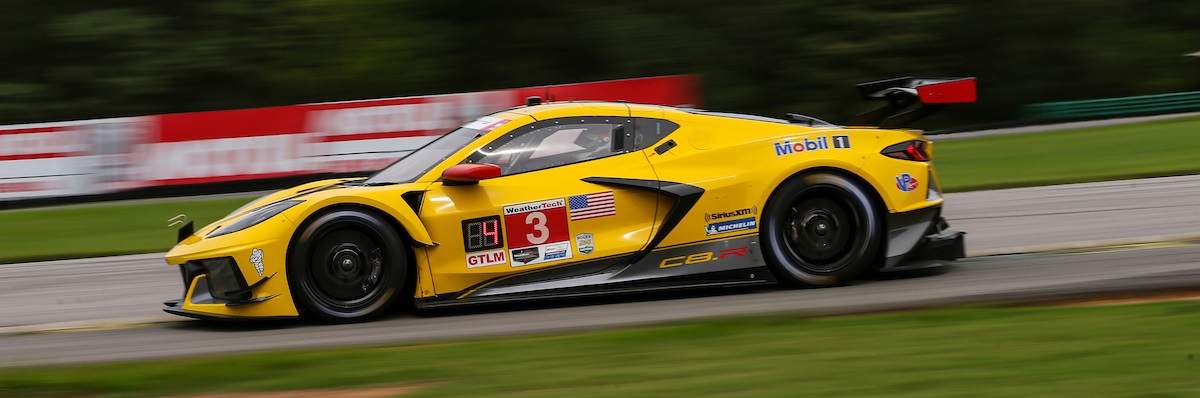
Now the No. 3 Corvette C8.R has taken its third win of 2020 after Taylor and Garcia took victory in Sunday’s Michelin GT Challenge at Virginia International Raceway. The victory was unexpected, with Garcia only moving into the lead in the closing laps of the two-hour, 40-minute race. The No. 911 Porsche of Nick Tandy looked like a shoe-in for the win and was leading with just 18 minutes remaining when the Core Autosport-run entry cut a left rear tire, forcing Tandy to come into the pits.
Garcia then held off the No. 25 BMW M8 GTLM of Bruno Spengler and the hard-charging Porsche of Tandy, who was now on fresh rubber, to take the victory. If the race was any longer, Garcia may not have made it, with the No. 3 Corvette C8.R suffering heavy high-speed vibrations in the latter stage of the event. The Corvette Racing crew later sourced the cause of the vibrations to a broken rear diffuser, but without knowing what the cause of the issue was, the Spaniard was understandably concerned while behind the wheel.

“It took me a little bit (to know what was wrong), but the whole car was shaking a lot,” he said. “About 200 kph, the whole car was shaking a lot. It was coming from the rear.”
“I thought it was terminal because it was vibrating really bad,” he added. “But once I got used to it and knew it wasn’t interfering with the performance, I knew I could handle it. With the gap I could manage to the BMW. It was stressful not knowing what would happen if the rear diffuser would have fallen off, but the C8.R held on.”
Garcia also praised the Corvette C8.R for retaining a good degree of downforce and drivability even without a rear diffuser.
“So, the C8.R is also good with almost no rear diffuser or rear splitter. I’m very proud of that,” he said. “Very proud that everything stayed in one piece even though it was very challenging to drive there at the end.”

Spengler crossed the finish line second in the No. 25 BMW, while Tandy completed the podium after setting the fastest lap of the race on his charge back to the front. The No. 4 Corvette C8.R of Tommy Milner and Oliver Gavin finished fourth after Gavin went off-track following a restart earlier in the race.
Click here for full results from the 2020 Michelin GT Challenge from VIR.
Subscribe to GM Authority for more Indy 500 news, IndyCar news, motorsports news and around-the-clock GM news coverage.
Sam McEachren for GM Authority
Chevrolet Has Built 1,750,000 Corvettes

The 1,750,000th Corvette is white and red, paying tribute to the 1953 original. It’ll be raffled off later this year.

NATIONAL CORVETTE MUSUEMFACEBOOK
Last Friday, without much fanfare, Chevrolet built Corvette No. 1,750,000. It’s an Arctic White coupe, with an Adrenaline Red interior—a spec paying homage to the 1953 Vette—and there’s a chance it could be yours.
The National Corvette Museum announced last month that this particular Corvette would be raffled off, and it’s selling 1500 virtual tickets at $200 a pop. A drawing will be held on September 4, and until then, Corvette #1,750,000 will live in the Museum alongside the millionth (a 1992 convertible) and the 1.5 millionth (a 2009 convertible) Vettes. Hopefully this one doesn’t end up in a sinkhole. All the proceeds from the raffle will be donated to the Museum.
Corvette No. 1,750,000 is extremely well equipped. It’s got the 3LT package along with the must-have Z51 Performance Pack, a front-end lift, the Engine Appearance Package, and a handful of other options. It’d cost you at least $81,000 to order a similar 2020 Corvette, so suddenly, a $200 raffle ticket doesn’t seem like such a bad deal.

NATIONAL CORVETTE MUSEUM FACEBOOK
Given that the very first Corvette was built on June 30, 1963, it took Chevrolet 67 years, one month and 15 days to build 1,750,000 examples. Not bad for a sports car. For context, it took Porsche 53 years to build a million 911s, and Mazda 26 years to produce its millionth Miata. Ford has built over 10,000,000 Mustangs, but that’s not a true sports car like a Corvette. Nissan reached the million Z-Car milestone sometime in the early Nineties, but even still, the Corvette has to be the most popular sports car of all time.
“This type of milestone only comes around every 10 or so years for Corvette,” said Kai Spande, head of the Bowling Green plant. “For this landmark achievement to also be one of the early mid-engines is just awesome for us and for our customers. It’s an amazing time to be part of the Chevrolet brand.”
At the time of writing, 400 raffle tickets remain, so if you want to own a landmark Corvette, get your credit card out. We’ll check back in when Chevy builds its 2 millionth Corvette.
This Is Likely the Mid-Engine Flat-Plane V-8 Corvette Z06 Testing Out in the Open

That certainly sounds like a flat-plane engine.
The Corvette switching to a mid-engine layout is huge news, but it’s not the only major change happening with the car. In October, Chevy revealed the race-ready C8.R, now packing a naturally aspirated 5.5-liter flat-plane crank V-8 engine—a big step away from the pushrod V-8s found in the new road car and last-generation race car. A Chevy engineer confirmed the engine would make its way to a road-going Corvette, and this test car is likely it.
GMAuthority.com managed to snag a video (above) of what seems to be the next-generation Z06 accelerating through the entrance of General Motors’ Milford Proving Grounds back in June. The car’s looks aren’t what interests us—it’s the sound. Unlike the normal Corvette, which has a traditional, deep pushrod V-8 noise we’re familiar with, this one sounds more like the flat-plane C8.R. It has more in common sound-wise with a Ferrari 458 than it does with any Corvette.
Though Chevy hasn’t officially confirmed it, the dual-overhead-cam flat-plane V-8 will likely be the engine powering the C8 Z06. In the race car, it uses direct injection, and makes around 500 horsepower and 480 lb-ft of torque, according to engineers. It’s expected to make more in the road car. We’re curious to see what Chevy has in store.
This isn’t the first time we’ve heard this engine. Back in January, Facebook user Jim Lill shared a video (below) to the C8 Corvette Owners group showing what looks to be a heavily camouflaged Corvette testing in the mountains east of San Diego on a cloudy afternoon.
Though Chevy hasn’t officially confirmed it, the dual-overhead-cam flat-plane V-8 will likely be the engine powering the C8 Z06. In the race car, it uses direct injection, and makes around 500 horsepower and 480 lb-ft of torque, according to engineers. It’s expected to make more in the road car. We’re curious to see what Chevy has in store.
Brian Silvestro for Road and Track
KISS Guitarist Paul Stanley Loves His C8 Corvette Stingray


With its exotics looks, mid-engine layout and near 500 horsepower V8 engine, the C8 Corvette Stingray was always going to be a car that attracted rock stars, professional athletes and actors and actresses as owners.
Among the celebrity owners of the new C8 Corvette is KISS rhythm guitarist and co-lead vocalist Paul Stanley. In a post shared with his Facebook fans this week, Stanley had the following to say about his new mid-engine ‘Vette:
“For years the auto industry said “Buy American” (and) I said ‘when you manufacture world-class cars I’ll buy them.’ For me the 2020 Corvette C8 is beyond that. It raises the bar with cutting edge technology. It’s a machine I’m proud to drive AND it’s drop dead GORGEOUS. I LOVE mine!”
Stanley’s C8 Corvette appears to be a Summit White model with the Morello Red interior upholstery and black 5-spoke trident wheels. He also appears to have equipped the ‘Vette with the available Bright Red brake calipers and Carbon Flash painted mirrors but opted against the Z51 performance package, judging by the lack of the lower front splitter.

While Stanley indicates that he has avoided owning American cars in the recent past, this isn’t the first time his name has been associated with the iconic Chevrolet Corvette. Back in 2014, Stanley worked with Chevrolet Accessories to develop the 2015 Corvette Stingray Paul Stanley Concept, which featured candy red exterior paint, a silver painted roof, a silver grille insert, quilted parchment leather seats and more. At the time, Stanley said the C7 Corvette was“undeniable in terms of its aesthetics,” and “a world-class piece of machinery.”
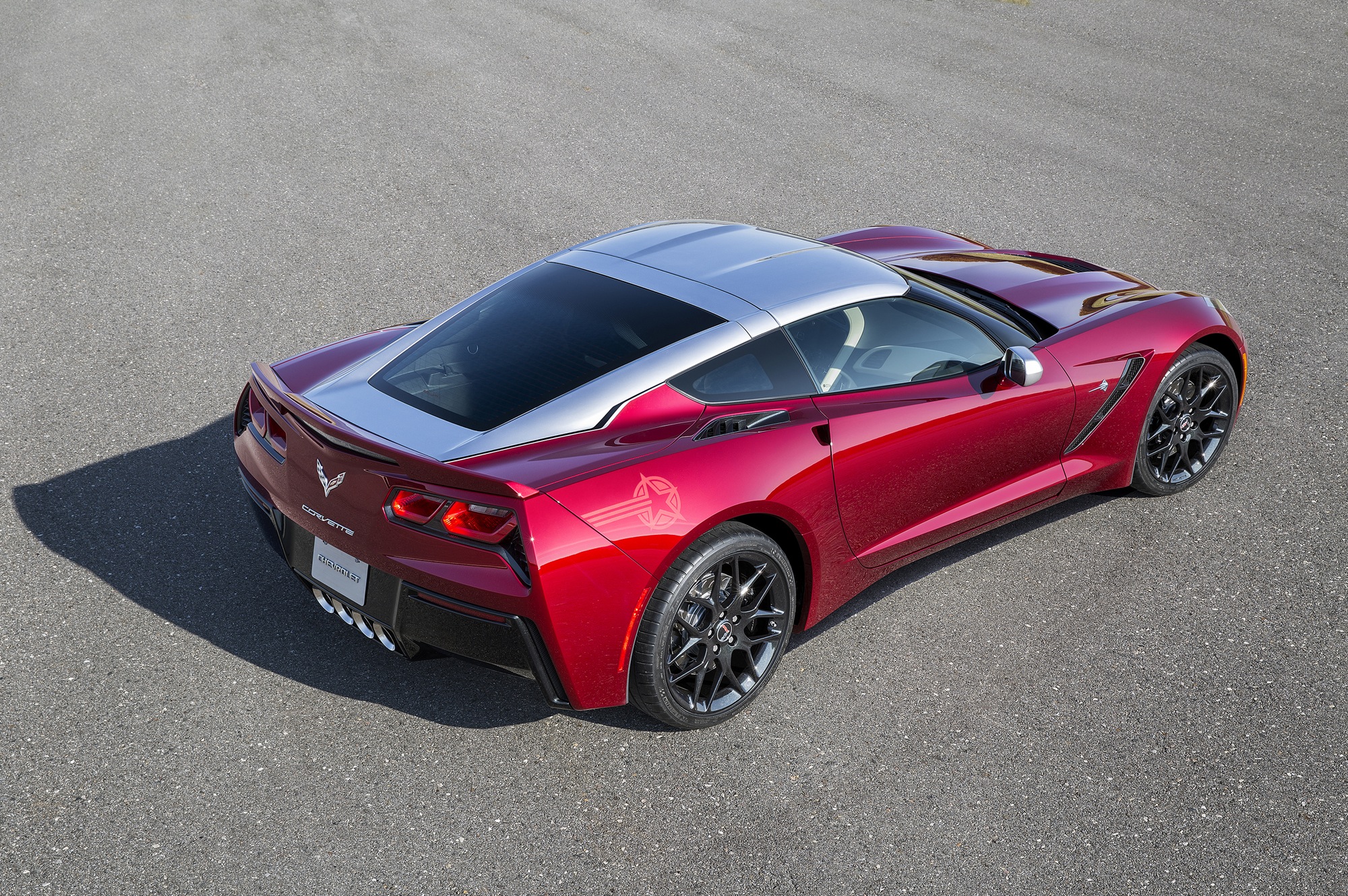
Paul Stanley Edition Corvette
At the time, Chevy’s vice president for performance vehicles and motorsports, Jim Campbell, said Stanley’s passion for cars made him an easy fit for the 2014 collaboration.
“It was great working with Paul Stanley, because of his vision and passion for design and automobiles,” Campbell said.

So there you have it, not only is Paul Stanley a fan of the C8 Corvette – he liked the sports car so much he decided to put one in his garage.
Source: SAM MCEACHERN
2020 Corvette Stingray is the Official Pace Car of the 104th Indianapolis 500


We’ve been expecting to hear this news and finally today it has been confirmed by Chevrolet that the new 2020 Corvette Stingray will be the official Pace Car of the 104th Indianapolis 500. This marks the 17th race that Corvette has served as the official Pace Car, and the 31st Chevrolet to lead the field.
This year’s running of the Indy 500 will take place on Sunday, August 23 with the race being shown live on NBC.
With no fans allowed in attendance this year due to the COVID-19 pandemic, the official pace car driver will be GM President Mark Reuss.

“It’s truly an honor to have the opportunity to be behind the wheel of the mid-engine Corvette Pace Car at such a historic race as the Indy 500,” said GM President Mark Reuss. “The 2020 Corvette Stingray is the result of a close collaboration between the Corvette Racing and production engineering teams, setting a new benchmark for supercars around the world.”
The 2020 Corvette Stingray Pace Car is Torch Red and features the high Wing Spoiler and ground effects package. The Z51 Coupe will also wear the 104th Indy 500 livery on the doors. The new 2020 Stingray is capable of accelerating from 0-60 in 2.9 seconds and has a top speed of 194 mph, so it should have no trouble in setting the pace for the IndyCar racers.

“This is a continuation of our outstanding partnership with Chevrolet,” Indianapolis Motor Speedway President J. Douglas Boles said. “We’re so grateful for all that Chevrolet has contributed to the success of our events. The Torch Red 2020 Corvette Stingray is a world-class machine rich with speed, performance and excitement, perfectly suited to pace the ‘500′ field.”
Chevrolet has been linked to the Indianapolis Motor Speedway with both entities founded in 1911. Company founder and namesake Louis Chevrolet and his brothers Arthur and Gaston raced in the early 500-mile races with Gaston winning the race in 1920. Today, Louis Chevrolet rests in peace in a local Indianapolis cemetery just 15 minutes away from the track.


Update
This afternoon we came across this Facebook post from Corvette Exterior Design Manager Kirk Bennion sharing these words from fellow GM designer Adam Barry who led the project. The 2020 Corvette Pace Car features a number of items from Genuine Corvette Accessories as discussed:

Source:
Indianapolis Motor Speedway
Open-Throttle Therapy Awaits In A 2020 Chevy Corvette Z51

A small donation to Ronald McDonald House could permanently put you in the driver’s seat of the fastest production Corvette yet!
Commonly referred to as “America’s Sports Car”, the Chevrolet Corvette has been offering thrills since its big unveiling back in 1953. With 60 years of production over eight generation designs, the all-new C8 Corvette is a game-changer. For the first time, the model is powered by a mid-mounted V8 engine. Even the C8’s body was drastically redesigned for aerodynamics, but stunning enough to stop car enthusiasts dead in their tracks. Get get your hands on the fastest production Corvette yet – a 2020 Chevrolet Corvette Z51 with 3Lz trim. A small donation to the Ronald McDonald House will enter you into the drawing for this incredible C8. Enter the code WIN here to receive double entries!

Finished in a stunning Elkhart Lake Blue Metallic, the exterior is nothing short of magnificent. On all four corners sit staggered 5-spoke Carbon Flash-painted aluminum wheels (19-inch front, 20-inch rear) wrapped with sticky Michelin Pilot Sport 4S rubber. Further complementing the exterior is the addition of a high-wing Carbon Flash rear spoiler and an exposed carbon fiber ground effects kit. Open the doors to a stunning black interior that features carbon fiber trim and GT2 bucket seats.
Powered by a mid-mounted 6.2-liter LT2 V8 engine with an appearance package, the new C8 generates 495-horsepower and 470 lb/ft of torque that can propel this car from 0 to 60 miles per hour in a lightning quick 2.9 seconds. Sending that power down to the rear wheels is an 8-speed Dual Clutch automatic transmission. The Z51 Package gives this aggressive Corvette a unique Z51 adjustable performance suspension, an electronic limited-slip differential, an altered axle ratio, large Z51 Brembo brakes, a sport exhaust, enhanced cooling, and improved traction.


If you’re looking for a car that is can drive to the track, smoke the competition, and then drive home, look no further than this performance-oriented 2020 Chevrolet Corvette Z51. Even if the track isn’t your thing, this would make one head-turning daily driver. A small donation to the Ronald McDonald House will enter you into the drawing for this incredible C8. Enter the code WIN here to receive double entries! The Ronald McDonald House helps support families to stay close to their child while they receive treatment at a local hospital.
*Actual Corvette may vary from images above based on availability.*
Sign up for the Motorious Newsletter. For the latest news, follow us on Facebook, Twitter, and Instagram.
Amie Williams for Motorious
2020 Corvette Convertible Production Officially Kicks Off Today


It’s been a long time coming, but today we received confirmation that the first 2020 Corvette Convertibles have started production. The plant has been building convertibles for the Captured Test Fleet for the last few months so it’s not anything new to the production team, but it is great news for buyers who have been patiently waiting for this day to come.
We have been reminded that Convertible production will see a ramp-up so expect quantities to be small in these first few weeks before gradually expanding into its regular production schedule.
We are also expecting a quality-control hold on these first batches of the HTC, but I doubt it will be too long. It would be very cool to see a customer-ordered convertible showing up later this month at Corvettes at Carlisle or the NCM’s Anniversary Show, so let’s keep our fingers crossed!
The 2020 Corvette Convertible is our favorite model of the two and we can’t wait to see those happy customers showing off their rides. We expect the number of videos on youtube showing the hardtop convertible’s operation to grow exponentially in next few months so brace yourselves for that!
That’s the latest we have on the Convertible C8 Corvette…stay tuned for any updates or news we can pass along! For a recap of all things related to the C8 Corvette Stingray Convertible, just hit this link to check out our previous stories on the HTC.
Keith Cornett for Corvette Blogger
Corvette Racing at Road America: Another Wild 1-2 Finish for Corvette C8.R

By Corvette Racing -Aug 2, 2020


Garcia, Taylor take second GTLM win of season; Gavin, Milner finish as runners-up
ELKHART LAKE, Wis. (Aug. 2, 2020) – Corvette Racing took its second consecutive 1-2 finish in the IMSA WeatherTech SportsCar Championship’s GT Le Mans (GTLM class) following a chaotic finish Sunday at Road America. Antonio Garcia and Jordan Taylor won for the second time in their No. 3 Mobil 1/SiriusXM Chevrolet Corvette C8.R following a late-race pass in torrential rain.
Oliver Gavin and Tommy Milner placed second in the sister No. 4 Corvette C8.R. It was the eighth victory at Road America for Corvette Racing, and the team’s first there since 2016. Garcia and Taylor both won for the first time in their IMSA career at Road America and extended their points lead to 10 in the class. Gavin and Milner unofficially moved to third in the standings.
Chevrolet also grew its lead in the GTLM Manufacturer’s Championship to eight points. Corvette Racing has now won three consecutive races in the category.

Things weren’t looking positive for the first half of the race. Taylor, who qualified second, led early but the expected tire degradation reduced the pace for the GTLM cars. Adding to the problems for the team were electronics issues on the No. 4 Corvette that left both Gavin and Milner without traction control.
The predicted rain for the race came with just under an hour to go. Garcia, who took over with two hours left in the race, was the first GTLM runner to pit for rain tires and stopped from sixth place. Two other GTLM cars followed suit but three others stayed out, including the then-leading Porsche which skidded off-track during a downpour at Turn One.

Milner remained on slick tires during the first deluge as officials halted the race with 43 minutes left. The rain let up initially before cars returned to the track with about 25 minutes to go once the red flag was lifted. Following the final pit stops for wet tires, racing resumed with seven minutes left and Garcia in second place.
An even more intense rain began to fall with just minutes left in the two-hour, 40-minute race. Garcia was locked in a back-and-forth duel with Porsche’s Nick Tandy just before the GTLM leader and the third-place Porsche went off-track late in the lap. Both Garcia and Milner, who did a masterful job on a wet track with no traction control, were able to get through the chaos and took the checkered flag under a race-ending, full-course caution period.
Corvette Racing’s next event is the GT-only Michelin GT Challenge at Virginia International Raceway on Saturday, Aug. 22.
ANTONIO GARCIA, NO. 3 MOBIL 1/SiriusXM CHEVROLET CORVETTE C8.R – GTLM RACE-WINNER:
“It was super tough. Because of the wave-by, we were at the back of all the GTD cars. So the spray we had back there was amazing. It was impossible to see anything. The first thing was to go by a couple of LMP2 cars while fighting (Nick) Tandy to catch up to the 24 BMW. It was a very intense three laps. I knew from Sebring practice that the Corvette C8.R was really good in the wet, even if today was beyond wet! I had Nick all over me, and we had many times when we were together… almost just sailing together instead of racing together. I knew the Carousel and the Kink were going to be really bad, and the line I took on the previous lap seemed to work. Luckily enough for me it was the same and I was one of the few cars to make it through. It’s another 1-2 finish for Corvette Racing, which is amazing. It’s finally my first victory at Road America, so it’s been a very good weekend.”
WHAT DID YOU SEE OF THE BMW AHEAD OF YOU? DID HE SPIN ON HIS OWN? “The Carousel and the Kink were almost impossible to go through that part of the track. There is really nothing you can do there. It depends on the depth of the water. The Corvette C8.R survived it better than the rest. I don’t know if it was due to the race line I took. I was following the car behind me and saw the BMW lose control. The race still wasn’t done because I had to do another lap through there. It’s a credit to how good the C8.R is in the wet. Thanks to everyone at Team Chevy because this car seems to be working in all conditions.”
HOW IMPORTANT IS THIS WIN TO EXTEND YOUR POINTS LEAD? “We didn’t know starting the season how the C8.R would be. With the fourth at Daytona, we saw the potential of the car. Our team did a great job during the shutdown with fixing things that needed to be corrected. We’ve had a chance to win the last three races, and we’ve converted those. We need to keep putting pressure on everyone and make the rest of the field make mistakes. On our own, we need to be their in the end and maximize our points opportunities. The next one is VIR, where we have tested with the new Corvette. We will do what we can to keep this momentum and carrying on winning.”
JORDAN TAYLOR, NO. 3 MOBIL 1/SiriusXM CHEVROLET CORVETTE C8.R – GTLM RACE-WINNER:
“It was a wild day…very unexpected. The race started off strong for us. We took a different strategy to go with three stops from the beginning. Thankfully it worked out well with the timing the rain and track position. Antonio never gave up. It was a tough fight in tough conditions, but he did a great job of surviving for our second win of the year and third of the year for Corvette Racing.”
THIS RACE WAS ON THE NATIONAL NBC NETWORK. WAS THIS THE KIND OF EXCITEMENT THAT WAS GOOD FOR NETWORK TV? “It had a bit of everything. The start for me was exciting, and the battles were all good. I could see on the big screen across the frontstretch that the prototype battle was often exciting and had a little bit of everything with the strategies. The weather was a bit different for those who probably turn into NBC for NASCAR where they wouldn’t run in the rain. There were probably too many crashes for everyone’s liking, but the show was very exciting with the battle for the win at the end. You like to see that between the manufacturers.”
TALK ABOUT WINNING ON THE SAME DAY AS YOUR BROTHER (RICKY TAYLOR): “It’s definitely cool. I think this is the first time we’ve won on the same weekend. I know we’ve gotten a pole on the same weekend, but in all the years a win has never gone both our ways. It was cool to watch their battle at the end with the 10 car. I know my dad’s team hasn’t won here either, and we tried hard for many years.”
OLIVER GAVIN, NO. 4 MOBIL 1/SiriusXM CHEVROLET CORVETTE C8.R – FINISHED SECOND IN GTLM:
“I take my hat off to the team every time for never giving up. It didn’t look like we were going to be finishing that high up in the dry. But as we all know, there was a chance of rain all around. In this part of the world when the rain comes, it comes big. You just have to take you chances and make the right calls at the right time. We got a little lucky with a few things, and ultimately the No. 3 Corvette made the right choice on the right tires at the right time. We didn’t quite get that break or make that decision at that time. But then as all the pit stops cycled through for that last restart, we knew we just had to flat-out race. Our car was compromised a little as we didn’t have any traction control as part of an electrical issue throughout the entire race that we couldn’t really get on top of it. I fought it all during my stints. I honestly don’t know how Tommy kept the car on the track when he driving around on slick tires behind the safety car. I mean… water that was three or four inches deep on slick tires with no TC was amazing. For us to come away, even with all the stuff that happened, with a one-two finish is pretty spectacular. Hats off to the team and the crew and also to the C8.R. It seems like it is a car that can live through some crazy circumstances and conditions on track and deals with it. It’s a very fine car.”
TOMMY MILNER, NO. 4 MOBIL 1/SiriusXM CHEVROLET CORVETTE C8.R – FINISHED SECOND IN GTLM:
“That was absolutely wild. We had kind of a tough day to start with, but it came back pretty well for us there at the end. Credit to the guys with their never-give-up attitude that Corvette Racing is famous for definitely paid off today. The conditions were unbelievably difficult. The call to stay out there on slicks just before the full-course yellow was just as much mine as it was the engineers. I thought it was the right thing to do to run one more lap to see how bad the rain was going to be. And it ended up being almost biblical in the amount of rain that came. In all the races I’ve done, this has been the most rain I’ve ever seen come down at one time. It was hard enough just keeping it on the track under yellow with slicks, and it was bad enough when it was still green just trying to survive. Then it went red flag so we had the opportunity to come in and change it to rain tires. That in itself was difficult. For me I knew I just needed to get to pitlane and survive. That was the name of the game there and see what happened at the end. Once we went green, it was the most difficult conditions I have ever driven in my life with the amount of spray and with traffic and having so many cars around. At times it felt like I was driving blind. I could have closed my eyes and would have had the same amount of visibility at that point. I just tried to use very bit of muscle memory and track knowledge I could as to where the track goes at certain points. In the end, luckily we just survived with a first and second for the team. The day didn’t start out well, but it ended as well as it could.”
(Not having traction control) “Because I didn’t have it from the time I got in the car, I had to manage it from the start. In the dry, it’s definitely difficult because you are trying to not use the rear tires too much. I felt like I did a decent job in that first run but driving in the wet without it makes it that much more difficult. To be honest, the Corvette felt really good in the wet. Even though we don’t have a lot of time in the wet, the guys made the right call with tire pressure. When the Michelin wet tires are new, they’re really good. That gave me the confidence early on to really push, get through traffic, and trust in the car and tire to find the fastest way around.”

Source:
CorvetteRacing.com