
2020 Corvette Production Resumes on May 26 Until October


GM notified Chevrolet dealers that 2020 Corvette production will resume May 26th and run through October. The start of regular production of the 2021 model year will begin on November 2nd.
The Bowling Green Corvette Assembly Plant will start off running only one shift in order to insure the safety of its workers and give its parts suppliers the chance to ramp up production at their own facilities
Last month GM stated that all 2020 Corvette orders that are currently in the system and at a 3000 or higher status, would be built. Two weeks after the start of regular production on May 36th, a cross-functional team will meet to develop an officially revised plan for 2020 vs 2021 allocation and build schedule.
This is great news since many customers who have placed orders for a 2020 Corvette, have been left in limbo wondering what would happen to their order.
2020 Corvette Convertible Production
Production of the 2020 Corvette convertible was expected to begin the first week of April, but that was before the factory shut down in late March. It was originally assumed that Chevrolet would push all 2020 Corvette convertible orders to the 2021 model year, however that won’t be the case. Customers will be happy to know that 2020 Corvette convertible production has been pushed back to July 20th.
As of right now, there are NO current constraints and all colors and option combinations are available.
NASCAR Restarts Its Engines During the Coronavirus Pandemic


By Spectrum News Staff North Carolina PUBLISHED 1:00 AM ET May. 20, 2020
On this week’s edition of Tying It Together with Tim Boyum, Tim and Ben give us a behind the scenes look at how NASCAR became the first major sport to return to action during coronavirus as the Coca-Cola 600 returns to North Carolina Memorial Day weekend.
We talk with Charlotte Motor Speedway Executive Vice President and General Manager Greg Walter, and NASCAR driver Chris Buescher gives us an honest look at the challenges racers will face when they return.
It’s a $6 billion business that employs more than 25,000 people in North Carolina, so a lot is riding on the success for NASCAR and the state. They must get it right, or it could delay live sports for some time.
Unguarded: GM Is Happy To Be Giving Away Its Covid-19 Playbook


In football, a team’s playbook is guarded with nearly manic effort by everyone in the organization, and woe be to any coach or player who loses one — much less the Benedict Arnold who for some reason might give a copy to the opposition.
But in today’s U.S. auto industry, playbooks are like the gospel: They’re meant to be given away and shared as widely as possible, with the more readers, the better.
That’s because the playbooks in question these days are the detailed, voluminous guides to how auto manufacturers are re-opening their plants with Covid-19 health and safety protocols. And in that regard, General Motors CEO Mary Barra and Jim Glynn, the company’s vice president of worker safety, are hoping their jointly authored, 48-page guide, “Returning to the Workplace with Confidence: Covid-19 Employee Guide,” reaches every corner of the industry.
It’s free to all, but that’s not the reason GM’s playbook seems destined to become a best-seller. Every company in the vast, deep network of the U.S. and global automotive supply chain is eager to rejoin the working economy again, but to do so their leaders must not only be careful in restarting but also take great pains to avoid any early misstep. Expertise like that provided by GM’s guidebook — and by those also produced by other companies, such as Tier One supplier Lear — can be invaluable not only to automotive manufacturers but also to thousands of other factory operators across the country.
“We knew we had to get this right ourselves and clearly articulate our requirements and what to do at every site,” Glynn told me. “Then we had to think about our supply base to help make them equally successful; we’ve had several seminars for a total of literally hundreds of suppliers wondering what we were doing to prepare for restart.” GM also, he said, has “shared our ideas with other companies and with competitors and with industry councils so we can learn from them as well and incorporate all the best practices into our documents.”
General Motors is re-starting its U.S. factories this week, so the company is taking every step leaders can think of to ensure that managers enact and follow the protocols, that employees and the United Auto Workers are comfortable with their requirements, and that everyone embrace the guides as a significant enabler for the company and the industry to restore production, sales, profits and renewed prosperity as quickly as possible.
To that end, Barra even directed a “care package” be sent to every GM employee last week that included a flyer with the highlights of the playbook, a letter signed by her, and five face masks that were manufactured at a company facility in Warren, Michigan. Her personal touch was reinforced by the fact that the package contained not just a single medical-grade mask but enough for a typical family.
Barra “wanted to make sure early on in this pandemic that every people leader in GM understood the protocol intimately,” Glynn explained. “And she recognized right away that, whether someone works in a plant or in a lab or in our technical center [in Michigan], or at an office in the Renaissance Center” headquarters of GM in downtown Detroit, “they are going to have some apprehensions about the virus and whether they’ll be safe. That was her focus.”
So the playbook is “meant to very comprehensively, and in as much detail as we could, provide help so that our people leaders can be as knowledgeable about our protocols as any medical or safety professional,” Glynn said. “Because they’re who people are going to turn to.”
GM’s protocols themselves demonstrate two advantages over much of the other information out there. One is an attribute enjoyed by some other OEMs and major suppliers: They’ve already learned and applied health and safety lessons from the restarting of their Asian plants a few weeks ago. Another edge is enjoyed by only GM and Ford, which is the fact that each of them reopened a U.S. plant a few weeks ago to shift quickly to production of pandemic-fighting medical equipment.
“Some of the ‘whats’ applied pretty well for the couple hundred people entering the site” at GM’s Kokomo, Indiana, electronics plant, which it refitted to produce ventilators, Glynn said. “But it gets more difficult when you’ve got 1,000 people coming into a [different] plant for a shift. So we are scaling up our approach so that, instead of just one entrance, we are duplicating our [screening] efforts at two or three entrances to the plant.”
The needs for new protocols, redesign of many plant-floor processes, and an overall abundance of caution can be counted on to slash productivity that most auto plants enjoyed pre-Covid 19. Yet at first, that shouldn’t be an issue because auto sales, and the entire manufacturing supply chain, will take a while to creak back to life.
And Glynn said that he expects factory productivity to rise rapidly anyway, after an initial orientation period. Even something as simple as donning a mask can pose a complication to an auto worker who wears glasses – or, as many do, safety glasses – by fogging them, for example.
“But we’ve learned tips and tricks to prevent that from happening,” he said. “We’re doing all of these things to protect people and help them be comfortable in the workplace. Once they understand that, productivity takes care of itself pretty quickly.
“Everywhere we’ve put this into place,” such as plants in Asia, Glynn said, “people get on it it and get back to normal productivity. They like the routine; they have a sense of accomplishment; and it feels comfortable for them to be back at work.”
Source: Dale Buss
Next-Gen Corvette C9 Renderings Imagine Return Of Front-Engine Layout

Will the C9 even have a gas engine?
The 2020 Chevy Corvette C8 debuted almost a year ago to tremendous fanfare. Production ramped up in early February after a delay, and many customers now have the new car in their driveways. Chevrolet moved the engine from the front to the back for the first time after decades of false starts, teases, and rumors. It’s too early to tell if customers warm to the new layout, and far too early to speculate about the C9, but what if Chevy flipped the design again, moving the engine back to the front – what would it look like? New renderings from Pedro Ruperto Mallosto on Behance.net provide a glimpse.
While the Corvette’s return to a front-engine layout for the next generation is unlikely, it doesn’t make imagining the possibilities any less exciting. The renderings show yet another evolution of the car’s angular design that the automaker introduced with the C7. Here, it’s much more refined than that, and looks much more like the classic Corvette millions have known for over half a century. The greenhouse is iconic, especially as it tapers in the bumper, reminiscent of the C6.


Imagining the next generation of a new model isn’t easy. We don’t know when the C9 will arrive. Chevy has a ton of C8 variants to deliver first, and by the time we reach the next-gen Corvette, the automotive landscape could be radically different. General Motors has said it’s all-in on fully electric vehicles, and that includes the Corvette. A next-gen, front-engine Corvette sounds exciting, but what would an all-electric Corvette look like if the design never had to accommodate a gasoline engine?
Source: Behance.net
2020 Chevrolet Corvette gets ‘Lambo doors’

The mid-engine 2020 Chevrolet Corvette Stingray aims to deliver an exotic car experience on a budget, but it’s missing one key element: doors.
Oh, the $59,995 coupe has two, but they’re just regular old doors that swing out like the ones on most cars, not the cool “scissors-style” doors originally made famous by Lamborghini.

Well, owners will soon be able to remedy that oversight thanks to Eikon Motorsports, a company that specializes in ‘Lambo Doors’ conversions on a wide variety of vehicles ranging from the Dodge Challenger and Cadillac Escalade to the … the Lamborghini Huracan, which doesn’t have them either.
The Scottsdale, Ariz., outfit is offering a kit for the C8 that attaches to the same bolts as the factory doors and is reversible, in case you tire of making a grand entrance whenever you get out of the car. Pre-orders are currently available for $2,999, or $4,300 installed with lifetime warranty.
You may end up getting the kit before your car, however, as the start of Corvette production was delayed several weeks due to last fall’s UAW strike and has since been suspended due to the coronavirus pandemic. Only 2,700 2020 model year Corvettes have been produced so far, according to Motor Authority, and the automaker may not be able to satisfy its current order list before the end of the calendar year.
2022 Chevrolet Corvette Z06

What We Know So Far

Overview
Now that the bubble of anticipation surrounding the mid-engine Corvette has burst, excitement is building for the even-mightier Z06 model. With an exotic flat-plane-crank V-8 engine, the 2022 Chevy Corvette Z06 will sound unlike any Vette that’s come before. It’ll also look meaner than the mainstream C8 thanks to flared fenders, larger air scoops, and aerodynamic addendum that actively adjusts to maximize high-speed downforce and cornering traction. Along with its exclusive powertrain and enhanced appearance, the super Chevy will inherit all the best features and technology from the regular model. Although we still don’t have all the juicy details about the new Z06, here’s what we know so far.
What’s New for 2022?
The first mid-engine Corvette Z06 is expected to go on sale in early 2021 as a 2022 model. As is tradition, it’s a more hardcore, track-focused version of the standard Vette, complete with bolder styling cues and serious performance attributes.
Pricing and Which One to Buy
- Z06: $85,000 (est.)
It should make sense that, since Chevy hasn’t officially revealed the new Corvette Z06, we can only speculate on how much it’ll cost. Its front-engine predecessor started at about $25,000 more than the base model, so we think it’s safe to add that number to the starting price of the 2020 Corvette, which starts at $59,995. That means the 2022 Z06 should open at around $85,000 when it eventually goes on sale.
Engine, Transmission, and Performance
The upcoming Corvette Z06 will receive a special engine that should make it sound similar to the supercars it’s trying to dethrone. The naturally aspirated 5.5-liter V-8 features a flat-plane crank, which means it should rev to between 8500 and 9000 rpm. This engine is expected to make over 600 horsepower, and it’s Ferrari-like howl is all but guaranteed to send shivers down the spine of bystanders. The unconventional V-8 will hook up to an eight-speed dual-clutch automatic transmission and rear-wheel drive. Considering that the 495-hp 2020 Corvette Z51 we tested rocketed from zero to 60 mph in just 2.8 seconds and completed the standing quarter-mile in 11.2 seconds at 122 mph, the Z06 will be even quicker in a straight line. A set of wider, stickier tires and more powerful brakes will help it corner harder and stop shorter than the regular Vette, too. Chevy will also strengthen the structure and recalibrate the suspension tune on the Z06 to help make sure its performance advantages are most obvious at the racetrack. A host of active aerodynamics that automatically adjust to optimize downforce will join the party for this new generation. We’ll have to wait until we get our hands on one to evaluate how its myriad improvements compare with the outgoing Corvette Z06.
Fuel Economy and Real-World MPG
Neither Chevy nor the EPA have indicated how efficient—or inefficient—the 2022 Corvette Z06 will be in the city and on the highway. Since the company’s flat-plane-crank V-8 is currently only found in the Corvette C8.R race car, we don’t have any government ratings for comparison. Once the Z06’s fuel-economy figures are released, and we have the opportunity to test one on our 75-mph highway route, we can evaluate its real-world mpg.
Interior, Comfort, and Cargo
The Bow Tie brand went above and beyond to ensure that the mid-engine Corvette’s interior could not be called boring. While the design certainly transcends what’s found on every other Chevy model, the square steering wheel and wall of climate-control buttons on the center console are unusual elements, to say the least. Still, the cabin layout caters to the driver, and the list of standard and optional features is extensive. This includes a 12.0-inch fully digital gauge cluster, a head-up display, heated and ventilated seats, and wireless charging. All of this and more will continue inside the new Z06. We expect its track-worthiness to be made apparent through additional carbon-fiber and microsuede interior accents as well as a set of even more aggressively bolstered seats. The Corvette’s capacious rear trunk should continue to provide a spot for drivers to carry two sets of golf clubs.
Infotainment and Connectivity
Cooked into the Corvette’s multilayered dashboard is an 8.0-inch touchscreen that supports Chevy’s Infotainment 3 Plus system. While we’ve only had minimal exposure to this specific setup, we found it to be mostly intuitive and responsive. We’re confident the Z06 will share the same interface and features, which include Apple CarPlay, Android Auto, and a Wi-Fi hotspot. Likewise, two separate Bose stereos are expected to be offered: a standard 10-speaker system and an optional 14-speaker setup. The new Z06 will continue to offer the Performance Data Recorder, which allows you to record video of everything from your track exploits to relaxed country-road cruises. And if you dare leave your Z06 with a valet, there’s a setting that keeps track of any nefarious activities the car-parker might try.
Safety and Driver-Assistance Features
The 2022 Corvette Z06 hasn’t been crash tested by the National Highway Traffic Safety Administration (NHTSA) or the Insurance Institute for Highway Safety (IIHS). While the regular C8 Corvette only has a handful a driver-assistance technology, such as blind-spot monitoring and rear cross-traffic alert, we expect those features to be available on the Z06.
Warranty and Maintenance Coverage
Chevy provides all of its models with a middle-of-the-road limited and powertrain warranty. While the company offers more complimentary maintenance than automakers who skip the free service altogether, it’s one of the shortest such plans in the industry.
- Limited warranty covers three years or 36,000 miles
- Powertrain warranty covers five years or 60,000 miles
- Complimentary maintenance is covered for the first visit
GM and Ford lay out plans to restart their US factories

(CNN)General Motors and Ford laid out plans for restarting their US factories while, at the same time, attempting to protect workers from the coronavirus.
Both companies detailed how they would thoroughly clean facilities and allot extra time between work shifts to do so. The automakers said they will also screen employees with questionnaires before they leave for work and temperature checks as they enter a plant or other facilities.
Employees who have recently been exposed to someone with the coronavirus or exhibit a high temperature or other Covid-19-related symptoms will be sent to local clinics for testing before they are allowed to return to work.
While in factories, employees will work at least six feet apart from one another whenever possible, the companies said. Employee workstations will be separated by clear plastic panels. Workers will also wear surgical-style face masks and clear plastic face shields whenever they’re required to work close to one another.
These practices are based on the experiences the companies have had at their factories in China and, in GM’s case, Korea. Ford executives said 90% of the employees at their plants in China, which started reopening in mid-February, have now returned to work. Ford also recently reopened a plant in Thailand that it operates with Mazda.
“Absolutely I would feel comfortable sending my family to work at Ford,” said Jim Farley, Ford’s chief operating officer, when asked how confident he felt in the steps the company was taking.

A Ford of Europe employee wearing protective equipment similar to that US employees will be required to wear.
Both Ford (F) and GM (GM) have also been operating a few plants in the US in order to make personal protective equipment and ventilators for healthcare workers. Ford has also been manufacturing face masks for its own workers around the world. Both companies also have some warehouses operating to distribute parts for repairs. Workers at those US plants have also been trying out the safety protocols and equipment that will go into wider use in the US as factories reopen.
Employees at Ford’s currently operating US plants will be sharing their experiences with other employees. Among other things, they will describe what it’s like working with masks and face shields on and the best ways to wear and use them, said Kiersten Robinson, Ford’s chief human resources officer.
Automakers are racing to make ventilators. But it’s not that easy
Both companies will also make changes to how “common areas,” such as dining areas, are used in order to keep employees apart from one another.
GM expects to restart operations in mid-May, according to an executive familiar with the plans. A Ford executive declined to provide a specific timeframe for restarting the company’s factories, but said decisions for each factory will depend on local conditions and requirements. The company said it is closely monitoring conditions in areas where it has factories.
The United Auto Workers Union, which represents assembly line workers at Ford, GM and Fiat Chrysler (FCAU), is asking for more coronavirus testing of employees.
“Our position is that we employ as much testing as is possible at the current time and commit to full testing as soon as it is available,” UAW president Rory Gamble said in a statement.
Peter Valdes-Dapena, CNN Business
Kentucky To End Coronavirus Restrictions for Manufacturing Beginning May 11th


With the latest news from the UAW and the State of Kentucky regarding the coronavirus shutdown, it looks like we are beginning to see the light at the end of the tunnel. And for Corvette fans, that means the resumption of the 2020 Corvette production could be here as early as May 18th.
The Big 3 domestic automakers have been negotiating with the United Auto Workers on when manufacturing can restart at the various facilities across North America. There’s a lot of moving parts to get manufacturing up and running as it’s not just the factory that needs to restart, but all the vendors and suppliers also need to be back to work as well. With the states having their own individual shelter in place orders, that could be dicey for the next month or so.
Michigan’s stay at home order for non-essential workers was extended through May 15th. Yesterday, Kentucky’s Governor Beshear issued guidance for when various businesses could reopen and set May 11th as the date for when manufacturing and automotive dealerships can resume operations. Reopening plans for the state of New York where the C8 Corvette’s LT2 V8 engines are assembled at the Tonawanda Powertrain facility are also still in the works. The good news there is that upstate New York wasn’t as hard hit as New York City and indications are that New York’s reopening plan could be rolled out regionally with manufacturing slated as one of the first sectors to be reopened.
A recent memo from GM to workers indicated that restarting the plants would take some time and that a team of salaried workers and managers would come in early as paid volunteers to prepare operations before the restart occurs. There may also be some discussions about plant workers going through retraining exercises to get back up to speed as the plant has been closed for over a month.
When workers return to manufacturing at the Corvette Assembly Plant, there will be new protocols set up to keep everyone as safe as possible. GM has said that the safety protocols for workers will include:
- Health and temperature screening
- Heavy workplace cleaning
- Social distancing strategies
- Following top medical and scientific data including guidance from the CDC
When it comes to recalling workers, UAW spokesman Brian Rothenberg said, “UAW President Rory Gamble has said the single focus should be on the health and safety of members and the litmus test should be whether your own family member would be safe going into that plant.”
The Corvette Assembly Plant shut down at the end of March 20th with approximately 2700 new Corvettes assembled to date. The production of the 2020 model year is expected to run through the end of August.
For GM employees building ventilators on COVID-19’s front lines, their work is actually saving them

“This is our saving grace, and if we can save one person it’ll all be worth it.”
Penni Cox wakes up before dawn, taking her coffee to-go as she makes the 10-minute drive down the road from her home to the General Motors campus in Kokomo, Indiana. She arrives at the Engineering Resource Center as the sun rises.
Until recently, its three stories stood empty; auto work in Kokomo has steadily drained, and the absence of opportunity has meant indefinite layoffs. Then, as the coronavirus swept across the globe, the building surged to life, reopening to make much-needed ventilators for the nation’s sick.
“It has been nonstop, and a whirlwind of emotions,” Cox told ABC News.
She was laid off on March 13, out of a job after nearly 14 years — three generations of her family, a part of the United Auto Workers. Her aunt, mother, grandmother, all worked at GM; her son will now join making ventilators; her grandfather worked across the street at Fiat-Chrysler. Before being laid off, her husband also worked at that FCA plant, where in late March, a fellow UAW worker tested positive for COVID-19 then died.
“It’s scary. The virus is scary. Not knowing our plant’s future is scary. But we won’t give up,” Cox said. “Work has slowly declined, we’ve been losing people to layoffs for a while, and unfortunately I was one of them.”
“You teach your children to help others. But when the time comes and you can finally do it — when they call you and say, ‘Hey, do you want to make ventilators?’ It’s like — well yeah!”

Her work ceased just as the virus flared, and hospitals braced for a deluge of patients and a looming ventilator shortage. As a precaution against the spread of COVID-19, the plant finally shut down.
In late March, General Motors and Ventec Life Systems announced a partnership to mass-produce critical care ventilators in response to the COVID-19 pandemic, pledging 30,000 by the end of August: a $489.4 million contract with the Department of Health and Human Services. Cox and her United Autoworkers Local 292 team were brought back.
Working “around the clock,” as General Motors said in a statement, their first ventilators began rolling off the line in a matter of weeks.
“Right now? It’s much more rewarding making a ventilator than making a car,” Cox said. “We’re all working long hours, it gets tiring, but when you see who you’re helping — it’s all worth it. I love my Chevys but I definitely feel much more sense of pride in making a ventilator.”
“There’s a mood in there that hasn’t been for a long time — we’ve been shrinking for so long,” UAW Local 292 President Matt Collins told ABC News.
“We’ve got mixed emotions,” he said of the good fortune brought about by grim circumstances. “But this has made a lot of new opportunities for a lot of people.”
Penni Cox arrives at the plant before 6:30 a.m. each day, where she — and everyone else — gets immediately checked for a fever before being admitted. Cox wears a mask and gloves throughout the day, except for when she eats or drinks.
On the line, Cox makes the ventilator back cases.
“We do a lot of messing with the screws,” Cox said. “The part that hangs on the cart you push around, that hook right there. Then a thermal cover, plastic pieces to the center band — it basically holds the main guts in.”
The Kokomo plant was picked to make the ventilators because it already handled precision electronic parts — and it had preexisting clean rooms, required for medical equipment production by the FDA.

“We’re pretty dedicated,” Cox said. “There are a lot of people putting in 10, 12 hour days. They just kept telling us, ‘We don’t have any work for you,’ and we just kept saying, Well you’ve got to!’ And then this came along. We’re kind of the little engine that could.”
From a workforce that was once roughly 12,000 strong, their union now has whittled down to a few hundred. But the ventilator production is expected to boost numbers operating out of the Kokomo facility to roughly 1,000.
“We’re so hungry for work, we’d build anything. We’d make cakes,” Collins said. His plant has seen hundreds of layoffs in the last few years, he said. And as membership declines, maintaining the local union can itself become more of a financial burden.
“But now this is going to save lives, and it’s just a really cool thing,” he said.
Collins, also a third-generation GM worker, is himself at higher risk for infection: Three years ago, he told ABC News, doctors found a tumor and removed most of one of his lungs. His voice wheezes lightly as he talks.
“I worry about going anywhere — but I feel safer going to the plant than I do going to the grocery store,” he said. “I couldn’t sit this out — I wanted to be a part of it. There’s no place I’d rather be.”
Asked about the parallels to World War II’s war effort — to “Rosie the Riveter” — Penni Cox shrugged.
“Not so much,” Cox said. “This is really nothing new for us — people give us credit and that’s nice but we’re just doing our jobs.”
“We’re not the heroes,” she continued. “The medical staff out there — they’re the real heroes. And they’re the ones that need help. We’re just trying to back them up.”
Once their contract with Ventec is over, the future is uncertain. There are no assurance there will be work ahead, Cox said.
“Our plant doesn’t really have anything to go back to,” she said. “We’re hoping that something big comes of this for us. ‘Cause when the ventilators are done — we could be done.”
“I feel like this is our saving grace — and if we can save at least one person in the process, that keeps us going every day,” Cox said. “The long hours, the sore hands, the climbing 50 million steps every day, it’ll all be worth it. So just let us show you what we can do.”
What to know about the coronavirus:
How it started and how to protect yourself: Coronavirus explained
What to do if you have symptoms: Coronavirus symptoms
Tracking the spread in the U.S. and worldwide: Coronavirus map
Sasha Pezenik
Everything You’ve Ever Wanted To Know About Hot Wheels (But Never Asked)

Many gearheads have a strange affinity to Hot Wheels. Here is everything you’ve ever wanted to know about the company, but never asked.

Toy cars can be divided into two categories: Hot Wheels and everybody else. For over 50 years, Mattel has dominated with what is now recognized as the best-selling toy in the world. It’s impossible to count how many car buffs, from mechanics to real race stars to TV personalities, grew up playing with these cars. Whether it was just a few models or massive collections, Hot Wheels has been part of car culture for decades and is never going to stop. Whether it’s a simple model or some fancy licensed vehicle, Hot Wheels simply enthralls.
Yet it’s incredible how some people are unaware of the facts of the company and its history. From its unique origins to how these cars are put together, the story behind Hot Wheels is fascinating. There are also touches from how some of these cars are more expensive than real ones to some unique touches on the culture. Here are 20 amazing facts about Hot Wheels to prove they’re more than just “kids toys.”‘
20/20 Real-Life Hot Wheels Jump Was A World Record

Growing up a massive Hot Wheels fan, racer Tanner Foust decided to honor them in a fun way. At the 2011 Indy 500, Foust talked the management into seeing up a massive orange ramp and raced down it in a rally car.
After 90 feet of track, Foust sailed 332 feet, the longest record for such a move. He topped it by driving through a 66-foot loop in 2012 to live out the dreams of every kid.
19 Technology In Car Building Is Amazing…
Making toys has become a very high-tech business today. Just like real car companies, Hot Wheels has adapted to the 21st century nicely. Computers and 3-D technology are utilized to make sure the designs are perfected before the building begins.
It also helps them keep on top of the latest car trends to ensure that today’s Hot Wheels are sleeker and more natural than the ones of the past.
18 But They’re Still Diecast
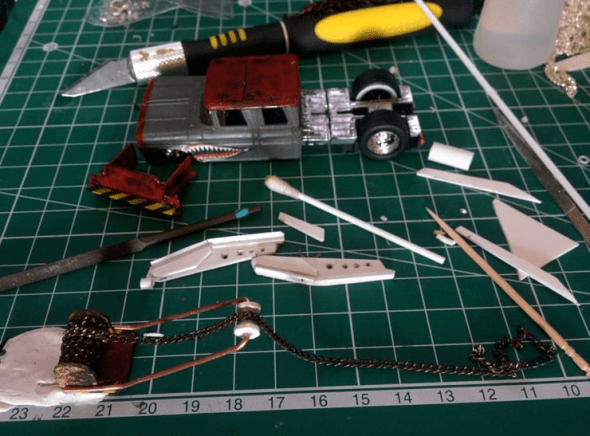
There are many toy car lines out there, but Hot Wheels is still the king of the bunch. The key reason is that, for all the advances in technology, every car is still diecast and built mostly by hand.
Even when cheaper materials are available, Mattel knows the diecast is what the fans want. It’s also helped in making customized cars at home for popular models. After 50 years, Mattel doesn’t want to mess with success and do away with diecast.
17 They’ve Worked With NASA

Hot Wheels have done a few astronaut-themed toys over the years. But that’s not the only connection they have with NASA. In 1998, they were able to work with the agency to create an exact replica of the Mars Rover, which landed on the Red Planet that very year.
They also worked with them in 2012 for scale models of the Curiosity rover. It’s amazing how the company got access to top-secret plans to make these toys.
16 Collectors Take It Seriously

Some may dismiss Hot Wheels as “just for kids.” But collectors take it more seriously than real automobiles. The 1969 Volkswagen Beach Bomb (only 16 prototypes were made) is known to go for at least $15,000.
Some rare models can go for a hundred grand, and collectors are always on the lookout for unique mint models. Entire museums are devoted to various cars as some Hot Wheels collections put legit car collectors to shame.
15 Scaling Down The Cars Was Tricky

A key to the company’s success is that they work with scores of real car companies to get looks at plans for their toy models. Yet it’s not so simple as just “make a smaller version.” The biggest challenge is to achieve the proper scale for the toys in a diecast model yet retain the details of the actual car.
That can be complex with some fancy vehicles. That every model has to be sized to fit the same tracks just adds to why it takes as long developing a toy car as a real one.
14 NASCAR Star Has The Record For The Longest Track

Ever since the Hot Wheels tracks were created, fans have been trying to top themselves making the most extended and most complex. A few have achieved great ones, but it’s fitting a NASCAR star holds the record for the longest.
In 2019, Joey Logano unveiled a 1,941-foot long track stretched across his garage. It weaves through his car collection with 1222 boosters before ending in Logano’s own 2018 HW Ford Mustang. Add yet another title to Logano’s list of accolades.
13 They Made A Car Coated In Diamonds
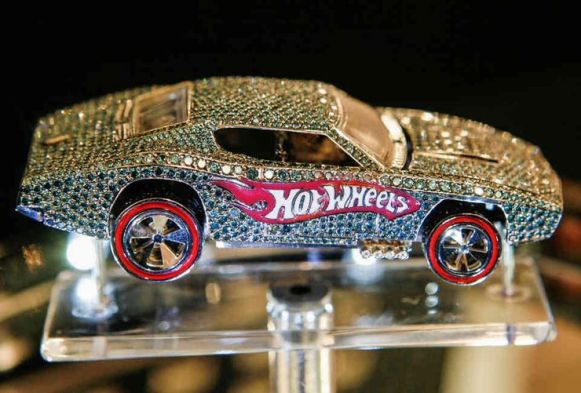
In 2008, Mattel made a big deal of celebrating the 40th anniversary of the Hot Wheels line. As a special reward, Mattel had Jasons of Beverly Hills craft the most expensive Hot Wheels car on the planet.
Cast in 18-karat gold, it’s covered with 2700 diamonds and gems totaling nearly $150,000 today. It’s become a rotating exhibit at toy museums for the glitziest Hot Wheels you could see.
12 The Darth Car Is A Speed Machine

While they do stick to toys, the company has been busy creating some real-sized cars for collectors. One of the most notable is based on Darth Vader, with the hood looking like his fearsome helmet and in jet black.
This isn’t just for show as it’s based on a C5 Corvette with a GM LS3 V-8 engine capable of 526 hp and 150 mph. The Dark Lord of the Sith would be proud of this powerful craft.
11 Every Car Is Tested To Make Sure It Can Run A Track

Almost from the beginning, Hot Wheels car fans had to have a track with the cars. They’ve gone from straight lines to elaborate roller-coaster-like loop systems to leave kids entertained for hours.
What few realize is that the track determines if a car makes it as Mattel prides itself on “every car can fit every track.” More than once, a prototype has to be altered when it won’t fit as the track decides a car’s final form.
10 There Are More Hot Wheels Cars Than Real Cars

While it’s tricky to figure out for sure, most sources agree there are at least one billion cars on the planet (give or take a few hundred thousand in auto graveyards). In contrast, since 1968, six billion Hot Wheels cars have been created.
True, many have been trashed and/or recycled, and it’s impossible to count how many have been lost in backyards. But given how 16 cars are produced every second, it’s no shock the toys outnumber the real deals.
9 Several Creators Are Legit Car Designers

The one constant of Hot Wheels is that the cars look just as good as the real deal. There’s an excellent reason for that as scores of the manufacturers are legitimate car designers. Larry Wood was a veteran of Ford before becoming one of the first Hot Wheels designers.
He’s not alone as Jack Ryan was a rocket designer who crafted the bearings that made the cars so great. Scores of the car designers were in real automobiles first, so it’s no wonder the vehicles look so good.
8 The Original Camaro Is Worth A Fortune

Mint conditions of the Original 16 Hot Wheels releases are all pretty collectible items. But one dominates from the pack. While versions of a Camaro were produced, a few had white enamel paint.
They had been meant to discover flaws in a prototype but accidentally released. A mint version of one went for a hundred thousand dollars and made this one of the most expensive toys on the planet
7 They Released A Custom Corvette Before GM Did

An early standout for the company at a custom Corvette in 1968. What made it notable was that the toy was released before GM had their actual Corvette in car dealerships.
The fact designer Harry Bradley had worked at GM indicates he may have “borrowed” the designs before he left to allow Mattel to beat GM to releasing a Corvette to the masses.
6 The Red Stripes Are Expensive

If you find what looks like an old Hot Wheels car, take a good look at the wheels. If they have red stripes, then you’ve just found a fantastic collector’s item. From 1968 to 1977, designers hand-painted red lines onto the wheels to make the cars look distinctive.
As a cost-cutting measure, they switched to all-black wheels in 1978. Some mint condition red-striped vehicles have been known to go for thousands online.
5 One Of The Original Cars Was Based On A Car With No Doors

The first wave of Hot Wheels was just 16 cars, and any of them can be valuable today. One is notable, the 1965 Dodge Deora. This car boasted no doors but rather a hatch for folks to crawl into.
It was based on a fun design used by Mike and Larry Alexander but in an irony, no real Dodge Deoras were built, to make this a truly unique model
4 A Tie-In Cartoon Got Pulled By The FCC

Today, cartoons based on toy lines are commonplace. But in 1969, Hot Wheels got in trouble when they put out a cartoon series about some teenage car drivers. Despite good messages, the show was hit by complaints about being a “half-hour commercial.”
The FCC agreed, and it was yanked off the air. The company was just ahead of their time with a cartoon tie-in for a hit toy line.
3 There’s A Fight On Where The Name Came From

Much of Hot Wheels is shrouded in myth, and that includes just where the name comes from. The familiar story is that when Eliot Handler saw the first models from designer Fred Adickes, he remarked: “those are some hot wheels you’ve got there.”
Another version is that Handler just blurted the name out in a meeting with a designer. Regardless, it just stuck to become one of the most popular toys on the planet.
2 They’re Number One…Because They Remain So Cheap

In the ranks of the most popular toys on the planet, Hot Wheels dominates. They’re not just the biggest toy vehicle sellers but also the number one selling toy in the entire world. The reason is that in many markets, the cars can still go for only a dollar each.
True, they can be put out in packs, and some nations charging a few bucks more. But many stores do sell the cars for less than a bottle of water, which is the reason they are so dominant.
1 Its Creator Was Married To Barbie’s Creator

Elliott and Ruth Handler were the First Couple of the toy world. The two had founded Mattel as a picture frame company in 1945. While making a dollhouse, Ruth decided to craft a series of dolls she named Barbie.
It was an instant hit to make Mattel a success. Elliott then realized how a toy car line could be great for boys to craft what would become Hot Wheels. The two remained together until Ruth’s death in 2002 (Elliott passed on nine years later) to be icons of their industry.
Sources: Mentalfloss.com, hotwheels.com, hotwheelsmedia.com, thrillist.com
Watch a Track-Day Comparison Between the Shelby GT500 and C8 Corvette

Both cars retail for about $81,000, but one is a lot more accessible.
 SPEED PHENOM ON YOUTUBE
If you’ve got $80,000 to spend and want an American high-performance car, now’s a pretty good time to be in the market. In addition to tire-shredding stalwarts like the Camaro ZL1 and Challenger Hellcat, Ford and Chevy have recently launched high-profile, track-ready sports cars. And thanks to a new video by Speed Phenom, we now know how they directly compare on track.
Naturally, we wanted to do this comparison ourselves. But the GT500 wasn’t ready during our Performance Car of the Year competition when we had an early C8 to test. And now that both cars are on sale, stay-at-home orders and track closures mean we’ll have to wait for an opportunity to do a full R&T comparison.
In the meantime, Speed Phenom does a good job of breaking down how they perform. With the caveat that he’s got a base model GT500 without the optional Pilot Sport Cup 2 tires, he notes that the car struggles for grip more often than the similarly-tired Corvette. It’s also less composed through mid-corner bumps, with slower cornering all around. Thanks to its massive horsepower advantage, though, it jets through straightaways.
The C8, meanwhile, benefits from serious mechanical grip. The better-balanced midship car fires through corners and has no problem putting its power down. That makes it more approachable, not surprising given that it’s the tamest version of the C8 while the GT500 is stretching the limits of the S550 platform. We’re sure to see more track-ready Corvettes soon, but for now the Stingray is a surprisingly capable start.
Mack Hogan- Road&Track
Scary Bobsled Crash Led Kristi Koplin Home Early, Just In Time To Fight COVID-19 As Urgent Care Nurse


Kristi Koplin, a pilot on the U.S. bobsled team, posted an emotional message on her Instagram account on Jan. 8, essentially telling the world she might be done with her sport.
The 33-year-old Koplin was hurt, struggling with the pain and injuries from a serious crash during her second-to-last run during a competition in Lake Placid, New York. The crash was so hard, she said, that she blacked out and woke up fearing she’d been paralyzed. Thankfully she wasn’t, but she had terrible bruises all over her body, another concussion and the growing realization that her life may not be building toward the Olympic Winter Games Beijing 2022.
So Koplin came home to Park City, Utah, to heal — physically and emotionally — and head back to work as an urgent care nurse.
She’s been alternating between bobsled and nursing for years, so the switch was normal. But soon the whole world turned upside down, as the COVID-19 pandemic started to spread, and Koplin became part of a team at Intermountain Healthcare testing for the virus at a drive-up clinic in an underground level of a parking garage.
“It’s been intense, because there is so much anxiety right now,” said Koplin, who is also a captain in the Army Reserve. “I try to help the people coming in by being calm, and giving them the knowledge and comfort that we’re here for them. We can figure out what is going on, test them and try to get them the info and the help they need.
“But yeah, it’s been go, go, go for the past couple of weeks, and that’s not going to stop anytime soon since Utah has it pretty bad where I am.”
Koplin is seeing a steady stream of sick people of all ages. The hard part is hearing their stories of fear and illness, as COVID-19 is the main theme of every conversation. She is dressed in full protective gear, making her look more like an astronaut than a caring nurse trying to test or triage — all in a parking lot, no less.
“Your heart breaks when you hear people are running low on inhalers, or they can’t find Mucinex or Tylenol in the store,” she said. “The essentials are running low everywhere and you want to help them, like the mom who can’t find Motrin to help break her daughter’s fever. I really want to help them.”
The COVID-19 virus weighs on Koplin’s mind too, as she lives with her two over-70 parents. She is isolating herself in the basement, trying to avoid bringing anything home from the testing station to her family.
“I understand the anxiety, I go up and down with it too,” she said. “I think my greatest fear would be to expose them — and have them come down with it. That is the scary part, you don’t know if you are carrying it with you. So that is why staying at home is so important for everybody to limit the spread. I can’t stay home, because I am part of the health care system, but I am trying to do my part at home.”
Koplin likely will not be home much longer though, as her reserve unit (Army Reserve 328 Field Hospital) is getting activated and will soon be deployed. She doesn’t know where she will be in the U.S., but she’s eager to help serve the areas in need.
Koplin now sees her early end to the bobsled season as a hidden blessing. She was having a strong season, ranked second overall in the second-tier North American Cup. She had won three gold medals and two silvers. But if she had not crashed and been injured, she would have continued the season until it ended due to the pandemic. Meaning she would have come back to nursing tired and a bit beat up from bobsled.
“I got a chance to rest. I got a chance to heal, and both those things helped me jump into this and deal with the grind,” Koplin said. “I really can see things happened the way the needed to.”
She’s back to working out, thanks to some equipment at her sister’s house, and the time and space from her crash has brought new perspective.
She doesn’t have to make any big decisions about bobsled right now.
“When that injury happened, my immediate thought was, I am done,” she said. “I went through a week of depression after that. Now, I am more like, I don’t want to be done. The Olympics are so close, it’s knocking at the door.
“I feel good, I still have so much passion about doing everything I am doing. So, I am just going to keep going, staying in shape and seeing where life takes me. I can feel it in my soul: this is what I need to be doing right now. I am helping people, and I am getting mobilized. And I am ready.”
Joanne C. Gerstner has covered two Olympic Games and writes regularly for the New York Times and other outlets about sports. She has written for TeamUSA.org since 2009 as a freelance contributor on behalf of Red Line Editorial, Inc.
1977 Chevrolet Corvette IMSA “SuperVette” race car for sale

Some fans complain that race cars don’t have much in common with road vehicles, but that wasn’t a priority in the 1970s. Loose regulations in the period allowed teams to erase nearly all road-car DNA as they searched for greater performance. This 1977 Chevrolet Corvette, dubbed the “SuperVette,” is an example of the era’s excesses.

Offered for sale by noted Porsche 959 restorer Canepa, the SuperVette was built to take advantage of a rule change in IMSA road racing. In 1976, the sanctioning body allowed full tube-frame cars to compete in its top-level series. Corvette racer John Greenwood saw this as an opportunity to build a more competitive car, and teamed up with designer Bob Reilly to make a tube-frame Corvette. This Corvette—COV002—is one of two chassis completed in 1977.

This car has almost nothing in common with a stock 1977 Corvette, which is a good thing because Corvettes offered very little performance at the timie. Underneath the swollen bodywork is a chassis and roll cage made from 2.0-inch chrome-moly tubing. Its bulging hood hides an aluminum 500-cubic-inch big-block V-8, making more than 750 horsepower. It was built by Don Nichols, whose Shadow Racing team competed in Formula 1, Can-Am, and F5000. The engine is harnessed to a Jerico 4-speed manual transmission.

COV002 was bought by John Paul, Sr. for the 1978 season. Paul raced with his son, John Paul, Jr., and both were later convicted for running an illegal marijuana trafficking operation. It was a different time, for sure.


It was the elder Paul who specified the Nichols-built engine, rather than one built by Greenwood. In an effort to reduce drag, the car also got a narrower track and more aerodynamic bodywork than its sibling.

Paul raced the ‘Vette during the 1978 IMSA season in the GTX class, primarily competing against Porsche 935s. The car earned two podiums that year. After that, it was sold but continued to race through the 1982 season. After retirement, the car changed hands a few more times before being bought by Canepa.


The Corvette has been restored to its 1978 racing specifications, and is currently eligible for to compete in vintage racing, according to Canepa. The seller didn’t list a price, but we don’t expect a car with this pedigree to sell cheap.


Stephen Edelstein for Motor Authority
An Inside Look at How General Motors is Mass-Producing Masks

Not all heroes wear capes – some of them wear masks.
The coronavirus (COVID-19) pandemic has created a critical shortage of face masks across the world, meaning these heroes are on the front lines of the crisis without the protection they need to keep themselves, their families and the people they serve safe.
With the help of engineers, designers, buyers and people in manufacturing, we were able to convert our Warren, Michigan facility to produce masks in less than seven days.
This facility is projected to produce up to 50,000 masks per day, or approximately 1.5 million each month. Below is a behind-the-scenes look at the facility and mask production process.
1. Source raw materials
We worked with automotive suppliers to develop the three layers of fabric in the masks. These companies typically provide GM with sound-deadening insulation found in doors, headliners and trunks, but they quickly altered their production processes to help manufacture these desperately needed masks.
2 Fold, weld, and cut
The custom-made “mask maker” automatically sandwiches the filter material and metal nose piece between an inner and outer layer of fabric. It then folds the pleats, welds the layers together, and cuts each mask accordingly.
3. Cut and attach the ear loops
Employees then cut ear loops from elastic straps and attach them to the mask using sonic welders. Often used in many automotive applications, these sonic welders use ultra-fast vibrations to “melt” the two materials together, without using heat. Ear loops are then checked to ensure size and secure attachment to the mask.
4. Sterilization
Masks are loaded into a sterilization cabinet that is filled with high levels of ozone for 20 minutes to sanitize the masks.
5. Bagging
From there, packages of 10 masks are bagged, sealed and prepped for delivery! While the GM team has identified a process for mass-producing masks in a short amount of time, we are continuously looking for improvements to speed up production. For example, during the first week the team manually labeled and sealed bags in two separate stations; now the team has sourced machines that save significant time by labeling and sealing bags in one station.
2020 Chevrolet Corvette C8 vs Lamborghini Huracan Evo: Closer Than You’d Think

With six figures separating their prices, are these mid-engine sports cars even comparable? Yes.

Alexander StoklosaWriterWilliam WalkerPhotographerMar 31, 2020
The new-for-2020 Chevrolet Corvette C8 can seemingly drive on water, its holy combination of exoticism and affordability winning praise and awards across the automotive spectrum. We named it a 2020 Automobile All-Star. Is there nothing the first-ever mid-engine Corvette can’t do?
Curious to test the new Chevy sports car’s limits, we put it up against another mid-engine supercar that we found lying around during our 2020 All-Stars testing: The 2020 Lamborghini Huracan Evo. Absurd? Perhaps. The duo’s base prices are separated by $124,039, and the Italian has a 141-hp advantage (136, if you count the extra five ponies the Corvette’s sports exhaust unlocks), two additional cylinders, and an extra driven axle. Surely, the Huracan will make meatballs out of the Vette, right?
So long as you suspend the obvious observation—that someone shopping for the Huracan definitely wouldn’t step foot in a dealership that also sells white bread stuff like the Equinox and Spark, and no would-be Corvette buyer is cross-shopping a new Lamborghini—this comparison is a lot closer than you might expect. Mostly, that’s because the Corvette punches way above its weight, and not due to any specific deficiency on the Lambo’s part.

Power And Acceleration? Yes.
Both the Corvette and Huracan are powered by naturally aspirated engines. The Chevy uses a 6.2-liter pushrod V-8 engine, an all-American masterpiece producing 490 horsepower and 465 lb-ft of torque in base form. Bump those figures by five each when the optional performance exhaust—fitted to our test car—is selected. That 495 horsepower and 470 lb-ft are sent to the rear wheels via an eight-speed dual-clutch automatic transaxle and an electronic limited-slip differential.

Lamborghini fits the Huracan with a 5.2-liter V-10, which produces 631 horsepower way up at 8,000 rpm (the Vette’s horsepower peak hits at 6,450, and its redline is similarly lower) and 442 lb-ft of torque at a high 6,500 rpm (the Corvette’s torque peak lands at 5,150). A seven-speed dual-clutch automatic transmission distributes engine torque to the front and rear axles via all-wheel drive.
Surprisingly, the Corvette streaks to 60 mph in 2.8 seconds (as tested by our friends at MotorTrend), matching the estimated figure for the Huracan Evo. The European boasts a higher top speed of 202 mph, whereas the Corvette tops out at 184 to 194 mph, depending on equipment. Since there are basically no places in America for owners to probe those speeds, the Lambo’s lead here is negligible. What counts is that the C8 can hang with the Lamborghini in straight-line speed—with less power (but greater torque) and without all-wheel drive. Oh, and for less than a third of the price. Take your pick on which engine sounds better—the Vette’s classic American soundtrack or the Lamborghini’s exotic V-10 wail, but know that the Huracan’s engine power seems to hit harder, likely a consequence of the drama-free all-wheel-drive traction it enjoys.

Handling And Drivability
Chevrolet has long tuned the Corvette for everyday use (well, at least the regular-grade Vettes), and the C8 delivers a downright supple ride. Our test car came with the adaptive suspension, which, left in its default Tour mode, soaked up bumps smoothly and quietly. The Lamborghini is more bucking bull, with a firm, unyielding suspension and a tendency to allow bump impacts to reverberate through the structure and cause cabin booming.
At the track, both mid-engine sports cars are capable, despite their vastly different personalities. The Lamborghini leverages its gobs of mechanical grip, all-wheel drive, and utterly stable-feeling chassis to simply go wherever the driver points the nose. For all the intensity in the V-10’s noise and the driver’s low seating position up near the front axle, the Huracan Evo is remarkably approachable when driven quickly. That isn’t to say it is boring—the experience is visceral, and you can coax the Lambo into giggly oversteer with an aggressive throttle foot, but the experience never feels a hair’s width away from a big, expensive, ego-bruising “oops” moment.
The Corvette also is forgiving when driven hard, though its driver-selectable chassis and powertrain modes seem to afford it greater behavior bandwidth than the Huracan. Flipping the Vette from Tour mode to its Track setting and dialing back the Performance Traction Management (PTM) to its more permissive stability-control thresholds wakes the C8 up considerably, though it also comes with a needlessly heavier (and artificial) steering weighting. Most drivers preferred the quicker-feeling, lighter Sport steering setting.

Details aside, the Corvette can be pushed comfortably to its limits, never delivering any snappiness or edge. The chassis seems tuned to initially dole out moderate understeer near its grip limit, but skilled drivers can easily transition past this safety net with heavier throttle inputs, revealing the Corvette’s balanced setup. Perhaps GM’s chassis-tuning mavens—some of the best in the business—built in the slight push to keep Corvette buyers uninitiated to mid-engine handling behaviors from backing their new C8s into guardrails.
We take greater issue with the Chevy’s brake pedal, which operates with a somewhat spongy weirdness (it artificially shifts its response depending on the drive mode). Never did we feel as if the Vette’s stopping power was in question—only that it was difficult to understand; the Lambo’s stoppers operated more linearly and predictably, with far better feel.
Looks And Prestige
Buying a Lamborghini isn’t solely about taking home an exotic car—you’re buying into a lifestyle, one in which you’ll be stopped often by passers-by looking to snap photos, or challenged to drag race by folks in Dodge Challengers with those stupid yellow lower-bumper pre-delivery protector caps still fitted. Everyone will assume you’re wealthy and eager for attention. But you already knew that. How does the Corvette compare?
Until now, the Vette has been a pretty common thing. General Motors considers it a volume sales model, so previous iterations weren’t rare. And we can’t ignore front-engine Corvettes’ street image as chrome-wheeled, automatic-transmission golf shuttles for old men. Forget all that.

The C8 attracts Lamborghini levels of attention, a phenomenon unlikely to subside no matter how many GM builds. Americans are intimately familiar with the Corvette, less so with this new wedge-shaped, exotic-looking version, so we encountered plenty of curious onlookers in California and especially Michigan with our test vehicles. Just like its performance, the long, pointy 2020 Corvette’s visual wattage zaps well beyond its attainable pricing.
Chevrolet also finally fixed the Corvette’s previously subpar interior, bringing it not merely in line with the sports car’s $60,000 base price, but to some plateau slightly beyond—knowing full well it’ll lose money on the less-expensive models as a result. Porsche’s been doing this for years with the 911, acknowledging that the same basic interior has to be acceptable both in the entry-level model and in those 911 variants costing twice as much. The Corvette’s cabin materials seem downright appropriate at our test car’s $80,000-some list price. Those nicer plastics and leather are stitched and tightly fitted to form truly original shapes and adventurous styling elements, such as the long, thin row of climate controls bifurcating the interior and the squared-off two-spoke steering wheel.
And, so, we end this non sequitur on familiar turf: The Corvette is a screaming deal, delivering the looks and performance of a more expensive vehicle. In the past, that’s been enough to occasionally pick off a Porsche in a head-on comparison—but is it enough to vanquish a Lamborghini? As we mentioned up front, there will be almost no overlap between C8 and Huracan Evo buyers, so the question is basically abstract. Dissociated from reality and buyer prejudice, however, yes, the Corvette rises to the Lamborghini’s occasion while delivering better everyday livability. And, remember, this is the base 2020 Corvette C8. Just wait until Chevy delivers the high-performance Z06, the hybrid, and the rumored 900-hp ZR1 hybrid. What will the Corvette usurp then?

| 2020 Chevrolet Corvette Specifications | |
| PRICE | $59,995 (base)/$83,825 (as tested) |
| ENGINE | 6.2L OHV 16-valve V-8/490-495 hp @ 6,450 rpm, 465-470 lb-ft @ 5,150 rpm (higher figures due to performance exhaust) |
| TRANSMISSION | 8-speed dual-clutch automatic |
| 2020 Lamborghini Huracan Evo Specifications | |
| PRICE | $184,034 (base)/$235,084 (as-tested) |
| ENGINE | 5.2L DOHC 40-valve V-10/631 hp @ 8,000 rpm, 442 lb-ft @ 6,500 rpm |
| TRANSMISSION | 7-speed dual-clutch automatic |
General Motors spins up global supply chain to make 50,000 face masks a day


GM today announced manufacturing details around building much-needed medical face masks. According to the company’s press release, it took the company less than seven days to go from nothing to producing the first production-made mask. The automotive giant said today in a released statement it expects to deliver 20,000 masks on April 8 and soon after, able to produce 50,000 masks a day once the production line is at full capacity.
These face masks are a vital piece of personal protective equipment (PPE) used by front-line healthcare staff to protect themselves against the virus-causing droplets that are spread by patients through coughing and sneezing in clinical settings.
GM turned to global partners to create this manufacturing line within a week. The company sourced material from GM’s existing supply chain and acquired manufacturing equipment from JR Automation in Holland, Michigan, and Esys Automation in Auburn Hills, Michigan. As the company’s press release says, GM even created an ISO Class 8-equivalent cleanroom in GM’s Warren manufacturing plant. GM and the UAW will seek two dozen volunteers to staff this new assembly line.
“The first people we called were those who work with fabric vehicle components,” said Karsten Garbe, GM plant director, Global Pre-Production Operations. “In a few days, the company’s seat belt and interior trim experts became experts in manufacturing face masks.”
While this team was creating a face mask assembly line, others within GM were working towards creating ventilators. Last Friday, March 27, President Donald Trump signed a presidential directive ordering GM to produce ventilators and to prioritize federal contracts. This came hours after the automaker announced plans to manufacture the critical medical equipment needed for patients suffering from COVID-19, the disease caused by the coronavirus.
Other automakers joined the fight, as well. Ford and GE Healthcare licensed a ventilator design from Airon Corp and plan to produce as many as 50,000 of them at a Michigan factory by July as part of a broader effort to provide a critical medical device used to treat people with COVID-19. Under this partnership, Ford said it expects to produce 1,500 Airon ventilators by the end of April, 12,00 by the end of May, and 50,000 by July.
Matt Burns; Tech Crunch
Watch a C8 Mid-Engine Corvette Hit 173 MPH on a Dry Lake Bed

Even off the pavement, the new ‘Vette is a rocket ship.
The 2020 C8 Chevy Corvette is a fast car. In base form, it can hit a staggering 194 mph flat-out. Even with the drag-inducing Z51 performance package, the car can still do 184. Hennessey Performance took theirs to 182 mph with ease before they turbocharged it to oblivion. Now, there’s another C8 top-speed run on the internet, and this time, it takes place on a dry lake bed.
Popular YouTube TheStradman took his new Z51-equipped Corvette to a dry lake bed in Utah to test out the top speed of the car. He managed to hit an impressive 173 mph before slowing down—not bad considering the uneven and bumpy surface. It helps that there’s absolutely nothing for miles in either direction. In fact, from inside the cabin, it looks a bit uneventful. Here’s a perspective from outside the car to give you a sense of how fast 173 mph is:
If the base Corvette is this quick right out of the box, we’re curious to see how the upcoming Z06 stacks up. Considering the last-gen car could hit 200 mph, we’re expecting big things.
Source: Brian Silvestro; for RoadandTrack
IMSA Announces Updates to 2020 IMSA WeatherTech SportsCar Championship and IMSA Michelin Pilot Challenge Schedules


The International Motor Sports Association (IMSA) today announced schedule updates for three 2020 IMSA WeatherTech SportsCar Championship and IMSA Michelin Pilot Challenge events.
- The Acura Sports Car Grand Prix at Mid-Ohio has been moved to the weekend of Sept. 25-27, 2020. It was originally scheduled for the weekend of May 1-3.
- The IMSA Monterey SportsCar Championship at WeatherTech Raceway Laguna Seca has been moved up one weekend to run on Sept. 4-6. It was originally scheduled for the weekend of Sept. 11-13. This date adjustment was made to accommodate IMSA competitors planning to participate in the 24 Hours of Le Mans, which now will run on Sept. 19-20.
- The 23rdannual Motul Petit Le Mans at Michelin Raceway Road Atlanta has been moved back one week and now will run Oct. 14-17 to provide teams a more balanced schedule as the season comes to its conclusion. The original dates of the event were Oct. 7-10.
These three event date changes are in addition to the previously announced reschedule of the Mobil 1 Twelve Hours of Sebring Presented by Advance Auto Parts, which now is set for Nov. 11-14. Previously purchased tickets for all four events will be valid on the new dates.
IMSA will provide additional series updates, broadcast information and event schedules as they become available.
Mid-Engined Chevy Corvette Video Analyses The 2LT Interior

The Goldilocks zone of Corvette C8 interiors?
By now, you should know that Chevrolet has started deliveries of the mid-engine 2020 Corvette. Lucky owners of the ‘Vette C8 are starting to receive their newest toy and most likely you’ve already seen one on the streets – that’s if the state you’re in is not affected by the coronavirus lockdown.
If you’re among those who are planning to purchase the new Corvette but are undecided with the trim level to choose, this video might be able to help you – especially if you’re particular with a car’s interior.
The Corvette C8 comes with three trim levels: 1LT, 2LT, and 3LT. The differences lie mainly in the features offered on each trim level, which defines that the cabin will look and feel like. That’s pretty important, considering that we spend so much time inside the car rather than staring at our investment from a distance. So, here’s a little guide.


The base 1LT trim isn’t really basic. With the entry-level trim, you already get the GT1 seats wrapped in mulan leather, a customizable 12-inch gauge cluster, push-button ignition and keyless entry, and an 8-inch Chevy MyLink infotainment system with Apple CarPlay and Android Auto, 4G LTE Wi-Fi, and 10-speaker Bose sound system. The Corvette 1LT trim is available in three color options: black, gray, or red.
Going up the 2LT trim gives you more interior color options plus features like a rearview camera mirror, a colored head-up display, heated/cooled seats, heated steering wheel, advanced blind-spot monitor, and rear cross-traffic warning. The infotainment gets upgraded as well with a wireless charger and a 14-speaker Boss audio system.
Finally, the 3LT trim dials up the ante by adding a premium Nappa leather with suede microfiber accents – all in combination with the GT2 seats that have more bolsters. These seem not a lot but the range-topping trim adds luxury to the sports coupe.
If you’re still undecided, watch the 2LT interior review on top of this page to check whether you need to take it down a notch to 1LT or go all out on the top-level 3LT.
Source: HorsePower Obsessed
How to Pump Gas without Passing Germs Around

The etiquette of doing something you do regularly while staying safe and clean.
- We might need new gas-pumping etiquette rules for the 21st century, both for selfish and altruistic reasons.
- We’ve known since 2011 that gas pump handles can be filthy—they’re worse than ATMs or escalators, even—but there’s no reason to worry if you take the right precautions.
- You can lower your risk by using gloves or paper towels to gas up, using touch-free pay options, and staying as physically separate from others as possible as you refuel.
You may have heard this one before: the best way to avoid catching some sort of communicable disease is to wash your hands well, and often. This advice isn’t exactly new, which hints at how reasonable and responsible it is.
Washing your hands to stay clean was the takeaway lesson from a 2011 study conducted by Kimberly-Clark Professional, which found gas pump handles were “the filthiest surface that Americans encounter on the way to work,” according to Reuters. The Los Angeles Times reported back then that the study found 71 percent of gas pump handles the Kimberly-Clark researched tested were considered “‘highly contaminated’ with the kinds of germs most associated with a high risk of illness.” Compare that to only 41 percent of ATM buttons and 43 percent of escalator rails.
The Kimberly-Clark Professional tests were done in big cities (Atlanta, Chicago, Dallas, Los Angeles, Miami, and Philadelphia) almost a decade ago, but when something like the coronavirus impacts pretty much every corner of the world, it’s a good reminder to take care when gassing up. When it comes to the COVID-19 coronavirus specifically, the National Institutes of Health has issued information that explains that coronavirus can be stable for 24 hours on some surfaces like cardboard and “up to two to three days on plastic and stainless steel.”
If you’re not already carrying disinfecting wipes in the car with you, this is a good time to start, assuming you have some available, and wipe off the pump handle and touchscreen, or any other surfaces you plan to touch, before your hands make contact. Even better, it might be a good idea to search out a station that accepts contactless payment at the pump, so you won’t need to come into physical contact with the touchscreen or anything else other than the pump handle. Two easy solutions to this issue are to either wear gloves or to use the paper towels commonly provided for window cleaning as a guard between your hands and the screen, buttons, and pump handle. Keeping gloves in the car is a good idea, but they shouldn’t be the disposable sterile gloves that hospitals can use when there’s a need for them there. If you don’t have gloves, keep some hand sanitizer in the car to use on your hands after filling up.
As for social distancing, it’s convenient that gas pumps are relatively far apart from one another, contagion-wise, but even so, choosing to fill up your tank at an off-peak time can be safer. If there are other people getting gas at the same time, keeping at least six feet between you and them is a good idea for everyone involved. And it should go without saying that you shouldn’t go into the store unless there’s a reasonable need to do so if there’s still a rapidly spreading disease going around.
The actual chance that you will catch a transmittable viruses at the gas station is low. As the Illinois TV station ABC-20 reported based on answers from a medical expert, the sequence of events that have to happen to get the virus from someone who has it (someone coughing onto the pump handle or touching the touchscreen with virus on their hands, and then you touching it and then your face) can be interrupted in any number of ways. Even so, there’s no harm in being extra careful in these potentially dangerous times.
Sebastian Blanco- Car and Driver
Hennessey’s twin-turbo C8 Chevy Corvette V-8 makes 643 horsepower early in development


It took 30 hours for Hennessey Performance Engineering to tear apart a new 2020 Chevrolet Corvette, install twin-turbo setup, and put it back together.
It’s no surprise, then, that the twin-turbo C8 Corvette isn’t ready to be sold to customers. The engine lacks intercoolers and Hennessey hasn’t cracked the code of GM’s new electrical architecture to reprogram the ECU.

“This is just the beginning, our own car, doing R&D,” company founder and CEO John Hennessey told Motor Authority.
On Monday, the engine made 643 horsepower and 570 pound-feet of torque at the wheels on a Dynojet dyno while running just 5 psi of boost. That compares to baseline testing HPE performed on the stock car which revealed 466 hp and 451 lb-ft of torque. HPE plans to offer a 1,200-hp version of the C8, which Hennessey said could make 18-20 psi of boost.
Hennessey took delivery of an orange C8 Corvette in Detroit on March 13. He and his daughter, Emma, drove back to the performance outfitter’s Texas headquarters and performed baseline testing before the Hennessey team tore apart the car.
The orange C8 fired back to life on Friday with twin 62-mm Precision Turbos and twin blow-off valves connected to the throttle body mounted behind the catalytic converters. Both turbos are oil-cooled with twin scavenge pumps that feed back into the motor.
The system is not intercooled. Instead, there’s a methanol injection setup to keep things from getting too hot. HPE is considering where to put intercoolers. The current packaging has limited space for intercoolers without cutting into trunk space, which Hennessey does not want to do. 2020 Chevrolet Corvette Stingray undergoes twin-turbo conversion at Hennessey
Hennessey told Motor Authority his team currently can’t tune the factory ECU, but it is looking at aftermarket solutions for the engine management system. He noted it took a year for solutions to come to market for the C7 and added, “hopefully, it won’t take a year.”
Hennessey said when the turbocharged C8 was first started it didn’t throw any codes, errors, or a check engine light. “The computer seems happy with the turbos,” Hennessey noted. A check engine light did appear when the front wheel speed sensors were disconnected to put the car on the dyno, Hennessey said.
The orange C8 will used for R&D of upcoming modifications. Hennessey said he doesn’t expect to deliver modified customer C8s for at least six months, and all will have intercoolers and full plumbing.
Joel Feder for Motor Authority
2020 Chevrolet Corvette vs. 2020 Ford Mustang Shelby GT500 at the Drag Strip

Did you see the two race on YouTube? We’ve tested them, too; here’s why the results were no surprise.

- We have tested both the 2020 Chevrolet Corvette (11.2 seconds at 122 mph) and the 2020 Ford Mustang Shelby GT500 (11.4 seconds at 132 mph) in the quarter-mile.
- A video on YouTube, however, shows flipped results: 11.5 seconds at 120 mph for the Corvette and 10.8 seconds at 132 mph for the GT500.
- As always, the driver and track conditions are critical, and our two-run average is far more repeatable than any one-off run at a drag strip.
When we tested Ford’s new 2020 Mustang Shelby GT500 against the top-dog 2020 Chevrolet Camaro ZL1 1LE, the Mustang came out on top on the drag strip. But how does the front-engine Shelby stack up against the other, now mid-engine, threat from Chevy?
Greg PajoCar and Driver

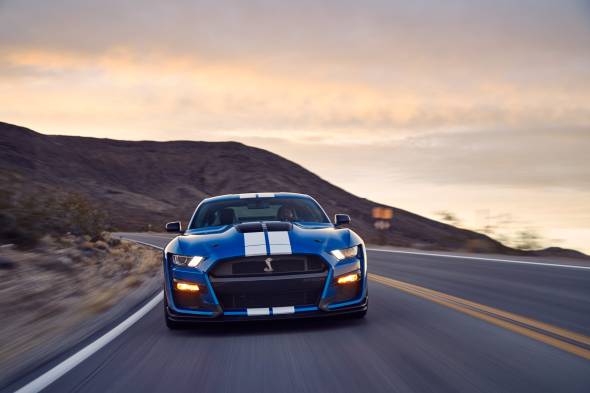
During our testing, the GT500 hurtled through the quarter-mile in 11.4 seconds at 132 mph. But that was on a regular street-like surface, not a sticky, prepped drag strip. We struggled mightily with traction at launch, and our best run was with the launch control set to the lowest rpm allowed (1200 rpm) to prevent igniting a rear-tire fire. However, no surprise: with more traction far, better numbers are possible, and we’ve seen numbers below 11 seconds at drag strips, including this kid, who ran a 10.665 shortly after he acquired the car.’Murica Which Ultimate Pony Car Is the 1/4-Mile King?This Kid Ran a 10.66 Quarter Mile In His GT500
On the other hand, the 2020 Corvette has far fewer launch struggles, as it benefits from its newly acquired mid-engine layout and rear weight bias. Moving the weight distribution rearward improves launch traction, helping it jump off the line much quicker. During our testing, and despite far less horsepower, the mid-engine Vette outaccelerated the GT500 through the quarter-mile by two tenths of a second, reaching it in 11.2 seconds at 122 mph.Advertisement – Continue Reading Below
We’re starting to see other people’s numbers from both of these cars, though, as customers are starting to take deliveries of their C8 Corvettes and GT500s. Contrary to our test results, there’s a video circulating on YouTube that shows the new GT500 beating the C8 Corvette through the quarter-mile by seven-tenths of a second. It raced to the quarter-mile in 10.8 seconds while the Corvette reached it in 11.5 seconds.
Keep in mind that the driver and conditions are huge factors in quarter-mile and acceleration results. We suspect that here, the Corvette likely got bogged down on the high-grip surface, as the launch control isn’t optimized for those conditions, and the 760-hp Mustang benefited from the extra traction on the track.
Connor Hoffman for CarandDriver
Chevy Camaro Mid-Engine Rendering Could Be Corvette’s Cool Sidekick


It’s not such a crazy idea.
The Chevrolet Corvette went mid-engine, so why not the Camaro? That’s the question this particular rendering from Carlifestyle on Facebook asks, figuratively and literally in the post. Sometimes, these oddball renderings can go off the rails but if we’re honest, this one has our interest … in a good way.
It’s not hard to see shades of the Lamborghini Huracan in this design, presumably because that’s the car this rendering is based upon. The side intake and lower rocker trim is a dead giveaway, but beyond that, this car definitely looks like a proper good ol’ Camaro.
And what are the attributes of this, dare we say, Lamaro? As with all things mid-engine, the nose is short and the hips are wide to accommodate an engine behind the driver. From this angle, it’s quite impressive how well the pony car adapts to life as a mid-engine supercar. Of course, this is also an exceptionally well-done rendering that could pass for something real if we didn’t know otherwise.
Here’s a radical thought. The Corvette and Camaro were a stout one-two punch for Chevrolet as front-engine performance machines from America. Camaro sales have fallen sharply in recent years, and the Corvette has transitioned to its new mid-engine form. Maybe creating a mid-engine Camaro could be the pony car’s salvation. Keep the one-two Bowtie punch, just move both the ‘Vette and ‘Maro to the mid-engine world. The Camaro certainly wouldn’t have any domestic competition in such form, and we wouldn’t have even a teeny problem driving the car you see here – be it a V6, V8, or even a neat hybrid.
Alas, Chevrolet already had the guts to build the C8 Corvette with its engine behind the driver. As such we suspect that absorbed all of GM’s gambling chips so the Camaro’s future will likely be far less interesting. The car is expected to disappear in the next couple of years as the current generation winds down, fading into the annuls of automotive history for a second time.
Christopher Smith for Motor1
2020 Chevrolet C8 Corvette Test Drive: Automobile All-Stars Winner


William Walker: Photographer Manufacturer Photographer Mar 11, 2020
It’s weird to say, but immediately after my first test drive in the new mid-engine, eighth-generation 2020 Chevrolet C8 Corvette, I was angry. Angry not because the car didn’t do what it should, but precisely because it did everything I asked of it, and did it beautifully—and I’d been led to believe it was a hot, understeering mess by the reviews I’d read elsewhere. How could they all have been so wildly off base?
There are many possible explanations, of course—differing driver skill levels, evaluation methods, and conditions. But two variables stand out among the rest: the C8 Corvette’s option for track or street alignments, and the length of exposure to the car. Addressing the latter issue first, we were lucky enough to spend the better part of week with the new C8, a rare chance given the limited availability of test cars so early in the Corvette’s production (All-Stars testing took place in early December 2019). That greater exposure to the car allowed us more time to get a feel for its behavior in a wide array of situations, both on the road and on the Streets of Willow Springs racetrack.
Perhaps even more importantly, however, was the choice of track and street suspension alignments. You see, the 2020 C8 Corvette has two official specifications for its alignment settings; the street alignment sets the camber at 0 degrees, while the track alignment sets the camber to 3 degrees negative. The result is the difference between a (somewhat) understeer-biased street setup and a balanced, ready-to-rotate super sports car. The former is intended to help Corvette owners new to the world of low polar-moment mid-engine cars make the transition without ending up backward in a guardrail their first time out. We spent our week with the Corvette in track-alignment mode, whether hammering out laps or zooming around the mountains near Lake Hughes.

But wait, isn’t that cheating, you ask? It might seem like it at first—track settings are meant for the track, not the street, right?–but Chevrolet itself recommends owners who use the track setting for track go ahead and leave the car setup that way all the time. No, it won’t cause excessive or premature tire wear, at least according to Chevy’s engineers. For the record, we did visually notice more wear to the front tires’ inside shoulders than we’d expect with the more conventional setup, so we’d be curious to see the state of the rubber after 5,000 or so miles with this alignment. It’s certainly something for owners to be aware of and to keep an eye on, at the very least.
Regardless, and not for nothing, the two alignment settings might better be named “beginner” and “advanced”. If you’re a moderately accomplished driver who’s comfortable with a car that’s willing to rotate, don’t leave the lot with your new Corvette until you’ve had the car set to its more aggressive alignment.
With that out of the way, holy cow, is this thing good! The nearly instant-on torque from the 6.2-liter V-8 means you’re never left wanting for thrust, the quick-shifting eight-speed dual-clutch transmission bangs out upshifts with authority, and the steering feel, while not telepathic, is still abundantly communicative. Detroit bureau chief Todd Lassa did note, however, that several of our evaluators found “the steering in its own separate Track mode is too heavy without doing anything for feel,” and resident professional race driver Andy Pilgrim pointed out, “The gearbox is very good on the street, but did not always give me the lower gear I wanted on the track.” If those are the worst things we could think to say after back-to-back runs in hardware as exotic as the $474,000-plus Ferrari F8 Tributo and the nearly as pricey McLaren GT, it’s pretty apparent the mid-engine Corvette is something special.
Braking is remarkably stable for a mid-engine car, as is power application, the latter thanks at least in part to the car’s Performance Traction Management system. Chevy’s PTM is one of the key technology transfers from the factory Corvette Racing program, and it shows its racing roots when put to the test. But of course even the best traction-control programs can’t work when the tires aren’t in contact with the road; that’s where the Corvette’s excellent suspension tune comes in.

“Glides over broken mountain roads like a hovercraft—but still sticks like crazy,” wrote contributor Arthur St. Antoine in his evaluation notes. Pilgrim agreed, noting the C8 Corvette “has more suspension travel than the Porsche 992, and feels more compliant, allowing more roll in transition; none of which is a bad thing for everyday driving comfort.”
In fact, far from a rabid, on-the-edge supercar, it’s clear the Chevy engineers behind the new C8 Corvette put a great deal of time and effort into the car’s daily driving demeanor, or, as features editor Rory Jurnecka noted, “It should make a nice road car with good interior space. Feels pretty easy to live with.” Not only is there a rear trunk that’ll fit two golf bags (or several carry-on bags or backpacks), there’s a front trunk (or frunk) that’ll hold some more. But the new C8 Corvette’s interior is what truly stands out in terms of daily comfort, especially in comparison to previous Corvettes.
“When I took the C8 on the road trip between the hotel and the winners’ shoot location, I was blown away at how good of a GT car it is,” social media editor Billy Rehbock said. “I put on the cooled seats, played music over the crystal-clear sound system, and rolled in complete comfort. My only complaint was that it was actually a bit quiet, even when being driven hard, but subsequent performance versions will fix that, no doubt.”
Beyond even the excellent interior feature set (though the verdict is still out on the extra-long button strip in the center console), the most notable and immediately noticeable upgrade to the C8 Corvette’s interior is the massive improvement of materials and build quality over previous generations. Our test car’s 3LT interior trim specification included Chevy’s upgraded infotainment system, a 14-speaker Bose audio system, and a head-up display. And in addition to the upgraded materials, it featured extended leather surface treatments, and GT2 bucket seats—though ours swapped the GT2 seats for “competition sport bucket” seats for an extra $500); the 3LT spec added $11,950 to the car’s $59,995 base price. Tack that cash onto the additional list of optional extras like the Z51 performance package ($5,000), magnetic ride control suspension system ($1,895), front lift system ($1,495), upgraded 19-inch front/20-inch rear wheels and tires ($1,495), and engine appearance package ($995), among others. Total price, as configured: a surprisingly reasonable $83,825.
Admittedly, this was a pre-production car, but it was also one of just a handful of streetable C8 Corvettes available at the time, meaning it had already lived a rather hard life before our testing even began. Sitting in the C8 back-to-back with the Ferrari F8, the Italian doesn’t come off as insanely luxurious or refined—and the F8’s interior is already perfectly lovely.
It’s no revelation that the 2020 Chevrolet C8 Corvette is a great performance value; the Corvette has been that way for decades. But for Chevy to have done such an impressive job on its first go with the engine behind the driver, and to have included so many improvements to the luxury and quality of the C8, all for a price that’s a fraction of the cars with which it competes, it’s easy to see why I was so angry after experiencing the car for myself—and it’s hard not to agree with Jurnecka when he says, “So glad this car is what I’d hoped for. Worth the wait.”
Nelson Ireson for Automobile