
[VIDEO] Watch this 2019 Corvette ZR1 Hit 191 MPH in the Standing Mile


Oh ZR1, how quickly we have forgotten you and moved on to the C8. But then comes along a video like this that reminds us that even with an engine upfront, you are still one of our favorites!
All kidding aside, the 2019 Corvette ZR1 is one of our favorite Corvettes of all time particularly because of the things it could do, like shooting down a former Space Shuttle runway at Cape Canaveral at nearly 200 MPH!
Typically we see these high speed runs with a ZR1 that has the ZTK’s High Wing. This Long Beach Red Corvette ZR1 has the low wing for less drag and it seems to definitely show off its speed in this standing mile run in which the Corvette reached a top speed of 191.16 MPH.
Two views are shown including the in-car with telemetry overlay on the screen. We see the car was still accelerating past the mile and we’re excited as they tell us that two more videos coming that show the ZR1 also running 2.3 miles and 2.7 miles down the runway.
The video comes the Johnny Bohmer Proving Grounds on Merritt Island Florida. Previously we have seen the Genovation GXE Electric Corvette run on the same track and in fact, it might be interesting to compare the two cars after the ZR1 shares the two final runs
From Johnny Bohmer Proving Grounds via YouTube:
C8 Corvette Secrets: The 2020 Corvette Has a Flying Car Mode


As we continue to digest all the new information that came out of last week’s First Drive Event with the 2020 Corvette Stingrays in Las Vegas, there is a new “Mode” to discuss that most Corvette enthusiasts have never heard of.
The 2020 Corvette Stingray has several “modes” that help drivers get the most out of their cars. We are already familiar with the regular driving modes that feature settings for Weather, Touring, Sport and Track, as well as the two customizable modes called MyMode and Z-Mode. But what you may not be aware of is that the 2020 Corvette Stingray’s equipped with Magnetic Ride Control also features a “Flying Car” mode.
Well, it is the 21st century after all!
Corvette’s Vehicle Performance Manager Alex MacDonald is responsible for the chassis tuning of the new Corvette and he was tasked with explaining much of the on-track performance capabilities of the new Corvette to those at Spring Mountain last week.
For the C8 Corvette, engineers have rolled out version 4.0 of Magnetic Ride Control with the biggest change to the system is the use of accelerometers rather than position sensors that measured wheel height. Here is the slide that was offered on the new Mag Ride for the C8 Corvette:

The Magnetic Ride Control is tied into the Corvette’s Performance Traction Management system and that’s where the Flying Car Mode comes into play.
When your crest an incline and the Corvette’s wheels are off the ground, they will spin faster like they are on ice or another slippery surface because there is no resistance. The performance traction control senses that and sends commands to slow the wheels. But that’s not the best reaction when on the track. The system now senses when the car’s front wheels leave the ground (and assumes that the rears will be leaving as well), and the system tells the performance traction control to ignore it because it knows that it’s temporary and that all four wheels will be back on the ground momentarily.
Here is Alex talking about the Flying Car Mode:
“The other interesting note about MR is that it communicates with the performance traction system and it tells that performance traction system that if the front wheels have just gone over a big crest that we know that one wheel-base later the rear is about to go over that same crest, we can adapt the traction control to work in that situation and we call that Flying Car Mode, which is a cool name for it, because it does detect when the car is airborne and we can alter the chassis controls to deal what happens when the car lands.”
Source:
Video by Keith Cornett
Tech We Would Like to See on the C8 Corvette: Active Aero
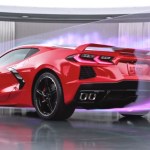

With the highest performance versions of the seventh generation Corvette, customers were forced to make a choice. Did they want their car to have the highest possible top speed, or did they want to sacrifice some of that by bolting a slew of aerodynamic aids to their car for maximum cornering ability?
We would love for Chevrolet to take that decision out of the ordering equation for buyers of the upcoming Z models and the Grand Sport. They could give buyers the best of both worlds with the incorporation of Active Aerodynamics.
Active Aerodynamics can take many forms, from grille vents that close at high speeds to streamline a car, to suspension that lowers at speed to reduce lift. We know that the Corvette team would build a fully functional system that integrates several of these technologies into a cohesive package, just like they did on the C7 ZR1’s chassis-mounted wing and innovative balancing front underwing, but what we mostly want to focus on here is the most visible piece of such a system, the rear wing.
This unit would elevate both the performance and even the prestige of GM’s looming halo car. There are several benefits of an active rear wing that accompany their off-the-charts cool factor.
1. An active rear wing can be lowered, causing it, for all intents and purposes, to disappear, along with any drag that it was creating. Top-end General Motors Products have become so fast that the most track-worthy editions have suffered at the dragstrip because of massive fixed wings. The effects of the C7 Z06/Z07’s wickerbill spoiler have been well documented. Chevrolet officially listed the top speed of ZR1’s with the “big-wing” ZTK package as 10 MPH lower than their stock counterparts, and the Camaro ZL1 with the 1LE package has proven slower than the car it is based on, even in distances as short as a quarter-mile. Allowing these serious track performers to retract their wing, and the ZTK/Z07/1LE models become the best version of their respective model-line with no excuses or asterisks, which is what buyers that dole out more funds expect.

Photo Credit: https://www.sciencelearn.org.nz
2. Just as these wings can retract to reduce drag and improve top speed, they can be “actively” placed in full “attack mode” for maximum downforce in the corners. This increases cornering speed, stability, and driver confidence which can lead to drastically lower lap times.
3. Upon hard braking, an active wing can also go vertical, transforming into an air brake. This assists the actual brakes, resulting in shorter stopping distances. It also keeps more weight in the rear of the car, again helping with stability and, especially in a rear-wheel drive car, improved corner exit speeds.

Photo Credit: Car Magazine (UK)
All three of these traits brought to the table by an active wing radically assist the driver and make the car faster in all aspects. The coolest thing is that, with the right programming, the wing does all three automatically with seamless transitions, and, did we mention how awesome they also look?
There has been speculation about Active Aero coming to the Corvette for several years now. These rumors were fueled by GM’s own patent filings which showed a sketch of a C7 fitted with advanced aerodynamic trickery. We think the top dog mid-engine offerings are the perfect place for the General to finally deploy this technology that can already be found on the majority of the world’s supercars.
Watch These Multiple C8 Corvettes Utilize Launch Control

For the last two days we’ve been in Corvette Heaven as we were invited by Chevrolet to come out to Las Vegas and test drive the 2020 Corvette Stingray. The test consisted of two parts that included a route through the Valley of Fire state park and then today we drove the new mid-engine sports cars at Spring Mountain Motor Resort & Country Club.
Today’s driving session culminated with the very talented instructors from the Ron Fellows Performance Driving School offering hot laps around the track. Each driver gave their passenger a demonstration of the capabilities of the new Corvette and those two fast laps started with engaging launch control as each car took to the track.
With 60% of the weight of the 2020 Corvette residing over the back wheels, the Launch Control demonstration shows just how quick these cars are able to put power to the pavement as those Michelin Pilot Sport 4S summer tires quickly hook up to send the car on the track.
We will be traveling from Las Vegas to home in Tampa on Wednesday, but keep checking back as we got a lot of great photos and videos from our 2020 Corvette drive on deck!
Source:
Video by Keith Cornett
Rare drawings, documents reveal secret history of mid engine Corvette

From an acclaimed concept car John DeLorean reportedly dismissed because he wanted something “smaller and more European,” to the design that ended a feud between a pair of GM giants — but may have set the Corvette back decades — a trove of unique documents, sketches and models tells a secret history of the 60-year quest to build a mid engine Chevrolet Corvette.
The story begins in the late 1950s with legendary Corvette chief engineer Zora Arkus-Duntov and came to fruition when the first mid engine 2020 Corvette Stingray sold for $3 million at auction in January.
Titled “The Vision Realized: 60 Years of Mid engine Corvette Design” and created by GM Design Archive & Collections, the exhibit included 19 original sketches by designers including Larry Shinoda and Tom Peters, the massive 4-Rotor rotary engine from the 1973 Aerovette engineering, a wood wind-tunnel model, even letters from Arkus-Duntov’s personal files.
“The story of the mid engine Corvette is incredibly complicated, full of fits and starts,” said Christo Datini, manager of the GM Design Archive & Collections. 
Cristo Datini at the General Motors Warren Technical Center in Warren, Michigan on Friday, January, 31, 2020 (Photo: Eric Seals, Detroit Free Press)
A mid engine Corvette was a dream shared by GM designers and engineers. The layout, in which the engine is behind the passenger compartment and immediately over the rear wheels, improves acceleration and handling. It’s been a mainstay at Ferrari for decades, and inspired repeated design and engineering projects at GM. None of them made it to production till now, largely because the Corvette’s original front-engine layout was so successful.
“Why would we change the Corvette?” GM chairman and CEO Richard Gerstenberg said to Arkus-Duntov before both men retired in the mid-1970s. “We sell every one we can make.”
‘Design without limit’
A generation of GM designers and engineers had already fought that attitude toward the sports car that debuted in 1953 model, and a couple more would before the midengine eighth-generation C8 Corvette Stingray debuted last year.
The exhibition included dozens of sketches, models, photos and documents.
“Our mission is to preserve the heritage of GM Design and educate our designers on GM’s prominence in the world of design,” Datini said. The archive also is working with the Detroit Institute of Arts on a massive exhibition dedicated to automotive design that opens this summer.
The Corvette exhibition closed at the end of January, but elements of it are likely to be displayed at other events and locations, possibly including the National Corvette Museum in Bowling Green, Kentucky, which provided materials for the collection.
Original magazines with drawings of what Corvettes could have looked like on display at the General Motors Warren Technical Center in Warren, Michigan on Friday, January, 31, 2020 (Photo: Eric Seals, Detroit Free Press)
Chevrolet Engineering Research Vehicle I, Also called SERV I and XP-708, was the beginning. A running model that debuted in 1960, the car had the looks of an Indy car and a chassis that tested what a midengine layout could do. It was “a design without limit” and an “admirable tool” to help Chevy figure out “what to put in Corvette,” said Duntov, himself a former driver in the 24 Hours of Le Mans sports car race.
CERV I was used as a test vehicle for years. Larry Shinoda, who would go on to be known as the father of the ’63 Corvette Stingray and the Mako Shark concept car, tweaked its design repeatedly as engineers tested it with seven different power trains.
GM eventually retired CERV I, selling it to the Briggs Cunningham Automotive Museum for $1. When the museum failed in the 1980s, GM bought it back for “somewhat more,” Datini said.
A model of the 1968 Chevrolet mid-engine Corvette Roadster that is one of many items for General Motors workers to see at the Corvette design display at the General Motors Warren Technical Center in Warren, Michigan on Friday, January, 31, 2020 (Photo: Eric Seals, Detroit Free Press)
Corvettes the world never saw
Shortly thereafter, Duntov heard rumors Ford was developing a Le Mans racer to challenge Ferrari and launched work on CERV II. GM decided not to race, Ford and Carroll Shelby built the GT40 that inspired “Ford vs. Ferrari,” and the CERV II was used as an engineering test bed at secret proving grounds and never seen by the public during its active lifetime. Built in 1964, CERV II had a 500-horsepower V8, 210-mph top speed and 2.8-second 0-60 mph time.
A picture of the CERV II Corvette. The sports car never went into production but it was influential in the design of the C5 production Corvette. (Photo: Eric Seals, Detroit Free Press)
“By that time, engineers and designers knew a midengine chassis was necessary” to get maximum performance from the ‘Vette, Datini said. Putting the engine behind the passenger compartment puts the car’s weight over the rear wheels to put down more power without spinning. Shifting balance from the production ‘Vette’s nose-heavy weight distribution would also improve handling.
Also in 1964, the XP-819 experimental car was being tested. Designed by Shinoda, it bore a strong resemblance to 1970 Corvettes, but Duntov hated it, calling it an “ugly duckling” at least in part because he wished his engineering team got some of the budget allotted to designing the car. It had a 327 cubic-inch V8 and pop-up headlights.
Like many concept and engineering vehicles, XP-819 was destroyed, chopped up. Years later, the pieces were found in NASCAR designer and mechanic Smokey Yunick’s garage.
Half Corvette, half Porsche
With a name GM would later recycle on a minivan, the Astro II XP-880 was never publicly identified as a Corvette, but it was one, intended for production in 1970, but never got there. It debuted at the New York auto show, featuring a nose, front fenders and Firefrost Blue paint that that foreshadowed 1970s production cars.
DeLorean, then Chevrolet general manager, asked for a rush program to create a different midengine design to match the midengine Pantera Ford was developing with Italian sports car maker De Tomaso to debut at the 1970 New York auto show. The XP-882 had a tapering body with dramatic fender flares and a louvered rear window like the Mako Shark II concept car. Like so many midengine ‘Vettes before and after, GM brass decided to stick with the tried and true front-engine layout.
Also in the 1970s GM president Ed Cole — another legendary engineer who led the development of the small block V8 and catalytic converter, among other achievements — became enamored with the Wankel rotary engine. Duntov built two midengine experimental ‘Vettes with rotary engines, glad for Cole’s support despite not sharing his enthusiasm for the engine.
Sketching and notes about the Corvette, one of the many originals on display for workers to see at the General Motors Warren Technical Center in Warren, Michigan on Friday, January, 31, 2020 (Photo: Eric Seals, Detroit Free Press)
The 1973 Corvette 2-Rotor XP-987GT was a smaller, European-scale sports car with a rotary engine. The body was all Corvette, but its chassis came from a Porsche 914. Italian design house Pininfarina built its body. GM displayed the 2-Rotor at auto shows in Frankfurt and Paris before the car disappeared, probably sold to a collector.
Bill Mitchell’s most beautiful car
At the same time, Duntov wanted to develop a bigger midengine Corvette. He and Cole hadn’t been on speaking terms since Duntov refused an annual bonus he thought was insultingly small. They made up, at least in part because Duntov wanted a budget to develop what would become the Corvette 4-Rotor Aerovette, an iconic, gull wing design. Duntov believed it was the most beautiful vehicle GM design chief Bill Mitchell oversaw in a career that included the ’57 Chevy Bel Air and ’66 Buick Riviera.
Duntov recycled the XP-882’s chassis for the Aerovette, which featured silver leather interior trim.
A picture of the Aerovette featuring bi-fold gulping doors in the sports car that was never made. It is one of many photographs, drawings and sketches on display on all things Corvette design inside the General Motors Warren Technical Center in Warren, Michigan on Friday, January, 31, 2020 (Photo: Eric Seals, Detroit Free Press)
Despite the car’s striking appearance, Duntov would come to believe his agreement to use a rotary engine was a nail in the midengine ‘Vette’s coffin.
Despite that, another midengine engineering car arrived in 1974. The XP-895 began its life with a steel body. Intrigued by the idea of lightweight materials, DeLorean asked Reynolds Aluminum to create an aluminum body. That cut the car’s weight by nearly 40%, but DeLorean pulled the plug on the project because he wanted a smaller, more European design.
That never happened, and design work on midengine ‘Vettes came to a halt for more than a decade, as GM struggled meeting the challenge of higher fuel prices.
Closing the deal
By 1986, the quest for a midengine Corvette was ready to create another giant figure, and it got one when a young designer named Tom Peters began work on the Corvette Indy concept car. Peters went on to become the chief designer of the sixth- and seventh-generation C6 and C7 Corvettes and play a key role in starting work on the 2020 C8.
With a radically short hood compared to production ‘Vettes and cutting-edge technologies including four-wheel steering, traction control and active suspension, the Indy — so named because it used a 2.65L V8 Chevy developed for Indy Car racing — kept dreams of the midengine ‘Vette alive
The 1990 CERV III — this time the C stood for “Corporate,” not Chevrolet Engineering Research Vehicle — was the next step. Datini’s research convinced him it was an attempt at a production version of the Indy.
CERV III had scissors doors and was built of Kevlar, carbon fiber and aluminum. With a 650-hp twin-turbo 5.7L V8, GM predicted a top speed of 225 mph. It debuted at the 1990 North American International Auto Show in Detroit.
After that, work on the midengine Corvette went undercover for two decades. Photos of disguised prototypes at test tracks surfaced from time to time, but the car seemed to be as much myth as metal. There are whispers the Great Recession halted work on one, setting development back years.
A display of Zora Arkus-Duntov known as “The Godfather of the Corvette” at the General Motors Warren Technical Center in Warren, Michigan on Friday, January, 31, 2020. (Photo: Eric Seals, Detroit Free Press)
Development of the 2020 Corvette Stingray began around eight years ago, a long time for most projects, but the blink of an eye when it’s the last chapter of a 60-year story.
Mark Phelan for Detroit Free Press
Chevy does a deep dive on mid-engine 2020 Corvette Stingray development in new documentary


Revolution, as the documentary is titled, will air in two parts and goes deep behind the scenes of the biggest ever change to the Corvette.
If there’s one word that describes the 2020 Chevrolet Corvette Stingray pretty darn well, it’s probably “Revolutionary.” It’s the first time in the nameplate’s history that the engine resides behind the driver, as Chevy elevates its long-running sports car to battle the world’s best.
Naturally, curious minds have to wonder what went on behind the scenes to make this car come together. Chevy has good news for you. Revolution, a two-part documentary detailing the C8-generation Corvette’s development, is set to air in the coming months, the brand said Monday.
Chevy told Roadshow the documentary will air on the Corvette’s homepage here, but for now, the quick trailer embedded above will give fans a taste of what the upcoming feature holds. There’s plenty of first-hand knowledge on display — the team that put the latest car together gets plenty of camera time. Numerous people in the mid-engine Corvette program spill how it felt to take an icon and reinvent it.
The documentary announcement comes just after Chevy announced that the production of the 2020 Corvette Stingray kicked off on Monday. With the C7-generation car in the rearview mirror, and all necessary retooling done for the mid-engine car, the workforce in Bowling Green, Kentucky is solely focused on the new Corvette.
Chevy didn’t have an exact timeline for when the first part of the documentary will air, but it should give fans eagerly awaiting their cars something to pass the time as deliveries begin in early March at the latest. Hopefully by this summer, we’ll see plenty of 2020 Corvettes on the road as the plant ships them out to their new homes.
Chevrolet Celebrates the Start of Regular Production for the 2020 Corvette Stingray


Zora’s dream of bringing a mid-engine Corvette to market has finally been fulfilled!
Chevrolet is celebrating the Start of Regular Production (SORP) of the 2020 Corvette Stingray today and they shared this photo of a Black mid-engine Coupe on the Corvette assembly line in Bowling Green, KY.
The car is the VIN 001 Corvette that was purchased by Rick Hendrick for $3 million last month at Barrett-Jackson. Chevrolet told us previously that the first mid-engine Corvette produced for customers would be a Black Coupe with the Z51 package.
Here is Chevrolet’s tweet celebrating the start of C8 production from this afternoon:
Chevrolet is saying that initial vehicle shipments to dealers are expected to begin in late February or early March.
Congratulations to all those who worked on the new Corvette to get it to this point and we are excited for all of our friends that have a new C8 Corvette on order. The new Corvette Stingray is a grand slam home run for Chevy and from it, we will see a paradigm shift in how people will view mid-engine sports cars in the future.
And with VIN 001 coming of the Corvette assembly line today, that future is now!
Update
Chevrolet also offered up this trailer for a documentary of the C8 Corvette’s development called Revolution:
Corvette Blogger
Mid-Engined Chevy Corvette C8 Production Has Started: Report

[UPDATE] Contacted by Motor1.com, GM spokesperson Chris Bonelli says production of the new Corvette will begin in February.
It’s a great day for those who have signed their names on the dotted line to buy a C8 as it appears production of the mid-engined Corvette has finally started. The eighth generation of Chevrolet’s popular sports car was originally scheduled to hit the assembly line towards the end of 2019, but the UAW strike took its toll and forced General Motors to push back production until February.
It looks like they’ve managed to get everything ready a few days sooner, with production at the Bowling Green, Kentucky factory now underway. The reveal comes to us from Chevy salesperson Mike Davenport through his YouTube channel called “Chevy Dude” where he regularly posts videos about everything interesting that’s going on related to the C8 and other models that have the bowtie emblem. He was the first to break the news about Chevy cutting back on dealer allocations for the Corvette’s 2020 model year, which was shortly confirmed to Motor1.com by a spokesperson.
It goes without saying Chevy Dude is talking about the production of customer cars, including his very own C8. Another tidbit revealed is about the cancellation of the optional exposed carbon fiber ground effects for the 2020MY due to supplier issues. If you have ordered the car already with this option, Chevy will have no other way but to delete it.
For those who haven’t pre-ordered the new Corvette and are interested in getting the 2020MY, it appears April is going to be the last month when dealers will be able to ask Chevy for cars. Interestingly, Chevy Dude also knows the production of the mid-engined sports car will transition to the 2021MY in September.
That effectively means the initial model year of the C8 will only be in production for about seven months. We also get to learn the first cars will hit dealers across the country around mid-February or closer to the end of the month.
As you might have heard already, the 2021MY is rumored to come with a price bump, but nothing is official at this point. All we have for the time being is a rumor originating from a “well-placed source” cited by Motor Trend who is saying the Corvette will lose the sub-$60,000 sticker. Chevy Dude doesn’t expect the price increase to be significant, based on his 20-year experience in selling cars and analyzing Corvette pricing changes from one model year to the next.
Motor1.com has reached out to Chevy for comment and will update the article if we get a response.
Source: Chevy Dude / YouTube
ROLEX 24 AT DAYTONA – AN IMPRESSIVE DEBUT FOR THE NEW CORVETTE C8.R


The 58th Rolex 24 at Daytona, the first round of the 2020 IMSA WeatherTech SportsCar Championship season, saw the first race for the new Corvette C8.R, the participation of an all-female driver line-up, 2019 NASCAR champion Kyle Busch’s first start in a 24-hour race and Ben Keating at the wheel of two different cars.
A NOTEWORTHY DEBUT FOR THE NEW CORVETTE C8.R
The #3 Corvette C8.R finished the first 24-hour race of its career in fourth place in GTLM (the equivalent of LMGTE Pro at the 24 Hours of Le Mans). Drivers Antonio García, Jordan Taylor and Nicky Catsburg encountered zero problems with the car and completed 785 laps (nearly 5,000 kilometers). Unfortunately, the same cannot be said of the #4 Corvette C8.R of Gavin-Milner-Fässler. As the car was in the top 5 in its class going into the ninth hour, an oil leak caused the car to return to its garage. The leak was found to be in an area that forced the mechanics to remove the engine for repair and the work took almost nine hours. The #4 was then able to hit the track again and finished the race in 36th place.
Much like the 24 Hours of Le Mans, the 24 Hours of Daytona is an extremely challenging race. To make it to the checkered flag with an all-new car is already a major accomplishment for Corvette Racing. The American team’s next stop is the 6 Hours of the Circuit of The Americas on Sunday 23 February in Austin, the fifth round of the 2019-2020 FIA World Endurance Championship season.
AN ALL-FEMALE DRIVER LINE-UP
All-female driver line-up Christina Nielsen, Katherine Legge, Tati Calderon and Rahel Frey shared GEAR Racing powered by GRT Grasser’s Lamborghini Huracan GT3 in the GTD class, but the car was forced to retire after a fire.
KYLE BUSCH ENJOYS HIS FIRST ENDURANCE RACE
2019 NASCAR champion Kyle Busch took the start in his first Rolex 24 at Daytona at the wheel of the AIM VASSER SULLIVAN team’s Lexus RC-F GT3. Along with teammates Parker Chase, Jack Hawksworth and Michael de Quesada, Busch finished 26th overall and ninth in the GTD class. The American driver pulled off a double and a triple stint without the slightest mistake and said after the race he really enjoyed the experience and hopes to return for the overall win.
BEN KEATING DOUBLES DOWN
Ben Keating participated in his 10th Rolex 24 at Daytona at the wheel of not one but two cars: the #52 ORECA 07 fielded by PR1 Mathiasen Motorsports in the LMP2 class and the #74 Mercedes AMG-GT3 fielded by Riley Motorsports in GTD. Both cars crossed the finish line, the #52 ORECA 07 in 10th place overall and second in its class two laps from the winners, and the #74 Mercedes AMG-GT3 in 29th place overall and 11th in its class. This was the fifth time Keating participated in the race with two different cars.
Source: 24H LE MANS
Radical New Corvette Renews Interest In American Cars In Japan

Having just captured the North American Car of the Year gong, the revolutionary all-new Chevrolet Corvette Stingray (C8), the first-ever Vette to get a mid-engined layout and right-hand drive, has just been unveiled in Japan for the first time. Given the fact that this reveal at the Tokyo Auto Salon was the first time that this radical new Vette has been shown anywhere in Asia, the reception was nothing short of rapturous.
At the world’s third largest customizing show, after SEMA and Germany’s Essen Motor Show, the Tokyo Auto Salon, staged inside the massive Makuhari Messe site became the location for GM Japan to unveil their biggest, most high profile launch in a decade.
Sitting on the stand in Zeus Bronze Metallic with a light tan-colored leather interior, GM Japan’s president Tadashi Wakamatsu explained to the thousands of gathered press and onlookers that the Japanese market would get a US-spec “2LT” and the high performance “3LT” and that deliveries would start in early 2021.Today In: Lifestyle
Asking several of the assembled media and Vette fans in the audience about their interest in the new coupe, this writer was not surprised to learn that all interviewees found the revolutionary new mid-engined layout, in comparison to the outgoing front-engined setup employed through seven generations of Corvette since the first 1953 model, especially appealing.

All pundits also agreed that the recently launched and highly rated movie “Ford v Ferrari” had heightened their desire to see the all-new Vette.
“Sure the Vette is not a Ford, but its a reasonably-priced mid-engined American muscle car and that is more than worthy of attention,” said one Vette fan. In a country where American cars account for less than 2 percent of the market, it is rare to hear car buyers speaking in such glowing terms of American cars.
Several other audience members said that they found the all-new mid-engined layout and right-hand-drive feature “extremely appealing.” Even though the starting price in Japan will hover around $100,000, in contrast to the surprisingly low $60,000 entry level sticker price in the U.S., dozens of Japanese onlookers expressed great interest in an American-made supercar that undercuts many of its European rivals like Lamborghini, McLaren and many Ferraris by less than half.
Even at that $100,000 entry level price in Japan, one sports car fan said, “I think Chevrolet have pretty much pulled a rabbit out of a hat here. Apart from the near 500 hp V8, which has switched from front-engined to mid-engined, it gets lightweight hi-tech aluminum construction, its composite and it has carbon fiber in it. And I love that sleek supercar silhouette.”
That is all true. But one of the main ways that parent company GM was able to keep the new Corvette’s starting price under $60,000 back home is to leverage the company’s economies of scale, with specific reference to the brand’s new Global B electrical platform. At last November’s L.A. Auto Show, I listened as Corvette chief engineer Tange Juechter explained how this new platform would provide the wiring, computers and structure for active safety systems, infotainment systems and even the groundwork for future electric cars.
GM Japan’s Wakamatsu couldn’t hide his joy as he unveiled the new Vette by saying, “We have a car here that gets inspiration from both an F35 jet fighter and and F1 race car. That great design, the all-new mid-engined V8 power, 0-60mph in 3 seconds and an appealing price tag is generating tremendous buzz in Japan.” And that will no doubt lead to unprecedented Vette sales in Japan. Time will tell.
Source: Peter Lyon for Forbes
Exclusive! C8.R Corvette 5.5L DOHC V-8 Pics and How the Flat-Plane Crank Alters Its Iconic Sound


There’s A New Engine In The C8.R Corvette, And It Sounds Nothing Like Its Predecessor.
They say beauty is in the eye of the beholder, and although that’s true, it can also be in the ear of the listener.
Since the Corvette first hit the streets back in the 1950s, it was imbued with the beautiful and nearly magical sound of V-8 performance. It was a deep, bass-filled rumble that just oozed a feeling of power. Over the years, the sound emanating from Corvettes, both on the street and at the track, had a distinctive note that became synonymous with the car. When the Corvette moved to the LS1 in 1997, the firing order was tweaked a bit, and although the sound did change, it still had that deep rumble that we all love.
But the only thing constant in the world is change. For the C8.R, Chevrolet Racing really changed things up with its new mid-engine marvel, but it wasn’t the engine placement that ended the car’s iconic sound signature. It was the engine itself. Gone is the deep baritone exhaust note, replaced instead with a high-pitched Ferrari-like sound. Think puberty in reverse. And although we love the sound of a wound-out Ferrari or other Italian supercars, having that pitch emanate from the back of a Corvette is something that will be hard to get used to. We’re not saying the sound is bad—it’s actually pretty badass—but it’s not even close to the sound signature we’ve come to associate with Corvettes.

The real culprit here isn’t the new 5.5L DOHC V-8 that Chevrolet moved to. Instead, it was the choice to go with a high-revving flat-plane crank. This drastically changed the firing order of the engine and eliminated the classic American V-8 sound that’s typical with the firing sequence of a traditional cross-plane crank. But we know what you’re thinking: “Well, this is just the race car, so I’m going to be able to get my V-8 rumble fix from the production car!” Well, yeah, for now. You see, for Chevrolet Racing to run this new DOHC flat-plane crank mill in the C8.R, it has to, according to the rules, run a similar engine in at least 300 production cars. So does this mean that an eventual C8 Z06 variant will lose its iconic exhaust note?


New Corvette Had ‘Reason to Go Back Out’ After Long Delay


Corvette “had reason” to take its No. 4 car back out on track after lengthy repair…
The “tough lessons” of the No. 4 Chevrolet Corvette C8.R’s tumultuous Rolex 24 at Daytona debut gave Corvette Racing confidence going forward with its new car, according to team manager Ben Johnson.
The silver No. 4 Corvette spent eight hours in its garage during the IMSA WeatherTech SportsCar Championship season-opener after a cracked bell housing resulted in an oil leak.
Having pitted at around 11 p.m. the car eventually returned to the track close to 8 a.m. but it still managed to be classified as a finisher, albeit 327 laps behind the GTLM class winner.
While not divulging the extent of the oil leak and associated damage, Johnson explained why the team kept its car in the garage for so long.
“To fix the problem we had to move the engine back,” he told Sportscar365.
“We tried to do it with the engine installed to expedite it but then we realized that if we wanted to get it back on track, we had to take time to take the engine out and put it back in.
“We just took our time to make sure that there was nothing else. At that point, we were no longer in contention, but we had reason to go out and just understand where else the car may have issues.
“It was just kind of a test session after that.
“I think we will go back and disassemble the whole car. We have some issues to address with the oil leak.”
Oliver Gavin, who shared driving duties in the No. 4 with Tommy Milner and Marcel Fassler, said the Corvette crew “wanted to be methodical” about its repairs which added to the length of time it spent in the garage.
The Englishman suggested that the car was starting to show signs of promising pace that it could have taken through the night had the leak not occurred.
“It was really tough on the guys, eight hours of working from midnight until eight in the morning, it was crazy,” Gavin told Sportscar365.
“As soon as that happened, we knew that our day was done and that we wouldn’t be challenging. It was a shame because up to that point, our car had just started to come along.
“It wasn’t super strong right at the start, but we were gaining on it as we went through the race. Could we have been in the mix at the end? Who knows. But there was a lot that we’ve learned from this.
“As a team, we figured a lot of stuff out today. Testing is great but you really see exactly where you are when you come to a race and see where your competition is.
“We’ll take that away and process the data to see how we can make ourselves and the car better for Sebring.”
The No. 3 Corvette fared better than its sister car with Antonio Garcia, Jordan Taylor and Nicky Catsburg bringing home a fourth-place class finish on the lead lap.
Johnson said that this car’s run wasn’t entirely straightforward, but it held up well enough to remain in contention for a podium heading into the final two hours.
“We had a slight clutch issue at one point, but we had fixed it after the first stop that we witnessed it, so it wasn’t a time loss,” he explained.
“But nothing held up that car specifically again. We were really happy that all the execution, pit stops, driver changes… all things that you don’t get to test in anger until you reach the race, all went super well.”
Johnson added that the Rolex 24 has given the Corvette team confidence ahead of its next race outing at the ‘Super Sebring’ endurance racing double-header weekend in March.
“Coming away from our first race with one car on the lead lap… the issue with the oil leak is obviously very apparent, but when we looked at it we realized it’s a pretty simple fix,” he said.
“I think it raises everyone’s confidence that we can get through some of these early tough lessons and move on to Sebring in a much better spot.”
Source: Daniel Llyod for Sportscar365
Big C8 news!

And we literally mean “big.”
With production of the all-new 2020 Chevrolet Corvette Stingray about to get underway next month, attention is now turning towards future variants. More specifically, the E-Ray, the first of two hybrids planned (the second likely named Zora), as well as the Z06, and, eventually, the ZR1. While we don’t have a precise timeframe as to when any of those will arrive, it goes without saying the Corvette engineering team led by Tadge Juechter is hard at work this very moment.
Details remain mostly vague, but GM Authority has learned something very cool about the C8 Z06. An inside source familiar with the project is claiming the C8 Z06 will sport a massive rear wing, even bigger than what’s found on the outgoing C7 Corvette ZR1. What’s more, it’ll produce higher levels of downforce and create less drag.


Although the C8.R race car has a big rear wing of its own, the Z06’s will differ in both appearance and functionality. Think more along the lines of the rear wing on the Koenigsegg Agera RS. Another unknown is whether or not the C8 Z06 will come with the rear wing as standard or if it will be optional. Some sources are claiming the Corvette team is leaning towards making it standard.
Assuming all goes to plan, the next Z06 could arrive in about two years’ time. Instead of the naturally aspirated 6.2-liter V8 with 490 horsepower and 465 lb-ft of torque, the C8 Z06 is expected to have a new NA 5.5-liter V8 with a flat-plane crank. Expect somewhere in the neighborhood of 600 hp.


Additional elements will include an improved suspension, brakes, and additional aerodynamic components aside from the rear wing. There shouldn’t be any mistaking the C8 Z06 for the C8 Stingray, even when the latter is equipped with the Z51 performance package. It should also go without saying the Z06 will command a significant price premium. A fully-loaded 2020 Corvette Stingray will surpass $100,000, so don’t expect the Z06 to cost any less.


Source; Jay Traugott; Carbuzz
Is the new midengine Corvette too good to be true?


“Wow — thank you so much, ma’am!” gushes a young parking attendant at the Jonathan Club in Santa Monica. “It made my day to see this car in person!”
That’s the contagious effect the all-new 2020 Corvette Stingray has on just about everyone. A toddler in a stroller pointed and squealed as I rolled by. A well-dressed businessman was studying the car with appreciation when I emerged from a store. “I’ve never been a Corvette guy, but I can actually see myself owning one of these,” he told me before jumping into his Audi R8.
Of course, $300,000-plus Lamborghinis and McLarens garner longing looks, but they don’t provoke the ear-to-ear grins that Chevy’s latest does. I have rarely seen a vehicle elicit so much joy, so consistently, as I did in the two days I had the eye-popping “Rapid Blue” version GM lent me for testing.
Chevy gave the world its first peek of the C8 (its internal name) last July, at an unveiling in a hangar in Tustin to a standing-room-only crowd of media, collectors and influencers. Chevy chose SoCal for the launch because it’s the most important market for the car — which is the first in the model’s 67-year history in which the engine sits behind, not in front of, the driver. At the event, journalists commented to me that it looked like a Ferrari, to which I replied, “Is looking like a Ferrari a bad thing?!”
Last month, I got the call: It was finally time to test-drive a pre-production version. When I slid behind the steering wheel, I entered a whole other world of aromatic leather, slick driver-centric controls and intuitive next-gen tech. I pushed the start button and the 6.2-liter V8’s 495 horses raucously screamed to life over my shoulder.

I headed to test-drive heaven — California 1. Almost immediately I was laughing at all the G-forces I could easily conjure with the steering wheel and my right foot. I played with the paddle shifters like a pinball machine (in automatic mode, the eight-speed, dual-clutch transmission is far faster than me—or you—but where’s the fun in that?).
From Malibu’s twistiest canyons to heavy 101 traffic, the Stingray ticked all the boxes. Cornering: tenacious grip without body roll. Steering: light and responsive. Brakes: grabbier than a pickpocket. Off-the-line acceleration: near-psychedelic pull with a dash of wheelspin, even with traction control on. Acceleration at speed: Just about terrifying, if it didn’t feel so darn capable and well-sorted.
I am not gushing. I’m merely reporting the delicious facts.
I am fortunate to have driven some of the best cars on the planet. So, when I say the new Vette exceeded my expectations, consider that a sizable understatement. And now perhaps the best news of all: The Corvette’s base price is $59,995. If you wanted to buy a midengine sports car with this level of capability from a European competitor, you’d have to spend five times as much, minimum.
GM has been producing competent Corvettes since the 1950s — two-seaters long on under-the-hood oomph but short on the kind of snob appeal that Aston Martins, Porsches and the like command. For all the performance prowess over time, there has always been some defensiveness on the part of Vette owners, who often cite one of the model’s best stats — its dollar-to-horsepower ratio. Those numbers are indeed impressive, but sports cars are about sex appeal; not every buyer sees the desirability of a lower sticker price over, say, Italian sheet metal.

Ironically, Corvette’s spiritual father and first chief engineer, Zora Arkus-Duntov, was himself European — Belgian-born and a successful endurance sports car racer. Duntov joined GM in 1953 after seeing the first Corvette concept earlier that year in New York City (constructed, under the skin, largely out of GM truck parts, including Chevy’s “Blue Flame” six-cylinder engine).
From the beginning, Duntov dreamed of a midengine version of the Corvette, where the engine’s weight would help to balance the car’s handling and allow for a clear view over a short hood. He constantly lobbied GM’s top brass to bring such a forward-leaning configuration to market.
But the costs and engineering required to shoehorn a powerful V8 engine into a small space without the benefit of a long hood were onerous. So were other technical challenges — cramped passenger space, little cargo room and no place to tuck a convertible roof, to name a few. Eventually, Duntov and his successors built several midengine concepts but never a production version.

Fast-forward to today. According to Tadge Juechter, Corvette’s chief engineer, his team had finally reached the limit of how much performance they could squeeze out of the Corvette’s front-engine architecture. Also, it was clear the car’s loyal buyers were aging. Those factors, along with huge strides in areas like materials science and production capabilities, gave Juechter and his team the moment they had been waiting for.
But would the car’s traditional owners feel abandoned? “On the marketing side, this was a huge endeavor. We did a heck of a lot of research,” says Steve Majoros, director of Chevrolet cars and crossovers marketing. “Could we retain loyalists and also attract new buyers who appreciate the configuration but who don’t have the best perception of the Corvette brand?”

Apparently, yes. “Die-hard Corvette fans didn’t believe that Chevy would really do it, but now that they’ve seen the car, no one is complaining,” says Mike Vietro, the founder of Corvette Mike, an Anaheim-based specialty sales, service and restoration shop that has been around for 38 years.
Think about it: a $60,000 midengine V8, capable of a sub-three-second zero-to-60 time, with the looks of a European exotic and the reliability and affordability of an American-made car. Against the odds, Chevy has managed to achieve the best of both worlds.
“The C8 demonstrates GM’s technical capability to run with the big boys in performance but at Chevy prices — one of the brand’s key philosophies,” says Don Runkle, former chief engineer for Chevrolet. “Another is a focus on racing. The new Vette epitomizes both.”
To that point, the C8’s track version, the C8.R, will make its endurance racing debut at the Rolex 24 at Daytona on Jan. 26. “With this new Corvette, there’s a direct linkage between the production-car and the racing programs,” says Majoros. “Working with the racing side is a great way to test new technologies that may find their way into production, and it’s also an internal training ground for engineering talent.”
From the epic expense of motorsports to the relatively low-volume nature of a sports car, it’s a small miracle, really, that the Corvette has survived at all, even putting aside where its pumping heart resides. Given economic downturns, gas price fluctuations, priority on new and greener powertrains, and the killing off of entire GM brands such as Pontiac, Saturn and Oldsmobile, the car‘s endurance is testament indeed to its accomplishments and fan base.
So thank you, Chevy, for finally doing what Duntov envisioned and for setting a new high-water mark for an irresistible, ultra-high-performance car that is also financially approachable as well as user-friendly. If that doesn’t have the Corvette’s far pricier competitors quaking, I’ll bet the sales numbers will. According to Chevy, already 45,000 consumers have preordered a car online; deliveries begin in February.
2020 Chevrolet Stingray Coupe
Price: $59,995; $83,825 as tested
Engine: 6.2-liter V8
Horsepower: 490; 495 as tested with optional Z51 performance package
Torque: 465 lb.-ft. – 470 lb.-ft. as tested
0 to 60: 3 seconds; 2.8 seconds as tested
Original Source: Sue Calloway; LA times
Patience and understanding are more than necessary

If you’re waiting for an all new 2020 Chevy C8 Corvette, it’s only natural that you’re wondering when your allocation is going to come up. And, with production just now kicking off, it’s easy to wonder whether yours will be considered a 2020 or a 2021 model (and what pricing implications that will have on your bottom line.) I’m sure some of you have plenty of other questions too and now, thanks to Mike Furman – one of the most famous Corvette salesman in the world – we have some answers. Keep reading for a full update on the Chevy C8 Corvette and what’s going on behind the scenes.
CHEVY ISN’T PRODUCING C8’S SLATED FOR CUSTOMER DELIVERY YET
One of the most important things we’ve learned from Mr. Furman’s latest e-mail update is that Chevy’s Bowling Green Assembly Plant is exclusively producing C8 Corvettes, but none of them are going to make it into customer’s hands. According to Furman, all of the C8’s produced so far and those produced through the end of January, are all “captured test vehicles.” Now, no clarification beyond that was mentioned, but in most cases, these are the vehicles used to fine-tune the production process, make sure everything lines up the way it should, etc. Chevy could have other uses for these vehicles, but usually, they are destroyed or recycled once their purpose has passed.
IF YOUR ALLOCATION COMES AFTER THE 2021 MODEL YEAR SWITCH, YOU’LL PROBABLY PAY MORE
We all know that the initial 2020 models will be cheaper than subsequent model years, however, the difference in cost between the 2020 and 2021 models has yet to be revealed. In his latest E-mail, Mike Furman raised a very important point.
Pricing for 2021 models will probably go up, but historically GM has not raised the price by more than $2,500 year-to-year.
So, it won’t be outrageously more expensive if you receive a 2021 model over a 2020. And, as pointed out by Furman, the C8 Corvette landed at some $10,000 less than anyone expected anyway, so you’re getting one hell of a deal for a world-class sports car anyway.
C8 CORVETTE PRODUCTION FOR CUSTOMER CARS STARTS IN THE FIRST WEEK OF FEBRUARY
If you’re lucky enough to have one of the first customer car allocations (you’re probably not,) you could be riding around in your new Vette very soon.
The production of customer-bound cars starts in the first week of February and GM will begin delivery sometime after that.
And, if you were considering skipping the museum delivery because of not having paint film protection for the ride hone, you can now get XPEL applied at NCM Motorsports Park before you head our on your maiden voyage.
CHEVY IS LIMITED ENGINE TORQUE FOR 500 MILES BECAUSE YOU CAN’T FOLLOW INSTRUCTIONS
When news about Chevy reducing torque in the C8 Corvette during the break-in period hit the net, some people lost their minds. Well, there’s a damn good reason that Chevy has to do it, and it boils down to the fact that people just don’t honor the break-in period as they should. As quoted on Mid-Engine Corvette Forum it has to do with ensuring that the break-in period is honored and, while torque will be reduced by 25-30 percent for around 500 miles, it doesn’t really affect performance that much:
“For the 8th generation Corvette, we have taken it a step farther. With more weight on the rear, the car has more traction and we take advantage of that with more aggressive gearing. That translates into more torque multiplication and more loads in the driveline. We decided for the first 500 miles to limit maximum torque in first and second gears. The torque reduction is roughly 25 to 30% depending on which transaxle (standard or Z51) and which gear. That may sound like a big reduction, but in reality the car is still really fast.”
The basic principle is that this is done to make sure the engine’s components wear properly during break-in and, ultimately, helps ensure the longevity of the engine. Apparently, Chevy is still going to ask customers to take it easy on the car during the break-in period too, so do yourself a favor and don’t get into it until you pass the golden 500-mile mark.
JAY LENO WAS THE FIRST NON-GM-EMPLOYEE TO DRIVE THE 2020 CHEVY C8 CROVETTE CONVERTIBLE Z51
ENJOY THE CHEVY C8 CORVETTE EXHAUST COMPILATION FROM DRIVE615
Source Robert Moore;Top Speed
Corvette C8.R impresses at Roar Before the 24, Daytona

The Corvette C8.R #4 driven by Oliver Gavin, Tommy Milner, and Marcel Fässler at the Daytona Roar Before the 24 at Daytona International Speedway. The C8.R is Corvette’s first mid-engine race car.

The Corvette C8.R #4 driven by Oliver Gavin, Tommy Milner, and Marcel Fässler at the Daytona Roar Before the 24 at Daytona International Speedway. The C8.R is Corvette’s first mid-engine race car.

The #3 Corvette C8.R driven by Antonio Garcia, Jordan Taylor and Nicky Catsburg at Daytona’s Roar Before the 24. The C8.R uses a 5.5-liter flat-plane crank engine different than the 6.2-liter push-rod engine that will be in the first production C8.
Chevy debuted the Corvette C8.R with the #3 and #4 cars. The race car gets lights in the lower fascia corners – where the production car has oil coolers. The #3 C8.R driven by Antonio Garcia, Jordan Taylor and Nicky Catsburg at Daytona’s Roar Before the 24.

At the Daytona Roar Before the 24 at Daytona International Speedway in Daytona Beach, the #4 Corvette C8.R driven by Oliver Gavin, Tommy Milner, and Marcel Fässler set fast time of the ‘Vettes – the time was just a tenth of a second off the fastest Ferrari.

The Corvette race car is lighter with more down-force (see the big wing) than the 3,647-pound production C8. The #3 Corvette C8.R driven by Antonio Garcia, Jordan Taylor and Nicky Catsburg at Daytona’s Roar Before the 24.

The Roar Before the 24 was the Corvette C8.R’s first outing in the IMSA Weathertech Series. The C8.R #4 driven by Oliver Gavin, Tommy Milner, and Marcel Fässler.

The #3 Corvette C8.R driven by Antonio Garcia, Jordan Taylor and Nicky Catsburg negotiates the infield turns at Daytona’s Roar Before the 24. The C8.R hits speeds of 170 mph ion the oval.

The C8 Corvette and Other NACTOY Finalists Discussed on Autoline TV

The 2020 Corvette Stingray was named as one of the three finalists for the prestigious North American Car of the Year Award and the winner will be named Monday morning (Jan 13th) in Detroit. The all-new mid-engine Corvette does have some stiff competition as it’s facing off against the redesigned Toyota Supra and the Hyundai Sonata midsize sedan.
If you’re looking for a scouting report on the three finalists, you’ve come to the right place!
In this recent episode of Autoline This Week, host John McElroy is joined by panelists Gary Vasilash, Jeff Gilbert and Lindsay Brooke to discuss the contenders up for what is by far the most important vehicle award of the year. All four members of the panel are “NACTOY Jurors” who tested each of the cars and they all weigh in on the strengths and weaknesses of each vehicle.
After watching this episode, I am feeling pretty good about the Corvette Stingray’s chances, but that Sonata does have a ton of style and technology for a $30K vehicle so it won’t be a given. Check out the full conversation below:
From Autoline Network via YouTube:
The North American Car, Truck and Utility of the Year (NACTOY) jury comprises roughly 50 automotive journalists from the U.S. and Canada. Every year they vote on the best new cars, trucks and utility vehicles that came out in North America. Three of the NACTOY jurors join us on Autoline This Week to discuss the three cars that made it to the finalists’ list, as well as some of the cars that did not make the list. They also predict which vehicles will win the awards for best car, truck and utility.
Panel: Garry Vasilash, Automotive Design & Production Jeff Gilbert, WWJ NewsRadio 950 Lindsay Brooke, SAE International John McElroy, Autoline.tv
Detroit Bureau Steve Burns will be live at the NACTOY award ceremony and will bring us any breaking news from the event. The North American Car, Truck, and Utility Vehicle of the Year awards will be announced on January 13, 2020, at 8 a.m. in Detroit.
Keith Cornett; Corvette Blogger
Corvette Poised for Sebring WEC Return


Corvette Racing set for COTA-Sebring double FIA WEC run with C8.R
Corvette Racing looks set to contest the 1000 Miles of Sebring, in what would be the second consecutive FIA World Endurance Championship outing for the new Chevrolet Corvette C8.R.
Sportscar365 has learned that provisional plans are in place to run the Sebring WEC race alongside its two-car factory GT Le Mans class program in the Mobil 1 Twelve Hours of Sebring the following day.
It would come as one of the prerequisites from the ACO, which has stipulated that the Pratt & Miller-run team must run in at least two regular-season WEC races in order to be guaranteed a pair of GTE-Pro entries for the 24 Hours of Le Mans.
The team ran the Shanghai WEC race in 2018 in addition to Sebring last year with its previous-gen Corvette C7.R.
While declining to comment or confirm on any WEC plans beyond its COTA entry, Corvette Racing program manager Doug Fehan said that it’s been their intention to run two regular-season races in the 2019-20 WEC season.
“Right now, that’s the plan but we’re running down a road,” Fehan told Sportscar365.
“We haven’t refined what exactly that plan is going to be. I couldn’t give you every detail and widget.
“We’ve been busy for a couple of years trying to race and design, build and develop the new car. This adds to the challenge of all of that.
“I think most people would understand that we don’t have it completely defined yet.
“It’s a case of dealing it in an orderly fashion.
“We can’t become overwhelmed too much with what’s going on down the road when we have to focus on what we need to accomplish [in Daytona] in a couple of weeks.”
While set to give the new mid-engined GTE contender its competition debut in the Rolex 24 at Daytona later this month, the car’s second race will come just four weeks later at Circuit of The Americas, with a single entry having been submitted for the WEC replacement round.
Fehan said details on that program, including drivers, have yet to be determined.
He explained the reason for doing the additional WEC races is to “try as best we can” to support the globe-trotting championship.
“We understand the value that has to the sanctioning body and the value to the global fan base,” he said.
“We know it’s important but they also know the business side of it that prevents us from doing both things. They get that.
“I think they also appreciate how hard we’re trying to make all of the accommodations we can to keep the ball moving down the field.
“It’s not easy for us and they know it’s not easy for us and they appreciate that.”
No Issues in 2019 ‘Super Sebring’ Endeavor
Fehan said the team faced no issues in its double-duty endeavor at Sebring last year, in what was only the second-ever time the team raced three cars between two different series on the same weekend.
In addition to its over-the-wall crew and several other staff, drivers Antonio Garcia, Jan Magnussen and Mike Rockenfeller took part in both Friday’s eight-hour WEC race and the around-the-clock IMSA enduro the day later.
“That worked out great,” Fehan said. “We were lucky because we had enough equipment.
“It’s not like you can piggyback what you have set up. You’ve got to have a completely additional set of stuff.
“Between stuff that we had in stock and stuff that we had for the Cadillac program, we had enough in place.
“That system is getting better and we learned from that on all the things we did right and all the things that we know we could improve upon.”
Source John Dagys; SportsCar365
Fassler impressed after first laps in new Corvette


The waiting is over for Marcel Fassler. This weekend’s Roar Before the Rolex 24 was the first opportunity for the three-time Le Mans winner to drive the revolutionary mid-engine Corvette Stingray C8.8 — either in a test or even on a simulator — and he likes what he’s found.
“I heard really good things beforehand, so I was really looking forward to my very first drive,” said Fassler. “I finally got my first chance on Friday, and I am more than positively surprised how good and how much fun it is to drive. It’s difficult to compare both cars, because they are completely different in how they were built and set up, but this is a big step forward. I’ve enjoyed every lap in this car around the track.”
Fassler won GTLM honors as part of a 1-2 outing for Corvette Racing in his Rolex 24 debut in 2016, with his car prevailing by 0.034s in the closest class finish in event history. The 43-year-old Swiss driver enjoyed the changing conditions at the Roar — which have ranging from a warm Friday to a wet Saturday to a sunny but chilly Sunday — as he tested the silver No. 4 Stingray with Tommy Milner and Oliver Gavin.
“The weather this weekend is the best we could have,” Fassler said. “Now we know hot conditions, we know wet conditions and today we’ll work with colder conditions. Experience shows that everything can happen at Daytona. It can be super warm or freezing cold, or a lot of rain like last year.”
Antonio Garcia, who shares the traditional yellow No. 3 Corvette with Jordan Taylor and Nicky Catsburg, was also pleased with the progress of the C8.R.
“It’s going the right way,” said Garcia, a two-time Rolex 24 winner. “We’ve got to gather as much data as possible to prepare for the first race of the season — the first race for the actual car. It’s going to be very difficult for us, because we don’t know how the car is going to behave, with a lot of unknowns. I think we’re as prepared as we can be, and we are using this test to be even more prepared. So far, it’s going well. But in racing, you never know. We’re probably the best team out there to get with a new car, and so far it looks good and drives good. I can’t wait until the start of the race.”
Corvette Racing Program Manager Doug Fehan shares the optimism of his drivers.
“Everything operationally has worked out well,” Fehan said. “The cars are performing well. We haven’t had any major issues in durability and reliability — things we are looking for here. Every day we come out we write another page in setup and learning about the chassis and aero on the car. So every lap’s an important lap.”
Original Source: J.J O’Malley; Racer
‘Everyday Supercar’: A New Corvette Puts a Target on Ferrari’s Back

The $60,000 Stingray pushes its engine to the middle and expectations through the roof.

From its dream-car debut in 1953 at the Motorama show at the Waldorf-Astoria hotel, the Chevrolet Corvette has kept its engine up front, where sports-car tradition says it belongs.
But with sales of many fast, fun cars on the wane — blame the rise of dully practical S.U.V.s, an aging boomer audience or a declining car culture — the Corvette’s creators saw the need for a radical about-face. The 2020 Corvette Stingray has moved its engine behind the driver and passenger, adopting the physics-approved layout that brought Ferdinand Porsche his first racing successes in the 1930s. Today, this approach is associated with money-torching supercars from Ferrari, Lamborghini and McLaren.
The long-awaited “mid-engine” Corvette easily outruns its formidable predecessor, as I learned during a time-warping desert drive near Tortilla Flat, Ariz. The eighth-generation “C8” Corvette is earning rapturous reviews and dominating industry awards, as a car that can take on European exotics that cost $200,000 and more, but at a $59,995 base price that reads like a misprint.
“It’s certainly a great moment in the car business,” said Eddie Alterman, chief brand officer for Hearst Autos and a former editor in chief of Car and Driver. “It’s nothing less than the democratization of the supercar.”
At General Motors, that democratization includes a virtual decree that Chevy’s relatively blue-collar baby generate vastly more sales than, say, its Porsche 911 nemesis, enough to earn its keep in profits. Yet sales of sports cars and muscle cars have plunged by nearly half since 2000, on track for just 230,000 this year, according to analysts at Motor Intelligence. A reborn Toyota Supra, despite huge fanfare, has found a lukewarm 500 buyers a month since its summer debut, fewer than one-quarter of the expected 25,000 to 30,000 first-year sales of the Corvette.
At Porsche, a single sport utility vehicle, the Macan, finds more buyers than all the brand’s sports cars and Panamera sedans combined. Unsurprisingly, the world’s speed merchants, including Lamborghini, Bentley and Jaguar, have developed S.U.V.s into their best-sellers around the world, with entries from Aston Martin and Ferrari on the way. Some of those companies had vowed to never sully their names with a sport utility. Never mind.
Into this minefield steps Tadge Juechter. As just the fourth chief engineer in the Corvette’s fabled 67-year history, Mr. Juechter holds one of the most scrutinized positions in the American industry, his every utterance parsed for clues to the ’Vette’s future.
The previous-generation Corvette, the first to wear the Stingray badge since 1968, also generated robust sales beginning in 2014. Yet Mr. Juechter and his team saw a car nearing its end, both in technical terms and its ability to win new buyers.
“We saw an aging demographic, the same faces at Corvette events year after year,” he said.
That honking, 6.2-liter V8 up front had become an Achilles’ heel. The Corvette’s top-shelf, $121,000 ZR1 edition was already pumping out 755 horsepower, keeping pace in an unprecedented industry horsepower war. Moving the engine aftward — shifting critical weight over driven rear wheels — became the only way to apply such monstrous force to the pavement while improving traction and stability.
The move risked alienating the Corvette’s tradition-loving buyer base. At a design clinic for owners of various sports cars, Mr. Juechter discovered that current customers were split roughly 50-50 on the mid-engine switch. But among supercar owners that Chevy hoped to conquer, 90 percent favored it.
“We had to go for it,” Mr. Juechter said. “We did it purely for physics rules, but the byproduct was that it would also appeal to a new generation. We try to respect the past, but not be stuck in the past.”
G.M. had teased the faithful for decades, experimenting with a midmounted layout in a series of fanciful prototypes, beginning with the CERV 1 (for Chevrolet Engineering Research Vehicle) in 1959. Finally, for the 2020 model year, the near-mythical mid-engine Corvette is here, including the coupe’s Ferrari-esque view of its V8, provocatively exposed below a glass cover.
The public’s first glimpse of the car, in April, supported the Corvette engineering team’s confidence. Mr. Juechter drove a prototype, its body work disguised by a black-and-white pattern, through a bustling Times Square, with Mary Barra, the G.M. chief, riding shotgun. Rolling, windows down, Mr. Juechter heard younger voices yelling, “Mid-engine Corvette!”
“We imprinted on young people a super passion for this car,” he said. “Our job is to push that, that every drive can be a joy, an adventure.”
Dodging Times Square tourists and Ubers in a 495-horsepower, roughly 190-m.p.h. sports car is one form of adventure. But in my Arizona test, including roller-coaster desert curves, this new model combined moonshot acceleration, handling, tech and versatility like no rival remotely near its price. That includes a 2.8-second catapult to 60 miles an hour, on a par with a $250,000 Ferrari 488 GTB; a sharply improved, jet-fighter-inspired cockpit; and a GPS-based video data system that records street or track drives, overlays them with animated telemetry readouts and lets drivers analyze their performance with racing software.


“It doesn’t have the operatic Sturm und Drang of a Ferrari or Lamborghini, but it really is an everyday supercar,” Mr. Alterman said.
Fuel economy is surprisingly decent, roughly 26 to 28 miles per gallon at a steady highway cruise. The Corvette is notably aerodynamic, and can deactivate half its cylinders to save fuel. The latest driver-adjustable magnetic suspension, a G.M.-first technology now adopted by several European exotics, lets the ’Vette drive as smoothly as some luxury cars in its Touring mode, despite the sleeping-bear V8 just over your shoulder.
“It couldn’t be just a weekend toy,” Mr. Juechter said. “A lot of people use this as their only car.”
Perhaps because do-it-all S.U.V.s are strong-arming sales — and definitely because today’s fans won’t put up with punishing rides or dodgy reliability — the worldwide trend is all about more practical sports cars that are safe and approachable for amateurs, yet still rewarding for skilled pilots.
Many mid-engine exotics lack a trunk, because the engine hogs the space. Yet Corvette designers made room for a trunk that can fit two golf bags, in addition to the Porsche-style “frunk” up front where the engine used to go.
Even the carefree convertible model doesn’t neglect its chores, with an ingenious powered soft-top that tucks away without stealing an inch of luggage space. Welcome practicality does bring a visual downside: The wide, chunky rear deck makes the ’Vette a bit back heavy.
Proper fits aside, wishful fans didn’t find a little red-ribboned Corvette under their Christmas tree: A now-settled G.M. strike has delayed production until February. For Chevy’s pampered halo car, only about 12 units each hour will roll off the production line in Bowling Green, Ky., down the road from the National Corvette Museum.
In anticipation of huge demand, more than 400 workers have been hired to fill a second daily shift, including employees laid off from Chevy’s closed plant in Lordstown, Ohio. (G.M. plans to open a new battery plant there, part of a $2.3 billion joint venture with LG Chem of South Korea.)
Mr. Juechter is confident that Chevrolet can sell every Corvette it can build, for now. The real test comes after the initial frenzy subsides. Mr. Alterman points to an increasingly short, roughly 18-month shelf life for such high-profile performers, with fickle buyers and collectors always in pursuit of the hot new thing. He sees the Corvette borrowing from Porsche’s ultra-profitable playbook, keeping the lineup fresh with myriad styles, performance upgrades and personalization options.
Though Mr. Juechter wouldn’t comment on future models, the cottage industry of Corvette rumors cites development of a hybrid ’Vette with up to 900 horsepower.
The dominance of S.U.V.s and the momentous shift to electrics has automakers playing offense.
Aside from an industry explosion of superpowered sport utilities, Ford ignited a controversy when it unveiled a Tesla-baiting electric S.U.V. and called it the Mustang Mach E. The traditional Mustang is enjoying its own golden age of performance, including a bonkers Shelby GT500 with 760 horsepower and an affordable four-cylinder model that gets 32 m.p.g. on the highway. Yet Mustang sales continue to tumble.
And while traditionalists are crying foul over the Mustang Mach E — first S.U.V.s stole customers, now they’re stealing legendary names — Mr. Alterman suggests that this heresy won’t be the last. A five-seat, Corvette-branded S.U.V. could be the most “everyday supercar” of all.
“You’ve got that sub-brand of the Mustang that’s so evocative,” he said, “so why not draw on it? There’s an opportunity for Chevy to do the same thing.”
Original Source Lawrence Ulrich; NY Times
Garcia: “Big Steps” to Come With Corvette C8.R at Roar


Corvette Racing drivers on anticipation of Roar Before Rolex 24 with new mid-engined C8.R…
Antonio Garcia believes there will be “big steps” to come in the Chevrolet Corvette C8.R’s development as the new-for-2020 mid-engined GT Le Mans class contender makes its public debut in this weekend’s Roar Before the Rolex 24.
The Pratt & Miller-built Corvette, along with Porsche’s 2019-spec 911 RSR, are the two all-new GTE-spec cars set for their first official competitive outings in IMSA WeatherTech SportsCar Championship competition during the three-day mandatory test.
While having already completed private testing at the 3.56-mile oval/road course, Garcia believe every lap will matter in their plan for the weekend.
“There is a lot to discover and develop,” Garcia said. “Usually your starting point is better than what you previously had.
“But this is completely different. We are still in the early stages with this new Corvette.
“There will be big steps for sure.
“I don’t know when we will get to the point where we will start making little steps. We need to run this car and we need to race it to find out where we are against our competition.
“We are concentrating on our own work. Whenever it becomes race time, we will know where we actually are.”
Garcia’s new full-season co-driver Jordan Taylor said they won’t necessarily be concerned about pace at the Roar, which will also set the pit lane and garage allocations through a qualifying session on Sunday morning.
The 28-year-old, who makes the switch from his family’s Wayne Taylor Racing operation, said little things, such as driver changes, will be a focal point as well once they achieve the targeted baseline.
“As many laps as we can get at the Roar and going through the program, getting all the drivers on the same page from a setup point of view and then the little things like pit stops and driver changes will be different than what we’ve had in the past,” he said.
“The car is a little more tricky to get in and out.
“Understanding that muscle memory of the process of getting in and out, where the seatbelts go, where the drinks bottle is, where the air hose goes… those little details that we haven’t refined that were refined with the C7.R are things that will show up in a 24-hour event, so those are things we will need to check off the list at the Roar.”
Gavin: “Very Structured” Plan for Weekend
Team veteran Oliver Gavin, who returns to the No. 4 entry alongside Tommy Milner, said that coming away with achieving 60 or 70 percent of their list will be considered a “big win” over the weekend.
“The team is going to have a very structured plan,” Gavin said. “And that’s one of the things that’s so good about Corvette Racing. We plan our time and fundamentally understand what all we have to work through and the list of things we need to achieve.
“The third drivers will need time in the car. We’ll all have to work through that program and procedure as best we can.
“Certainly we’ll learn a huge amount every time we go on track just with how certain tires work, how the braking package works, the aero setup, weight placement… all kinds of different thoughts that the team will look to work through.
“We know that of that list of 50 things we want to try and achieve, the chances are that if we can come away with 60 or 70 percent of that done, it’s a pretty big win.”
Original Source; John Dagys. Sportscar365
Silver No. 4 completes Corvette C8.R unveiling


Corvette Racing completed the unveiling of its brand-new C8.Rs with the predominantly silver No. 4 entry shown in private testing at Daytona International Speedway. The yellow No. 3 driven by Antonio Garcia, Jordan Taylor, and Nicky Catsburg was revealed last week.
The mid-engine halo car from General Motors replaces the ultra-successful front-engine C7.R and its many predecessors, which delivered victories at the Rolex 24 At Daytona, Mobil 1 Twelve hours of Sebring, 24 Hours of Le Mans, and numerous championships for the factory team based in Michigan.
The No. 4 will rely upon team veterans Oliver Gavin and Tommy Milner as its full-time drivers and Marcel Fässler, who slots in for the Michelin Endurance cup rounds.
Both C8.Rs return to Daytona for IMSA’s official Roar Before The 24 test, which runs from Friday through Sunday.
Marshall Pruett; Racer
Electric Corvette breaks top speed record at 211.8 mph (340.85 km/h)


Genovation broke its own record with its all-electric Corvette supercar by achieving a top speed of 211.8 mph (340.85 km/h).
At this point, we have been reporting on Maryland-based custom carmaker Genovation’s effort to bring an all-electric Corvette to market for years now.
They were supposed to launch their car, which they call the Genovation GXE, in 2018, but they are now talking about 2020 deliveries.
In the meantime, they have been breaking electric top speed records with their prototype.
In 2016, their modified battery-powered Z06 Corvette reached a record-breaking speed of 205.6 mph.
A year later, they broke their own record with a new top speed of 209 mph.
They have kept working on their prototype, and they now announced that they have achieved a new record top speed of 211.8 mph (340.85 km/h):
Andrew Saul, CEO of Genovation Cars, commented on the new achievement:
Andrew Saul, CEO of Genovation Cars, commented on the new achievement:
During the December test, we broke our previous speed record that was set in September of this same year. That earlier record run was hampered by strong crosswinds, so we were confident that under better weather conditions we could improve upon that result.
He added:
We are thrilled to be the only electric car manufacturer to not only test our vehicle’s record-breaking capabilities, but to validate and achieve this milestone not once, not twice, but three times. Based on the early analysis of the data generated from the new record, we’re confident that we can gain efficiencies which will result in further top end speeds.
The vehicle is equipped with a seven-speed manual transmission (optional paddle shifting eight-speed automatic), which can definitely help reach higher top speeds than single-speed vehicles, like most EVs available today.
However, when it comes to the range, the Genovation GXE is limited to what the company refers to as “more than 175 miles on a full battery charge.”
Original Source: Fred Lambert; Electrek
Why the C8 Corvette Stingray Is So Quick

The mid-engine Corvette hits 60 mph in 2.8 seconds. Here’s how.

We could forever debate the philosophical implications of the Chevrolet Corvette’s switch to a mid-engine layout, but when it comes to physics, the repercussions are clear: moving the Corvette’s heaviest component behind the driver has a dramatic effect on the car’s ability to accelerate.
The Z51-package C8 and the outgoing Z51 C7 have similar weight-to-power ratios, yet the new car can sprint to 60 mph almost a second sooner. To understand why, you have to remember that a tire’s grip is related to the mass it carries. To maximize a powerful car’s ability to accelerate, you want weight over the driven wheels—but only enough so that the car can put its power to ground. Once you’ve accelerated and upshifted to a speed where traction isn’t a concern, weight is acceleration’s enemy. The trick to making a powerful car quick, then, isn’t to make it heavy. It’s to manage where the weight lies.

The front-engine, rear-drive C7 had a front-to-rear weight distribution of 49/51 percent—roughly 1750 pounds on its rear tires when the car wasn’t moving. The mid-engine, rear-drive C8 carries less of its mass on the nose—there are 2210 pounds on the rear tires when stationary. That’s 460 pounds more, which means considerably more available traction at the rear wheels.
Because weight shifts rearward under acceleration, that figure only improves as the car gains speed. To take advantage of this additional traction, Corvette engineers fulfilled their God-given purpose: they sent more torque to the rear wheels. Compared with the automatic-transmission C7, the C8’s first gear is a massive 21 percent shorter—the new car’s rear wheels experience a torque increase of more than 20 percent from that change alone. When you factor in the 10 lb-ft bump from the new V-8, the LT2, the C8’s rear wheels receive an additional 1350 lb-ft. No wonder the new Corvette wears 305-section rear rubber in place of the C7’s 285s.
Those gearing changes alone would account for almost half of the C8’s amazing 0-to-60 gap over the old car—a 1.0-second advantage. The rest, of course, is a function of the available traction at the rear tires, the LT2’s 35 additional horsepower, and finally, the dual-clutch transmission. Which can both shift without interrupting power delivery and perform a perfectly violent launch-control clutch dump.
And violent it is. The C8’s peak acceleration is just over 1.0 g, occurring almost a second after launch. That figure dwarfs the C7’s 0.7-g peak. And in case you’re wondering, at those respective peaks, the C8’s rear tires are under 2900 pounds of load, and the C7’s carry only 2150. The same dynamic weight distribution affects braking. Additional weight on the rear of a C7 would even out braking performance—under 1.0 g of deceleration, the car’s front wheels carry 66 percent of the car’s total mass, while the C8’s deal with just 57 percent. This means the braking components up front can be made smaller, and indeed they were. Front rotors shrank from 13.6 to 13.3 inches, and the rears grew, from 13.3 inches to 13.8.
Braking distances didn’t really change relative to the C7, but the C8’s switch to a brake-by-wire setup (there is no direct, physical connection between brake pedal and hydraulic system) carries a number of advantages. GM says the change allows for the deletion of the traditional brake booster and vacuum pump, moves that give more front-trunk space and better sightlines.

Those are certainly benefits, but they’re unlikely to be the real reason for the switch. Consider the by-wire system a tacit admission of a forthcoming hybrid Corvette. (Hybrids and most electric vehicles use blended brake systems that can continually shift braking duties between electric regenerative braking and the conventional friction brakes. The drawback is inconsistent and unusual pedal feel. A by-wire pedal eliminates this.)
Once we start thinking about a hybrid Corvette, the mid-engine layout really starts to pay dividends. Namely, the possible installation of electric motors on the front wheels, to provide all-wheel drive. Another traction path that would not have been possible with a front-mounted engine.
Finally, the mid-engine car’s added rear traction will be a huge benefit to the inevitable high-output internal-combustion variants. Like our C8 test car, the base C7 easily put its power to the ground. Only the supercharged Z06 and ZR1 models had trouble—and the next ones will have less. Add in electric all-wheel drive with torque vectoring across the front axle and it’s clear why the Corvette switched to a mid- engine layout.
Hang tight, my little puppy dogs, because this is going to be one hell of a thrill ride.
MISSING THE MANUAL
There’s only one reason to celebrate the death of the manual transmission in the Corvette: the C7’s seven-speed was geared so long that it sapped the punch out of holeshots. Able to achieve more than 50 mph in first (56 mph on C7s without the Z51 package), the front-engine car’s off-the-line acceleration wasn’t nearly as brisk as its mid-engine successor’s. First gear in the C8’s twin-clutch automatic multiplies torque by an extra 50 percent compared with the old manual—in fact, second is almost as long as the manual’s first. Gearing a manual C8 with ratios similar to those of the dual-clutch would slow the 0–60 sprint by the time it takes to make the two shifts between a standstill and 60. The delta would likely be about half a second.
I don’t know about you, but I’d be fine with a manual-transmission C8 capable of 3.2 to 60. On second thought, there’s no reason to celebrate the death of the Corvette’s manual transmission. Now get off my lawn.
Source; Jason Cammisa- RoadandTrack