“This is our saving grace, and if we can save one person it’ll all be worth it.”
Penni Cox wakes up before dawn, taking her coffee to-go as she makes the 10-minute drive down the road from her home to the General Motors campus in Kokomo, Indiana. She arrives at the Engineering Resource Center as the sun rises.
Until recently, its three stories stood empty; auto work in Kokomo has steadily drained, and the absence of opportunity has meant indefinite layoffs. Then, as the coronavirus swept across the globe, the building surged to life, reopening to make much-needed ventilators for the nation’s sick.
“It has been nonstop, and a whirlwind of emotions,” Cox told ABC News.
She was laid off on March 13, out of a job after nearly 14 years — three generations of her family, a part of the United Auto Workers. Her aunt, mother, grandmother, all worked at GM; her son will now join making ventilators; her grandfather worked across the street at Fiat-Chrysler. Before being laid off, her husband also worked at that FCA plant, where in late March, a fellow UAW worker tested positive for COVID-19 then died.
“It’s scary. The virus is scary. Not knowing our plant’s future is scary. But we won’t give up,” Cox said. “Work has slowly declined, we’ve been losing people to layoffs for a while, and unfortunately I was one of them.”
“You teach your children to help others. But when the time comes and you can finally do it — when they call you and say, ‘Hey, do you want to make ventilators?’ It’s like — well yeah!”
A worker prepares to build production ventilators at the General Motors Kokomo manufacturing facility in response to the coronavirus disease (COVID-19) outbreak in Kokomo, Ind., April 6, 2020.
Her work ceased just as the virus flared, and hospitals braced for a deluge of patients and a looming ventilator shortage. As a precaution against the spread of COVID-19, the plant finally shut down.
In late March, General Motors and Ventec Life Systems announced a partnership to mass-produce critical care ventilators in response to the COVID-19 pandemic, pledging 30,000 by the end of August: a $489.4 million contract with the Department of Health and Human Services. Cox and her United Autoworkers Local 292 team were brought back.
Working “around the clock,” as General Motors said in a statement, their first ventilators began rolling off the line in a matter of weeks.
“Right now? It’s much more rewarding making a ventilator than making a car,” Cox said. “We’re all working long hours, it gets tiring, but when you see who you’re helping — it’s all worth it. I love my Chevys but I definitely feel much more sense of pride in making a ventilator.”
“There’s a mood in there that hasn’t been for a long time — we’ve been shrinking for so long,” UAW Local 292 President Matt Collins told ABC News.
“We’ve got mixed emotions,” he said of the good fortune brought about by grim circumstances. “But this has made a lot of new opportunities for a lot of people.”
Penni Cox arrives at the plant before 6:30 a.m. each day, where she — and everyone else — gets immediately checked for a fever before being admitted. Cox wears a mask and gloves throughout the day, except for when she eats or drinks.
On the line, Cox makes the ventilator back cases.
“We do a lot of messing with the screws,” Cox said. “The part that hangs on the cart you push around, that hook right there. Then a thermal cover, plastic pieces to the center band — it basically holds the main guts in.”
The Kokomo plant was picked to make the ventilators because it already handled precision electronic parts — and it had preexisting clean rooms, required for medical equipment production by the FDA.
The first production ventilators are seen at the General Motors Kokomo manufacturing facility in response to the coronavirus disease (COVID-19) outbreak in Kokomo, Ind., April 13, 2020.
“We’re pretty dedicated,” Cox said. “There are a lot of people putting in 10, 12 hour days. They just kept telling us, ‘We don’t have any work for you,’ and we just kept saying, Well you’ve got to!’ And then this came along. We’re kind of the little engine that could.”
From a workforce that was once roughly 12,000 strong, their union now has whittled down to a few hundred. But the ventilator production is expected to boost numbers operating out of the Kokomo facility to roughly 1,000.
“We’re so hungry for work, we’d build anything. We’d make cakes,” Collins said. His plant has seen hundreds of layoffs in the last few years, he said. And as membership declines, maintaining the local union can itself become more of a financial burden.
“But now this is going to save lives, and it’s just a really cool thing,” he said.
Collins, also a third-generation GM worker, is himself at higher risk for infection: Three years ago, he told ABC News, doctors found a tumor and removed most of one of his lungs. His voice wheezes lightly as he talks.
“I worry about going anywhere — but I feel safer going to the plant than I do going to the grocery store,” he said. “I couldn’t sit this out — I wanted to be a part of it. There’s no place I’d rather be.”
Asked about the parallels to World War II’s war effort — to “Rosie the Riveter” — Penni Cox shrugged.
“Not so much,” Cox said. “This is really nothing new for us — people give us credit and that’s nice but we’re just doing our jobs.”
“We’re not the heroes,” she continued. “The medical staff out there — they’re the real heroes. And they’re the ones that need help. We’re just trying to back them up.”
Once their contract with Ventec is over, the future is uncertain. There are no assurance there will be work ahead, Cox said.
“Our plant doesn’t really have anything to go back to,” she said. “We’re hoping that something big comes of this for us. ‘Cause when the ventilators are done — we could be done.”
“I feel like this is our saving grace — and if we can save at least one person in the process, that keeps us going every day,” Cox said. “The long hours, the sore hands, the climbing 50 million steps every day, it’ll all be worth it. So just let us show you what we can do.”
Many gearheads have a strange affinity to Hot Wheels. Here is everything you’ve ever wanted to know about the company, but never asked.
Toy cars can be divided into two categories: Hot Wheels and everybody else. For over 50 years, Mattel has dominated with what is now recognized as the best-selling toy in the world. It’s impossible to count how many car buffs, from mechanics to real race stars to TV personalities, grew up playing with these cars. Whether it was just a few models or massive collections, Hot Wheels has been part of car culture for decades and is never going to stop. Whether it’s a simple model or some fancy licensed vehicle, Hot Wheels simply enthralls.
Yet it’s incredible how some people are unaware of the facts of the company and its history. From its unique origins to how these cars are put together, the story behind Hot Wheels is fascinating. There are also touches from how some of these cars are more expensive than real ones to some unique touches on the culture. Here are 20 amazing facts about Hot Wheels to prove they’re more than just “kids toys.”‘
20/20 Real-Life Hot Wheels Jump Was A World Record
Growing up a massive Hot Wheels fan, racer Tanner Foust decided to honor them in a fun way. At the 2011 Indy 500, Foust talked the management into seeing up a massive orange ramp and raced down it in a rally car.
After 90 feet of track, Foust sailed 332 feet, the longest record for such a move. He topped it by driving through a 66-foot loop in 2012 to live out the dreams of every kid.
19 Technology In Car Building Is Amazing…
Making toys has become a very high-tech business today. Just like real car companies, Hot Wheels has adapted to the 21st century nicely. Computers and 3-D technology are utilized to make sure the designs are perfected before the building begins.
It also helps them keep on top of the latest car trends to ensure that today’s Hot Wheels are sleeker and more natural than the ones of the past.
18 But They’re Still Diecast
There are many toy car lines out there, but Hot Wheels is still the king of the bunch. The key reason is that, for all the advances in technology, every car is still diecast and built mostly by hand.
Even when cheaper materials are available, Mattel knows the diecast is what the fans want. It’s also helped in making customized cars at home for popular models. After 50 years, Mattel doesn’t want to mess with success and do away with diecast.
17 They’ve Worked With NASA
Hot Wheels have done a few astronaut-themed toys over the years. But that’s not the only connection they have with NASA. In 1998, they were able to work with the agency to create an exact replica of the Mars Rover, which landed on the Red Planet that very year.
They also worked with them in 2012 for scale models of the Curiosity rover. It’s amazing how the company got access to top-secret plans to make these toys.
16 Collectors Take It Seriously
Some may dismiss Hot Wheels as “just for kids.” But collectors take it more seriously than real automobiles. The 1969 Volkswagen Beach Bomb (only 16 prototypes were made) is known to go for at least $15,000.
Some rare models can go for a hundred grand, and collectors are always on the lookout for unique mint models. Entire museums are devoted to various cars as some Hot Wheels collections put legit car collectors to shame.
15 Scaling Down The Cars Was Tricky
A key to the company’s success is that they work with scores of real car companies to get looks at plans for their toy models. Yet it’s not so simple as just “make a smaller version.” The biggest challenge is to achieve the proper scale for the toys in a diecast model yet retain the details of the actual car.
That can be complex with some fancy vehicles. That every model has to be sized to fit the same tracks just adds to why it takes as long developing a toy car as a real one.
14 NASCAR Star Has The Record For The Longest Track
Ever since the Hot Wheels tracks were created, fans have been trying to top themselves making the most extended and most complex. A few have achieved great ones, but it’s fitting a NASCAR star holds the record for the longest.
In 2019, Joey Logano unveiled a 1,941-foot long track stretched across his garage. It weaves through his car collection with 1222 boosters before ending in Logano’s own 2018 HW Ford Mustang. Add yet another title to Logano’s list of accolades.
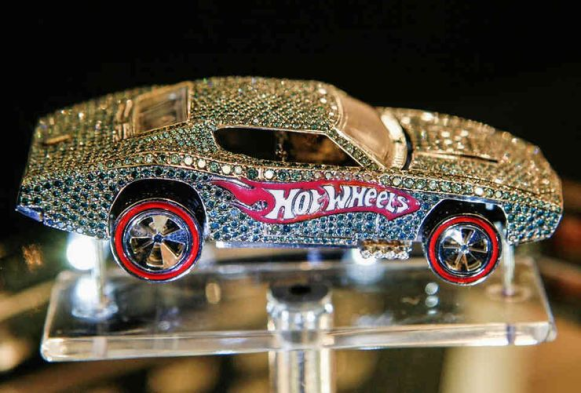
13 They Made A Car Coated In Diamonds
In 2008, Mattel made a big deal of celebrating the 40th anniversary of the Hot Wheels line. As a special reward, Mattel had Jasons of Beverly Hills craft the most expensive Hot Wheels car on the planet.
Cast in 18-karat gold, it’s covered with 2700 diamonds and gems totaling nearly $150,000 today. It’s become a rotating exhibit at toy museums for the glitziest Hot Wheels you could see.
12 The Darth Car Is A Speed Machine
While they do stick to toys, the company has been busy creating some real-sized cars for collectors. One of the most notable is based on Darth Vader, with the hood looking like his fearsome helmet and in jet black.
This isn’t just for show as it’s based on a C5 Corvette with a GM LS3 V-8 engine capable of 526 hp and 150 mph. The Dark Lord of the Sith would be proud of this powerful craft.
11 Every Car Is Tested To Make Sure It Can Run A Track
Almost from the beginning, Hot Wheels car fans had to have a track with the cars. They’ve gone from straight lines to elaborate roller-coaster-like loop systems to leave kids entertained for hours.
What few realize is that the track determines if a car makes it as Mattel prides itself on “every car can fit every track.” More than once, a prototype has to be altered when it won’t fit as the track decides a car’s final form.
10 There Are More Hot Wheels Cars Than Real Cars
While it’s tricky to figure out for sure, most sources agree there are at least one billion cars on the planet (give or take a few hundred thousand in auto graveyards). In contrast, since 1968, six billion Hot Wheels cars have been created.
True, many have been trashed and/or recycled, and it’s impossible to count how many have been lost in backyards. But given how 16 cars are produced every second, it’s no shock the toys outnumber the real deals.
9 Several Creators Are Legit Car Designers
The one constant of Hot Wheels is that the cars look just as good as the real deal. There’s an excellent reason for that as scores of the manufacturers are legitimate car designers. Larry Wood was a veteran of Ford before becoming one of the first Hot Wheels designers.
He’s not alone as Jack Ryan was a rocket designer who crafted the bearings that made the cars so great. Scores of the car designers were in real automobiles first, so it’s no wonder the vehicles look so good.
8 The Original Camaro Is Worth A Fortune
Mint conditions of the Original 16 Hot Wheels releases are all pretty collectible items. But one dominates from the pack. While versions of a Camaro were produced, a few had white enamel paint.
They had been meant to discover flaws in a prototype but accidentally released. A mint version of one went for a hundred thousand dollars and made this one of the most expensive toys on the planet
7 They Released A Custom Corvette Before GM Did
An early standout for the company at a custom Corvette in 1968. What made it notable was that the toy was released before GM had their actual Corvette in car dealerships.
The fact designer Harry Bradley had worked at GM indicates he may have “borrowed” the designs before he left to allow Mattel to beat GM to releasing a Corvette to the masses.
6 The Red Stripes Are Expensive
If you find what looks like an old Hot Wheels car, take a good look at the wheels. If they have red stripes, then you’ve just found a fantastic collector’s item. From 1968 to 1977, designers hand-painted red lines onto the wheels to make the cars look distinctive.
As a cost-cutting measure, they switched to all-black wheels in 1978. Some mint condition red-striped vehicles have been known to go for thousands online.
5 One Of The Original Cars Was Based On A Car With No Doors
The first wave of Hot Wheels was just 16 cars, and any of them can be valuable today. One is notable, the 1965 Dodge Deora. This car boasted no doors but rather a hatch for folks to crawl into.
It was based on a fun design used by Mike and Larry Alexander but in an irony, no real Dodge Deoras were built, to make this a truly unique model
4 A Tie-In Cartoon Got Pulled By The FCC
Today, cartoons based on toy lines are commonplace. But in 1969, Hot Wheels got in trouble when they put out a cartoon series about some teenage car drivers. Despite good messages, the show was hit by complaints about being a “half-hour commercial.”
The FCC agreed, and it was yanked off the air. The company was just ahead of their time with a cartoon tie-in for a hit toy line.
3 There’s A Fight On Where The Name Came From
Much of Hot Wheels is shrouded in myth, and that includes just where the name comes from. The familiar story is that when Eliot Handler saw the first models from designer Fred Adickes, he remarked: “those are some hot wheels you’ve got there.”
Another version is that Handler just blurted the name out in a meeting with a designer. Regardless, it just stuck to become one of the most popular toys on the planet.
2 They’re Number One…Because They Remain So Cheap
In the ranks of the most popular toys on the planet, Hot Wheels dominates. They’re not just the biggest toy vehicle sellers but also the number one selling toy in the entire world. The reason is that in many markets, the cars can still go for only a dollar each.
True, they can be put out in packs, and some nations charging a few bucks more. But many stores do sell the cars for less than a bottle of water, which is the reason they are so dominant.
1 Its Creator Was Married To Barbie’s Creator
Elliott and Ruth Handler were the First Couple of the toy world. The two had founded Mattel as a picture frame company in 1945. While making a dollhouse, Ruth decided to craft a series of dolls she named Barbie.
It was an instant hit to make Mattel a success. Elliott then realized how a toy car line could be great for boys to craft what would become Hot Wheels. The two remained together until Ruth’s death in 2002 (Elliott passed on nine years later) to be icons of their industry.
Both cars retail for about $81,000, but one is a lot more accessible.
SPEED PHENOM ON YOUTUBE
If you’ve got $80,000 to spend and want an American high-performance car, now’s a pretty good time to be in the market. In addition to tire-shredding stalwarts like the Camaro ZL1 and Challenger Hellcat, Ford and Chevy have recently launched high-profile, track-ready sports cars. And thanks to a new video by Speed Phenom, we now know how they directly compare on track.
Naturally, we wanted to do this comparison ourselves. But the GT500 wasn’t ready during our Performance Car of the Year competition when we had an early C8 to test. And now that both cars are on sale, stay-at-home orders and track closures mean we’ll have to wait for an opportunity to do a full R&T comparison.
In the meantime, Speed Phenom does a good job of breaking down how they perform. With the caveat that he’s got a base model GT500 without the optional Pilot Sport Cup 2 tires, he notes that the car struggles for grip more often than the similarly-tired Corvette. It’s also less composed through mid-corner bumps, with slower cornering all around. Thanks to its massive horsepower advantage, though, it jets through straightaways.
The C8, meanwhile, benefits from serious mechanical grip. The better-balanced midship car fires through corners and has no problem putting its power down. That makes it more approachable, not surprising given that it’s the tamest version of the C8 while the GT500 is stretching the limits of the S550 platform. We’re sure to see more track-ready Corvettes soon, but for now the Stingray is a surprisingly capable start.
Kristi Koplin, a pilot on the U.S. bobsled team, posted an emotional message on her Instagram account on Jan. 8, essentially telling the world she might be done with her sport.
The 33-year-old Koplin was hurt, struggling with the pain and injuries from a serious crash during her second-to-last run during a competition in Lake Placid, New York. The crash was so hard, she said, that she blacked out and woke up fearing she’d been paralyzed. Thankfully she wasn’t, but she had terrible bruises all over her body, another concussion and the growing realization that her life may not be building toward the Olympic Winter Games Beijing 2022.
So Koplin came home to Park City, Utah, to heal — physically and emotionally — and head back to work as an urgent care nurse.
She’s been alternating between bobsled and nursing for years, so the switch was normal. But soon the whole world turned upside down, as the COVID-19 pandemic started to spread, and Koplin became part of a team at Intermountain Healthcare testing for the virus at a drive-up clinic in an underground level of a parking garage.
“It’s been intense, because there is so much anxiety right now,” said Koplin, who is also a captain in the Army Reserve. “I try to help the people coming in by being calm, and giving them the knowledge and comfort that we’re here for them. We can figure out what is going on, test them and try to get them the info and the help they need.
“But yeah, it’s been go, go, go for the past couple of weeks, and that’s not going to stop anytime soon since Utah has it pretty bad where I am.”
Koplin is seeing a steady stream of sick people of all ages. The hard part is hearing their stories of fear and illness, as COVID-19 is the main theme of every conversation. She is dressed in full protective gear, making her look more like an astronaut than a caring nurse trying to test or triage — all in a parking lot, no less.
“Your heart breaks when you hear people are running low on inhalers, or they can’t find Mucinex or Tylenol in the store,” she said. “The essentials are running low everywhere and you want to help them, like the mom who can’t find Motrin to help break her daughter’s fever. I really want to help them.”
The COVID-19 virus weighs on Koplin’s mind too, as she lives with her two over-70 parents. She is isolating herself in the basement, trying to avoid bringing anything home from the testing station to her family.
“I understand the anxiety, I go up and down with it too,” she said. “I think my greatest fear would be to expose them — and have them come down with it. That is the scary part, you don’t know if you are carrying it with you. So that is why staying at home is so important for everybody to limit the spread. I can’t stay home, because I am part of the health care system, but I am trying to do my part at home.”
Koplin likely will not be home much longer though, as her reserve unit (Army Reserve 328 Field Hospital) is getting activated and will soon be deployed. She doesn’t know where she will be in the U.S., but she’s eager to help serve the areas in need.
Koplin now sees her early end to the bobsled season as a hidden blessing. She was having a strong season, ranked second overall in the second-tier North American Cup. She had won three gold medals and two silvers. But if she had not crashed and been injured, she would have continued the season until it ended due to the pandemic. Meaning she would have come back to nursing tired and a bit beat up from bobsled.
“I got a chance to rest. I got a chance to heal, and both those things helped me jump into this and deal with the grind,” Koplin said. “I really can see things happened the way the needed to.”
She’s back to working out, thanks to some equipment at her sister’s house, and the time and space from her crash has brought new perspective.
She doesn’t have to make any big decisions about bobsled right now.
“When that injury happened, my immediate thought was, I am done,” she said. “I went through a week of depression after that. Now, I am more like, I don’t want to be done. The Olympics are so close, it’s knocking at the door.
“I feel good, I still have so much passion about doing everything I am doing. So, I am just going to keep going, staying in shape and seeing where life takes me. I can feel it in my soul: this is what I need to be doing right now. I am helping people, and I am getting mobilized. And I am ready.”
Joanne C. Gerstner has covered two Olympic Games and writes regularly for the New York Times and other outlets about sports. She has written for TeamUSA.org since 2009 as a freelance contributor on behalf of Red Line Editorial, Inc.
Some fans complain that race cars don’t have much in common with road vehicles, but that wasn’t a priority in the 1970s. Loose regulations in the period allowed teams to erase nearly all road-car DNA as they searched for greater performance. This 1977 Chevrolet Corvette, dubbed the “SuperVette,” is an example of the era’s excesses.
Offered for sale by noted Porsche 959 restorer Canepa, the SuperVette was built to take advantage of a rule change in IMSA road racing. In 1976, the sanctioning body allowed full tube-frame cars to compete in its top-level series. Corvette racer John Greenwood saw this as an opportunity to build a more competitive car, and teamed up with designer Bob Reilly to make a tube-frame Corvette. This Corvette—COV002—is one of two chassis completed in 1977.
This car has almost nothing in common with a stock 1977 Corvette, which is a good thing because Corvettes offered very little performance at the timie. Underneath the swollen bodywork is a chassis and roll cage made from 2.0-inch chrome-moly tubing. Its bulging hood hides an aluminum 500-cubic-inch big-block V-8, making more than 750 horsepower. It was built by Don Nichols, whose Shadow Racing team competed in Formula 1, Can-Am, and F5000. The engine is harnessed to a Jerico 4-speed manual transmission.
COV002 was bought by John Paul, Sr. for the 1978 season. Paul raced with his son, John Paul, Jr., and both were later convicted for running an illegal marijuana trafficking operation. It was a different time, for sure.
It was the elder Paul who specified the Nichols-built engine, rather than one built by Greenwood. In an effort to reduce drag, the car also got a narrower track and more aerodynamic bodywork than its sibling.
Paul raced the ‘Vette during the 1978 IMSA season in the GTX class, primarily competing against Porsche 935s. The car earned two podiums that year. After that, it was sold but continued to race through the 1982 season. After retirement, the car changed hands a few more times before being bought by Canepa.
The Corvette has been restored to its 1978 racing specifications, and is currently eligible for to compete in vintage racing, according to Canepa. The seller didn’t list a price, but we don’t expect a car with this pedigree to sell cheap.
Not all heroes wear capes – some of them wear masks.
The coronavirus (COVID-19) pandemic has created a critical shortage of face masks across the world, meaning these heroes are on the front lines of the crisis without the protection they need to keep themselves, their families and the people they serve safe.
With the help of engineers, designers, buyers and people in manufacturing, we were able to convert our Warren, Michigan facility to produce masks in less than seven days.
This facility is projected to produce up to 50,000 masks per day, or approximately 1.5 million each month. Below is a behind-the-scenes look at the facility and mask production process.
1. Source raw materials
We worked with automotive suppliers to develop the three layers of fabric in the masks. These companies typically provide GM with sound-deadening insulation found in doors, headliners and trunks, but they quickly altered their production processes to help manufacture these desperately needed masks.
2 Fold, weld, and cut
The custom-made “mask maker” automatically sandwiches the filter material and metal nose piece between an inner and outer layer of fabric. It then folds the pleats, welds the layers together, and cuts each mask accordingly.
3. Cut and attach the ear loops
Employees then cut ear loops from elastic straps and attach them to the mask using sonic welders. Often used in many automotive applications, these sonic welders use ultra-fast vibrations to “melt” the two materials together, without using heat. Ear loops are then checked to ensure size and secure attachment to the mask.
4. Sterilization
Masks are loaded into a sterilization cabinet that is filled with high levels of ozone for 20 minutes to sanitize the masks.
5. Bagging
From there, packages of 10 masks are bagged, sealed and prepped for delivery! While the GM team has identified a process for mass-producing masks in a short amount of time, we are continuously looking for improvements to speed up production. For example, during the first week the team manually labeled and sealed bags in two separate stations; now the team has sourced machines that save significant time by labeling and sealing bags in one station.
With six figures separating their prices, are these mid-engine sports cars even comparable? Yes.
Alexander StoklosaWriterWilliam WalkerPhotographerMar 31, 2020
The new-for-2020 Chevrolet Corvette C8 can seemingly drive on water, its holy combination of exoticism and affordability winning praise and awards across the automotive spectrum. We named it a 2020 Automobile All-Star. Is there nothing the first-ever mid-engine Corvette can’t do?
Curious to test the new Chevy sports car’s limits, we put it up against another mid-engine supercar that we found lying around during our 2020 All-Stars testing: The 2020 Lamborghini Huracan Evo. Absurd? Perhaps. The duo’s base prices are separated by $124,039, and the Italian has a 141-hp advantage (136, if you count the extra five ponies the Corvette’s sports exhaust unlocks), two additional cylinders, and an extra driven axle. Surely, the Huracan will make meatballs out of the Vette, right?
So long as you suspend the obvious observation—that someone shopping for the Huracan definitely wouldn’t step foot in a dealership that also sells white bread stuff like the Equinox and Spark, and no would-be Corvette buyer is cross-shopping a new Lamborghini—this comparison is a lot closer than you might expect. Mostly, that’s because the Corvette punches way above its weight, and not due to any specific deficiency on the Lambo’s part.
Power And Acceleration? Yes.
Both the Corvette and Huracan are powered by naturally aspirated engines. The Chevy uses a 6.2-liter pushrod V-8 engine, an all-American masterpiece producing 490 horsepower and 465 lb-ft of torque in base form. Bump those figures by five each when the optional performance exhaust—fitted to our test car—is selected. That 495 horsepower and 470 lb-ft are sent to the rear wheels via an eight-speed dual-clutch automatic transaxle and an electronic limited-slip differential.
Lamborghini fits the Huracan with a 5.2-liter V-10, which produces 631 horsepower way up at 8,000 rpm (the Vette’s horsepower peak hits at 6,450, and its redline is similarly lower) and 442 lb-ft of torque at a high 6,500 rpm (the Corvette’s torque peak lands at 5,150). A seven-speed dual-clutch automatic transmission distributes engine torque to the front and rear axles via all-wheel drive.
Surprisingly, the Corvette streaks to 60 mph in 2.8 seconds (as tested by our friends at MotorTrend), matching the estimated figure for the Huracan Evo. The European boasts a higher top speed of 202 mph, whereas the Corvette tops out at 184 to 194 mph, depending on equipment. Since there are basically no places in America for owners to probe those speeds, the Lambo’s lead here is negligible. What counts is that the C8 can hang with the Lamborghini in straight-line speed—with less power (but greater torque) and without all-wheel drive. Oh, and for less than a third of the price. Take your pick on which engine sounds better—the Vette’s classic American soundtrack or the Lamborghini’s exotic V-10 wail, but know that the Huracan’s engine power seems to hit harder, likely a consequence of the drama-free all-wheel-drive traction it enjoys.
Handling And Drivability
Chevrolet has long tuned the Corvette for everyday use (well, at least the regular-grade Vettes), and the C8 delivers a downright supple ride. Our test car came with the adaptive suspension, which, left in its default Tour mode, soaked up bumps smoothly and quietly. The Lamborghini is more bucking bull, with a firm, unyielding suspension and a tendency to allow bump impacts to reverberate through the structure and cause cabin booming.
At the track, both mid-engine sports cars are capable, despite their vastly different personalities. The Lamborghini leverages its gobs of mechanical grip, all-wheel drive, and utterly stable-feeling chassis to simply go wherever the driver points the nose. For all the intensity in the V-10’s noise and the driver’s low seating position up near the front axle, the Huracan Evo is remarkably approachable when driven quickly. That isn’t to say it is boring—the experience is visceral, and you can coax the Lambo into giggly oversteer with an aggressive throttle foot, but the experience never feels a hair’s width away from a big, expensive, ego-bruising “oops” moment.
The Corvette also is forgiving when driven hard, though its driver-selectable chassis and powertrain modes seem to afford it greater behavior bandwidth than the Huracan. Flipping the Vette from Tour mode to its Track setting and dialing back the Performance Traction Management (PTM) to its more permissive stability-control thresholds wakes the C8 up considerably, though it also comes with a needlessly heavier (and artificial) steering weighting. Most drivers preferred the quicker-feeling, lighter Sport steering setting.
Details aside, the Corvette can be pushed comfortably to its limits, never delivering any snappiness or edge. The chassis seems tuned to initially dole out moderate understeer near its grip limit, but skilled drivers can easily transition past this safety net with heavier throttle inputs, revealing the Corvette’s balanced setup. Perhaps GM’s chassis-tuning mavens—some of the best in the business—built in the slight push to keep Corvette buyers uninitiated to mid-engine handling behaviors from backing their new C8s into guardrails.
We take greater issue with the Chevy’s brake pedal, which operates with a somewhat spongy weirdness (it artificially shifts its response depending on the drive mode). Never did we feel as if the Vette’s stopping power was in question—only that it was difficult to understand; the Lambo’s stoppers operated more linearly and predictably, with far better feel.
Looks And Prestige
Buying a Lamborghini isn’t solely about taking home an exotic car—you’re buying into a lifestyle, one in which you’ll be stopped often by passers-by looking to snap photos, or challenged to drag race by folks in Dodge Challengers with those stupid yellow lower-bumper pre-delivery protector caps still fitted. Everyone will assume you’re wealthy and eager for attention. But you already knew that. How does the Corvette compare?
Until now, the Vette has been a pretty common thing. General Motors considers it a volume sales model, so previous iterations weren’t rare. And we can’t ignore front-engine Corvettes’ street image as chrome-wheeled, automatic-transmission golf shuttles for old men. Forget all that.
The C8 attracts Lamborghini levels of attention, a phenomenon unlikely to subside no matter how many GM builds. Americans are intimately familiar with the Corvette, less so with this new wedge-shaped, exotic-looking version, so we encountered plenty of curious onlookers in California and especially Michigan with our test vehicles. Just like its performance, the long, pointy 2020 Corvette’s visual wattage zaps well beyond its attainable pricing.
Chevrolet also finally fixed the Corvette’s previously subpar interior, bringing it not merely in line with the sports car’s $60,000 base price, but to some plateau slightly beyond—knowing full well it’ll lose money on the less-expensive models as a result. Porsche’s been doing this for years with the 911, acknowledging that the same basic interior has to be acceptable both in the entry-level model and in those 911 variants costing twice as much. The Corvette’s cabin materials seem downright appropriate at our test car’s $80,000-some list price. Those nicer plastics and leather are stitched and tightly fitted to form truly original shapes and adventurous styling elements, such as the long, thin row of climate controls bifurcating the interior and the squared-off two-spoke steering wheel.
And, so, we end this non sequitur on familiar turf: The Corvette is a screaming deal, delivering the looks and performance of a more expensive vehicle. In the past, that’s been enough to occasionally pick off a Porsche in a head-on comparison—but is it enough to vanquish a Lamborghini? As we mentioned up front, there will be almost no overlap between C8 and Huracan Evo buyers, so the question is basically abstract. Dissociated from reality and buyer prejudice, however, yes, the Corvette rises to the Lamborghini’s occasion while delivering better everyday livability. And, remember, this is the base 2020 Corvette C8. Just wait until Chevy delivers the high-performance Z06, the hybrid, and the rumored 900-hp ZR1 hybrid. What will the Corvette usurp then?
Engineers and technicians set-up and test the machines that will be used to manufacture Level 1 face masks Monday, March 30, 2020 at the General Motors Warren, Michigan manufacturing facility. Production will begin next week and within two weeks ramp up to 50,000 masks per day, with the potential to increase to 100,000 per day. (Photo by John F. Martin for General Motors)
GM today announced manufacturing details around building much-needed medical face masks. According to the company’s press release, it took the company less than seven days to go from nothing to producing the first production-made mask. The automotive giant said today in a released statement it expects to deliver 20,000 masks on April 8 and soon after, able to produce 50,000 masks a day once the production line is at full capacity.
These face masks are a vital piece of personal protective equipment (PPE) used by front-line healthcare staff to protect themselves against the virus-causing droplets that are spread by patients through coughing and sneezing in clinical settings.
GM turned to global partners to create this manufacturing line within a week. The company sourced material from GM’s existing supply chain and acquired manufacturing equipment from JR Automation in Holland, Michigan, and Esys Automation in Auburn Hills, Michigan. As the company’s press release says, GM even created an ISO Class 8-equivalent cleanroom in GM’s Warren manufacturing plant. GM and the UAW will seek two dozen volunteers to staff this new assembly line.
“The first people we called were those who work with fabric vehicle components,” said Karsten Garbe, GM plant director, Global Pre-Production Operations. “In a few days, the company’s seat belt and interior trim experts became experts in manufacturing face masks.”
While this team was creating a face mask assembly line, others within GM were working towards creating ventilators. Last Friday, March 27, President Donald Trump signed a presidential directive ordering GM to produce ventilators and to prioritize federal contracts. This came hours after the automaker announced plans to manufacture the critical medical equipment needed for patients suffering from COVID-19, the disease caused by the coronavirus.
Other automakers joined the fight, as well. Ford and GE Healthcare licensed a ventilator design from Airon Corp and plan to produce as many as 50,000 of them at a Michigan factory by July as part of a broader effort to provide a critical medical device used to treat people with COVID-19. Under this partnership, Ford said it expects to produce 1,500 Airon ventilators by the end of April, 12,00 by the end of May, and 50,000 by July.
Even off the pavement, the new ‘Vette is a rocket ship.
The 2020 C8 Chevy Corvette is a fast car. In base form, it can hit a staggering 194 mph flat-out. Even with the drag-inducing Z51 performance package, the car can still do 184. Hennessey Performance took theirs to 182 mph with ease before they turbocharged it to oblivion. Now, there’s another C8 top-speed run on the internet, and this time, it takes place on a dry lake bed.
Popular YouTube TheStradman took his new Z51-equipped Corvette to a dry lake bed in Utah to test out the top speed of the car. He managed to hit an impressive 173 mph before slowing down—not bad considering the uneven and bumpy surface. It helps that there’s absolutely nothing for miles in either direction. In fact, from inside the cabin, it looks a bit uneventful. Here’s a perspective from outside the car to give you a sense of how fast 173 mph is:
If the base Corvette is this quick right out of the box, we’re curious to see how the upcoming Z06 stacks up. Considering the last-gen car could hit 200 mph, we’re expecting big things.
The International Motor Sports Association (IMSA) today announced schedule updates for three 2020 IMSA WeatherTech SportsCar Championship and IMSA Michelin Pilot Challenge events.
The Acura Sports Car Grand Prix at Mid-Ohio has been moved to the weekend of Sept. 25-27, 2020. It was originally scheduled for the weekend of May 1-3.
The IMSA Monterey SportsCar Championship at WeatherTech Raceway Laguna Seca has been moved up one weekend to run on Sept. 4-6. It was originally scheduled for the weekend of Sept. 11-13. This date adjustment was made to accommodate IMSA competitors planning to participate in the 24 Hours of Le Mans, which now will run on Sept. 19-20.
The 23rdannual Motul Petit Le Mans at Michelin Raceway Road Atlanta has been moved back one week and now will run Oct. 14-17 to provide teams a more balanced schedule as the season comes to its conclusion. The original dates of the event were Oct. 7-10.
These three event date changes are in addition to the previously announced reschedule of the Mobil 1 Twelve Hours of Sebring Presented by Advance Auto Parts, which now is set for Nov. 11-14. Previously purchased tickets for all four events will be valid on the new dates.
IMSA will provide additional series updates, broadcast information and event schedules as they become available.







 SPEED PHENOM ON YOUTUBE


