
This Corvette achieved supercar-rivaling speed without a single drop of gasoline


Several companies are developing electric supercars but, for now, the fastest one of all is a modified Corvette.
Maryland-based Genovation Cars built an electric Corvette called the GXE, and that car just hit 211.8 mph at the Kennedy Space Center in Florida. That’s the same as a Ferrari SF90 Stradale. Genovation claims that is also a world record for a street legal electric supercar, but the company was competing against itself. The GXE set the previous record of 210.2 in September 2019.
The GXE boasts 800 horsepower, which is 45 hp more than the 2019 Corvette ZR1 — the most powerful production Corvette ever. The GXE is also based on the same C7-generation Corvette platform as the ZR1, rather than the mid-engined Corvette C8. However, the GXE is a hair shy of the ZR1’s 212-mph top speed — for now, at least. Genovation claims the electric car is capable of more than 220 mph. It will need that kind of speed to beat an upcoming crop of electric supercars.
Croatian firm Rimac claims its Concept Two will reach 258 mph, while the Japanese Aspark Owl boasts a claimed top speed of 248 mph. Running prototypes of both cars exist, but no customer cars have been built, and their manufacturers’ top-speed claims have not been independently verified. The second-generation Tesla Roadster has a claimed top speed of 250 mph, but the car hasn’t gone into production yet. The same goes for the Lotus Evija, which will surpass 200 mph, according to its maker.
The Bugatti Chiron remains the fastest car in the world, having achieved 304 mph in August 2019. A handful of other automakers are eyeing the 300-mph barrier, but with gasoline rather than electric power. While electric motors can produce absurd amounts of horsepower (of the cars listed above, the GXE is the least powerful), heavy battery packs put electric cars at a disadvantage when it comes to weight.
The GXE isn’t exactly a stripped-down track car, either. It comes with adaptive suspension, a 10-speaker JBL audio system, and 10.4-inch central touchscreen. Genovation plans to build a limited production run of 75 cars, with the first customer deliveries expected in 2020. The company previously quoted a price of $750,000, which could buy you 12 gasoline-powered 2020 Corvettes.
Source; Digital Trends– Stephen Edelstein
Ro leads USA Skeleton with sixth place finish in Koenigssee’s European Cup


KOENIGSSEE, Germany (Dec. 15, 2019)– Mystique Ro (Nokesville, Va.) finished sixth in the women’s skeleton European Cup race in Koenigssee today as the top U.S. finisher. It was Ro’s career-best European Cup finish, besting her former personal record by three places.
“This has been a trip with a lot of new information flooding in every week,” said Ro, who’s never raced on the European tracks before this season. “It’s been challenging, but fun. Koenigssee has definitely been a track that has tested my confidence. I had some rough training runs, so I watched sleds for six-plus hours a day throughout the week. It was nice to see things click at the end of the trip and to end with a solid personal record.”
Ro has a huge advantage at the start, and she gave herself the lead right off the block today with push times of 5.08 and 5.04 seconds. Both runs of 53.86 and 53.31 seconds were sixth best of each heat. Mystique’s total time of 1:47.17 placed her in sixth.
The European Cup took place in conjunction with the Intercontinental Cup, and Ro said she enjoyed having teammates with her who were also learning the foreign tracks for the first time.
“I’m glad I had the support and encouragement of my teammates as a majority were sliding here for the first time and having similar issues,” Ro said. “Matt (Antoine) has been great at keeping us focused and very encouraged throughout training.”
Ro was ninth yesterday with a combined time of 1:49.11. She clocked starts of 5.13 and 5.06 for runs of 54.96 and 54.15 seconds, respectively.
Kristen Hurley (Columbia, Conn.) just missed yesterday’s top-20 cutoff for the second heat with a run of 56.98 seconds, which placed her in 21st. She moved up four spots today to 17th with a total time of 1:50.43 after clocking runs of 55.67 and 54.76.
British competitor Amelia Coltman claimed gold yesterday in 1:46.21. Germans Josefa Schellmoser and Hanna Staub earned silver and bronze with total times of 1:46.83 and 1:47.42, respectively. Endija Terauda from Latvia was today’s winner in 1:45.78. Luisa Hornung from Germany claimed silver in 1:45.94, while Coltman secured bronze in 1:46.46.
Austin McCrary (Colleyville, Texas) was the sole men’s competitor in Koenigssee. He finished 10th yesterday with a combined time of 1:44.78 and 12th today in 1:43.85. McCrary’s best push time over the two days was 4.99 yesterday, and he posted the sixth-best time of yesterday’s second heat to show his potential on the German track.
Please direct media inquiries to the USABS Marketing and Communications Director Amanda Bird at amanda.bird@usabs.com.
Results
Women’s skeleton race #1
1. Amelia Coltman (GBR) 1:46.21 (53.39, 52.82);
2. Josefa Schellmoser (GER) 1:46.83 (53.47, 53.36);
3. Hanna Staub (GER) 1:47.42 (53.85, 53.57);
9. Mystique Ro (USA) 1:49.11 (54.96, 54.15);
21. Kristen Hurley (USA) (56.98, DNS);
Women’s skeleton race #2
1. Endija Terauda (LAT) 1:45.78 (52.93, 52.85);
2. Luisa Hornung (GER) 1:45.94 (53.27, 52.67);
3. Amelia Coltman (GBR) 1:46.46 (53.46, 53.00);
6. Mystique Ro (USA) 1:47.17 (53.86, 53.31);
17. Kristen Hurley (USA) 1:50.43 (55.67, 54.76);
Men’s skeleton race #1
1. Felix Seibel (GER) 1:43.37 (51.77, 51.60);
2. Lukas David Nydegger (GER) 1:43.45 (51.74, 51.71);
3. Krists Netlaus (LAT) 1:43.71 (51.66, 52.05);
10. Austin McCrary (USA) 1:44.78 (52.68, 52.10);
Men’s skeleton race #2
1. Amedeo Bagnis (ITA) 1:42.35 (50.97, 51.38);
2. Cedric Renner (GER) 1:42.48 (51.35, 51.13);
3. Krists Netlaus (LAT) 1:42.50 (51.44, 51.06);
12. Austin McCrary (USA) 1:43.85 (52.02, 51.83);
About USA Bobsled & Skeleton
USA Bobsled & Skeleton (USABS), based in Lake Placid, N.Y., is the national governing body for the sports of bobsled and skeleton in the United States. USABS would like to thank its sponsors, suppliers and contributors for their support: BMW of North America, Under Armour, Kampgrounds of America, BiPro, Boomerang Carnets, Hudl, Tesa Tape, PVS International, Machintek, deBotech and Carpenter. For more information, please visit the USABS website at www.usabs.com.
2020 Chevy Corvette Widebody Rendering Looks Seriously Sinister


The 2020 Chevy Corvette changed the game for the iconic model by putting the engine behind the passenger compartment for the first time. We’re still months away from the C8 Corvette entering public hands, but that hasn’t stopped HugoSilva Designs from imagining a new Corvette with a downright sinister widebody kit that does little to quell the Corvette’s already busy styling.
The trio of renderings shows a lowered and stanced Corvette with the wheels pushed to the corners and new sheet metal to cover them. At the front, there’s an aggressive lower front fascia that hovers inches above the ground. The new front fenders arch over the big wheels tucked underneath. The design probably increases engine and brake cooling.
At the rear, the tires receive new, wider fenders that enhance the car’s already pronounced hips. There appear to be additional vents at the back of the new fenders, likely aiding in cooling. The lower rear fascia is new, while the bumper has carbon fiber accents. The exhaust tips are unique; however, they do maintain the stock car exhaust’s general shape and design. Then there’s the massive rear wing completes the widebody kit. You can see hints of Lotus in the car’s design from certain angles, too, but it’s only a passing resemblance if you squint.


One aspect of the new Corvette that’s flown under the radar since its debut in July is the aftermarket scene. Tuners and the Corvette go back decades, and they’re not abandoning the mid-engine Corvette just because the engine moved. There will be body kits, intake and exhaust systems, and more for the car when it arrives, allowing customers to customize their ride further or increase its performance.
Right now, the automaker is preparing for the new model’s launch and is seeking new employees to help with it. Production for the Corvette is set to begin in February with customer deliveries following. General Motors missed its self-imposed deadline of beginning production by the end of the year due to the UAW contract strike that lasted six weeks.
Source: HugoSilva Designs via CarScoops
World Cup racing resumes in Lake Placid on Friday


World Cup racing resumes in Lake Placid on Friday
LAKE PLACID, N.Y. (Dec. 12, 2019)– The second week of bobsled and skeleton World Cup racing begins tomorrow at the Olympic Sports Complex in Lake Placid. This weekend will feature skeleton races for the women and men, a women’s bobsled competition, and double four-man bobsled races.
The detailed schedule is as follows, with all times listed in EST:
Friday, Dec. 13
10 a.m.: Women’s skeleton heat #1
11:30 a.m.: Women’s skeleton heat #2
2 p.m.: Men’s skeleton heat #1
3:45 p.m.: Men’s skeleton heat #2
Saturday, Dec. 14
10 a.m.: Four-man bobsled heat #1
11:45 a.m.: Four-man bobsled heat #2
2 p.m.: Women’s bobsled heat #1
3:45 p.m.: Women’s bobsled heat #2
Sunday, Dec. 15
10 a.m.: Four-man bobsled heat #1
11:45 a.m.: Four-man bobsled heat #2
Savannah Graybill (Denver, Pa.), Megan Henry (Roxbury, Conn.) and Kendall Wesenberg (Modesto, Calif.) will represent Team USA in the women’s skeleton competition, while Andrew Blaser (Meridian, Idaho), Austin Florian (Southington, Conn.) and Alex Ivanov (Carlisle, Mass.) will compete in the men’s race.
Wesenberg led USA Skeleton last weekend with a sixth place finish, while Florian was the top men’s finisher in 14th. Henry, Blaser, and Ivanov made their World Cup debuts last weekend. The team is eager to medal on home ice before the tour heads to Europe.
Two American sleds are entered into the women’s bobsled race. Three-time Olympic medalist Kaillie Humphries (Carlsbad, Calif.) and Olympic silver medalist Lauren Gibbs (Los Angeles, Calif.) will once again team together. Humphries and Gibbs aim to repeat their gold medal performance from last weekend’s season opening race. Brittany Reinbolt (Searcy, Ark.) and Sylvia Hoffman (Arlington, Texas) narrowly missed the top-six last weekend, and are hungry to podium on Saturday.
Hunter Church (Cadyville, N.Y.) put together two strong fifth place finishes in last weekend’s double two-man races, and the 23-year-old is eager to get back on ice in four-man, which he considers his specialty. Josh Williamson (Lake Mary, Fla.), Jimmy Reed (Garmisch, Germany), and Kyle Wilcox (Tampa, Fla.) will compete with Church in both races.
Codie Bascue (Whitehall, N.Y.) continues to battle back from a hamstring injury sustained during team trials. He will race with Blaine McConnell (Tacoma, Wash.), Adrian Adams (Reidsville, N.C.), and Kris Horn (Pembroke, Mass.) in the first race, and with McConnell, Chris Kinney (Stockbridge, Ga.), and Horn in the second competition.
Geoff Gadbois (Milton, Vt.) is scheduled to race with Chris Avery (San Diego, Calif.), Kinney, and Dakota Lynch (Boise, Idaho) on Saturday, and Avery, Adams, and Lynch on Sunday.
Please contact USABS Marketing & Communications Director Amanda Bird at 518-354-2250, or amanda.bird@usabs.com, with media inquiries. Media interested in attending either weekend of racing can apply for a credential at https://www.whiteface.com/media.
About USA Bobsled & Skeleton
USA Bobsled & Skeleton (USABS), based in Lake Placid, N.Y., is the national governing body for the sports of bobsled and skeleton in the United States. USABS would like to thank its sponsors, suppliers and contributors for their support: BMW of North America, Under Armour, Kampgrounds of America, BiPro, Boomerang Carnets, Hudl, Tesa Tape, PVS International, Ferris Mfg. Corp, Machintek, deBotech and Carpenter. For more information, please visit the USABS website at www.usabs.com.
Ode to the Burnout


Save your letters. we know better.
Thanks to the curiosities of a liberal-arts education, I found myself with a 21-credit workload in my last semester of senior year, one that included a seminar on John Milton’s Paradise Lost. Published in 1667, the epic, 10-volume poem wraps itself around the biblical fall of man, painting a picture of humanity’s temptation from Satan’s view. Our professor argued that, deep down, Milton saw temptation as a kind of litmus test for the soul.
This story originally appeared in the December 2019 issue of Road & Track.
If that’s true, Performance Car of the Year might well be the bar exam for moral fortitude. Spend a week in the world’s most spectacular cars. Visit a beckoning track and some of the country’s best roads. Don’t go weak in the knees at the soprano trill of a 600-hp, twin-turbocharged 3.8-liter McLaren V-8. Try not to think too hard about being one of the first people on the planet to get your hands around the neck of the mid-engine Corvette. Be a good boy. But as John Henry opined, a man ain’t nothing but a man. We were somewhere outside Tahoe when that wide lake of asphalt and six days of sleep deprivation finally got to me. I’d spent the better part of a week pretending to be a professional. But when I found myself alone, in the first mid-engine Corvette, with acres of empty ski-park pavement ahead, no amount of restraint or discipline could stand up to desire. I had found my garden, and the serpent was waiting.
I’m more of a middle-path kind of guy, anyhow.
Burnouts and donuts, juvenile as they may be, are as pure a celebration of the automobile as you’ll find. Sports cars are wrapped up in the quandaries of personal freedom more than any other vehicle on four wheels, in pushing the bounds of legally and socially acceptable behavior. We do the math every time we choose to take the convertible to work instead of the family crossover, when we push a brake zone a little deeper, when we lean on the accelerator while chasing shadows up a mountain. Or when we turn the rear tires to billowing clouds. Modern life is increasingly a series of confined boxes, and a sports car fits in none of them.

A good burnout isn’t entirely frivolous. If you listen, it will tell you a thing or two about the people who put the car together. In this age of eager litigation, some automakers simply deny you your inalienable right to light tires on fire. Doesn’t matter how many systems you shut off, a digital overlord will step in and pull power until you get back to acting like an adult. On a certain level, it makes sense. If you sat down and designed a sports car by bullet point, listing necessary functions on a spreadsheet, a burnout would be last on the list. Apart from drag racing, the act serves no logical function. But it’s such a fundamental question: Who’s in control of this vehicle? You or some attorney in Michigan?
This next-generation Corvette has moved the badge further from its roots than any Vette before. And from the moment I saw it sulking in the California sun, I needed to know if the thing remembered how to be America’s sweetheart. So I switched off everything and leaned into mechanical masochism. Somewhere, Satan smiled. The car performed a perfect pirouette, that pushrod small-block screaming at the sky while the tires went to vapor. A devotional to free will. Automotive enthusiasm’s shit-eating grin.

If God really wanted us to be good all the time, he wouldn’t have planted that apple tree. Or given us rear-wheel drive.
Original Source: Road&Track
Daily Driver 2019 Corvette ZR1 Runs the Quarter Mile in 8 Seconds
With the C8 Corvette on the way, the 2019 Corvette ZR1 has sort of slipped from our collective consciousness, yet every once in a while a video comes along that snaps our focus back to the most powerful Corvette ever made.
It took the tuners over a year to unlock the secrets of the ZR1’s ECU, but thanks to HP Tuners and shops like Houston’s Late Model Racecraft, the true potential of the supercharged LT5 V8 has finally been unleashed.
YouTube channel High Tech Corvette calls this ZR1 one of the fastest in the country right now and we agree as we watch it blast through the quarter-mile in 8.7 seconds at over 155 mph.
With the drag radials on the car, this ZR1 hooks up so well that even removing the rear high wing only saves a few hundredths on the clock.
From High Tech Corvette via YouTube:
Hennessey Performance Offers First Look at Packages to Tune the C8 Corvette Up to 1200 HP


Texas tuning shop Hennessey Performance has shared some initial information and photos today as they begin to detail their plans to tune the 2020 Corvettes with the top package offering a whopping 1200 HP.
The HPE1200 package will feature a specially-built twin-turbo LT2 V8 with upgraded internals including forged aluminum pistons and forged steel connector rods. The HPE1200 Twin Turbo C8 Corvette will also see its factory dual-clutch transmission upgraded and fortified to handle the additional power.
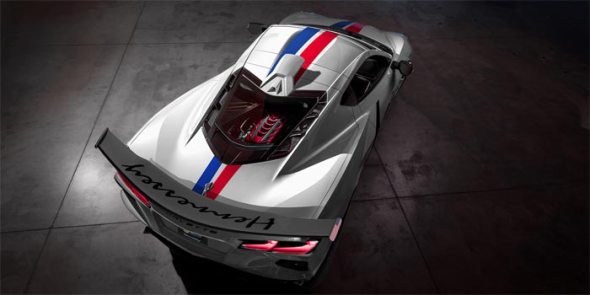
“We expect the new C8 Corvette to be an excellent platform from which our clients can further personalize their cars, which obviously includes adding more power and performance,” said company founder and chief horsepower evangelist, John Hennessey. “Over the past several months we have had hundreds of inquiries from C8 buyers wanting to know what we will be offering for the new Corvette. Thus, we created an online questionnaire and have received over 250 completed forms and getting more every day. The customers are telling us what they want and big surprise – they want more power!”
Not just content to tune the engine, Hennessey’s C8 Corvette packages will also offer its signature “CarbonAero” carbon fiber body upgrades that includes a front splitter, air dam, and a rear carbon fiber wing. HPE will also offer an upgrade to the Brembo brake systems, as well as an upgraded Penske suspension, and wheel/tire upgrades.

Hennessee says a stainless-steel exhaust system upgrade is also in the works as well as a 700-hp supercharger system once the car’s computer can be accessed for tuning.
“We are very excited about the new C8 Corvette and have big plans for it,” said Hennessey. “From mild to wild, we plan to offer a wide variety of track-tested parts and upgrades that come with a warranty. We’ve modified over 500 C7 Corvettes since 2013 and expect to upgrade many more C8 Corvettes starting in 2020!”

Hennessey has a form on their website to gauge customer interest in their HPE packages for the C8 Corvette, so if you’re interested, head over to HennesseyPerformance.com.
Original source Hennessy Performance
The 2020 Chevrolet Corvette is Here! And the BEST C8 Content is at MotorTrend


The 2020 Chevrolet Corvette is one of the most anticipated vehicle reveals of the century so far–are you as excited as we are? For the first time, the production-spec Corvette will be a mid-engine car, opening possibilities to a much higher level of performance than we’ve ever seen from the ‘Vette. But you know all that. You’re here for world-class, comprehensive 2020 Corvette coverage and photos you can only find at MotorTrend.
So be sure to check back frequently, as we’ll be adding Corvette content after the C8’s reveal. Enjoy!
Motor Trend links:
- EXCLUSIVE: C7 vs. C8 Corvette on the Track! Pro Racer Randy Pobst Drives Both (W/Video)
- The Chevrolet Corvette is the 2020 MotorTrend Car of the Year
- 2020 Chevrolet Corvette Pros and Cons Review: Setting a New Standard
- The 2020 Corvette C8 Beats These 10 Amazing Cars in our Figure-Eight Test
- The 2020 Chevrolet Corvette C8 is Faster-Accelerating Than These 10 Pricier Cars (W/Video)
- 2020 Chevrolet Corvette vs. 2020 Porsche 911 Comparison: Two Icons on Equal Footing (W/Video)
- EXCLUSIVE: 2020 Chevrolet Corvette Stingray First Test: The C8 Keeps Its Promises (W/Video)
- Refreshing or Revolting: 2020 Chevrolet Corvette Stingray (W/ Video)
- 2020 Corvette C8.R First Look: Think of it as a Mid-Engine C8 Z06 Teaser
- Exclusive: What Are All Those Buttons in the 2020 Corvette C8? (W/Video)
- Exclusive: Hear and Watch the C8 Corvette Start, Rev, and Launch (W/ Video)
- Exclusive: Testing the C8 Corvette As Seen From the Driver’s Seat (W/ Video)
- Exclusive: 6 Cool 2020 Chevrolet Corvette C8 Easter Eggs (W/Video)
- Exclusive: What Can You Fit in the 2020 Corvette C8? We Find Out! (W/Video)
- How Much Will the 2020 Chevy Corvette C8 Cost to Insure?
- How to Buy One of the First 2020 C8 Corvettes in America
- Corvette vs. Fighter Jet! Racing a ZR1 Against a U.S. Navy F/A-18 Hornet!
- Exclusive: We Drive Mid-Engine Chevrolet Corvette (Historic) Prototypes
- 1967 Shelby GT500 vs 1967 Chevrolet Corvette Sting Ray 427
- 9 Times We Put a Mid-Engine Corvette on the Cover of MotorTrend
- What the Mid-Engine Corvette Must Learn from the C7 Corvette Stingray
- 2014 Chevrolet Corvette Visits Legendary NASA Space Sites
- This Special ‘69 Chevrolet AstroVette is What You Drive to a Saturn V
CORVETTE CONVERTIBLE

- Refreshing or Revolting: 2020 Chevrolet Corvette C8 Coupe vs. Convertible
- Can the 2020 Chevrolet C8 Corvette Convertible Hold as Many Golf Clubs as the Coupe?
- Chevrolet Corvette Convertible: A History in Photos From C1 to C8
- Refreshing or Revolting: 2020 Chevrolet Corvette C8 Convertible
- What are the Differences Between the 2020 Corvette C8 Convertible and Coupe?
- What The Corvette Convertible Can Teach Us About Z06 and ZR1
- 2020 C8 Corvette Convertible: Here’s How We’d Build Ours
- REVEALED: 2020 Chevrolet Corvette C8 Convertible First Official Photos, Info
- Chevrolet Corvette C8 Convertible Gets First-Ever Power Hard Top for 2020
- 2020 Chevrolet Corvette C8 Convertible Price Sees Huge Price Bump
OMG NEW CORVETTE
- Corvette C8 Coupe Tops Out at $106,205—$10K More Than the C7 Z51!
- GM-UAW Strike Further Extends Wait for 2020 C8 Corvette Stingray
- Your Guide to the C8 Corvette’s Digital Gauges (W/Video)
- How to Use Launch Control and Burnout Mode in the C8 Corvette (W/ Video)
- Chevrolet Corvette C8 Convertible Weighs 102 Pounds More Than Coupe
- REVEALED! Mid-Engine 2020 Chevrolet Corvette Stingray Makes 495 Horsepower (W/Video)
- We Ride in a 2020 Chevrolet Corvette Stingray Prototype! (W/Video)
- Supercar Bargain! 2020 Chevrolet Corvette Stingray to Start Below $60,000
- 2020 Chevrolet Corvette Interior Review: What’s Different Inside the C8 (W/Video)
- Can the New 2020 Chevrolet Corvette Really Hold Two Golf Bags? (W/Video)
- Build Your Dream 2020 C8 Mid-Engine Corvette in Chevrolet’s Mobile Showroom (W/Video)
- The 2020 Chevrolet Corvette C8’s Exterior Styling in Detail (W/Video)
- We See You: 2020 Chevrolet Corvette Convertible Peeks Out at Coupe Reveal
- Mid-Engine 2020 Corvette Basics: What You Need to Know
C8 ENGINE AND TECH
- LT2 vs. LT1: 8 Ways the C8 Corvette’s LT2 Engine Bests the C7’s LT1 (W/Video)
- How Much Power Does the 2020 Chevrolet Corvette Really Make? We Take it to the Dyno and Find Out (W/Video)
- C8 Corvette Dyno Test Follow-Up: What Really Happened (W/Video)
- 2020 Chevrolet Corvette C8: 4 Tech Triumphs
- 2020 Chevrolet Corvette: Three Challenges the Mid-Engine Car Presented
- Why Did the 2020 Chevrolet Corvette C8 Move its Engine? (W/Video)
- Take a Tour of the Mid-Engine 2020 Chevrolet Corvette’s Powertrain (W/Video)
FUN STUFF
- Track Test: Will the Chevrolet Corvette Z51 in Track Alignment Erase Understeer?
- How to Launch (JUMP) a 2020 Chevrolet Corvette in 5 Easy Steps
- The Chevrolet C8 Corvette Stingray Is a Loss Leader
- World Series MVP Wins 2020 Chevy Corvette, Has to Wait for His Like the Rest of Us
- 2020 Chevrolet Corvette C8 vs. C8.R: Here’s How the Race Car is Different
- Hear the Corvette C8.R’s Flat-Plane DOHC V-8 Sing for the First Time
- What Do the Corvette Codes Z51, Z06, and ZR1 Mean?
- First Production 2020 Chevrolet C8 Corvette Headed to Auction
- How Does the 2020 C8 Corvette Drive? How Fast is it? Find Out Next Week!
- Watch the 2020 Chevy Corvette Hit 194-MPH Top Speed in New Video
- Source: The C8 Corvette Z06 is Getting a Flat-Plane-Crank Twin-Turbo V-8!
- Surprise! 2020 Chevrolet Corvette C8.R Race Car Debuts at C8 Corvette Convertible Event
- Here’s What the C8 Chevrolet Corvette Z06 Could Look Like
- What the Mid-Engine Corvette Can Learn From the Pontiac Fiero
- 2020 Corvettes at Carlisle 2019 Bring Strong Reactions from 60K Hardcore Fans
- Top 10 Greatest American Cars of All Time
- 8 Mid-Engine Corvettes That Never Made it to Production
- How Chevrolet Corvette Wheel Designs Have Changed, From 1953-1996
- 2019 Genovation GXE Review: A Record-Setting Electric Corvette
- Chevrolet Corvette Photos: Tracking Corvette History In Photos
- A Look Back at the C7 Chevrolet Corvette as We Get Ready to Say Goodbye


Original source: Motor Trend
Most Expensive 2020 Chevy Corvette Convertible Costs $113,955

Configurator with pricing info is up, so we’ve decided to max it out.
We’ve been periodically checking Chevy’s website for the Corvette C8 Convertible configurator ever since it went up at the beginning of October to see if there’s pricing available. You can finally know how much the desired spec is going to set you back as the configurator now has all the pricing details included. Much like we did with the coupe a few weeks ago, we’ve decided to max out the online builder in an attempt to find out how much a fully loaded Stingray Convertible costs.
We’re not going to go through each and every option as we did in the previous post because most of them are identical. It’s worth pointing out the convertible commands a $7,500 premium over the coupe and it starts at $67,495 for the entry-level 1LT. Go for the better-equipped 3LT and the price jumps to $78,945, and then you can add this $995 Long Beach Red Metallic Tintcoat paint and a dual racing stripe also priced at $995.


The most expensive options available for the C8 Convertible are the $5,000 Z51 Performance Package and the $4,850 Grounds Effect Kit, but on top of these, you can also add the $2,095 grille insert and $1,145 side mirror caps both finished in visible carbon fiber. Another pricey option is the $2,695 wheel set measuring 19 inches up front and 20 inches at the rear, with a five-spoke design and a Performance Pewter-painted finish.
If you truly want to go all out with the configurator, Chevy will be more than happy to provide you with a two-piece leather travel bag set for $1,450 as well as indoor and outdoor car covers each priced at $460. Inside, a carbon fiber trim adds $1,500 to the final bill, while the Competition Sport bucket seats are an additional $500.
With all the boxes ticked, you’re going to end up with a 2020 Corvette Stingray Convertible that costs $113,955, plus an additional $110 worth of dealer-installed
As you’re probably aware by now, production of the C8 has been delayed until February 2020, so it’s going to be a long wait to park the new Corvette in your garage.
Hit the source link below to play with the configurator and see if you can beat our price.
Hit the source link below to play with the configurator and see if you can beat our price.
Original source: Adrian Padeanu; Motor1
VKTRY Performance Insoles Embrace Carbon Fiber For Energy Return


If just a touch of carbon fiber can provide benefits for athletes, then VKTRY founder Matt Arciuolo figured engineering a full-length carbon fiber insole had a range of untapped potential. Following nearly a decade of research and development, all sparked by an effort to provide the USA Olympic bobsled team more explosiveness on their starts, Arciuolo patented a carbon fiber footwear insole customizable to provide performance benefits for athletes far beyond the bobsled.
VKTRY, now four years beyond that patent and three years since producing its first commercial insoles, has made inroads in major college and professional sports the country over, gaining backing from LSU’s director of athletic training Jack Marucci, now-retired Lakers trainer Gary Vitti, Red Sox doctor James Creps and a handful of professional athlete endorders.
“Insole inserts are passive devices designed to absorb shock, but they don’t generate energy or return energy to the athlete,” Arciuolo says. “Instead of a passive device, I designed this carbon fiber insole to store energy and return it.”

The process works in four steps, all using the impressive strength-to-weight ratio of carbon fiber. When the heel hits the ground, the VKTRY insole absorbs the shock of the heel strike and returns it like a trampoline, Arciuolo says. When the second phase of an athlete’s gate moves their full body weight over the middle of the insert, the arched design deflects and adds cushioning. “The third phase is where the magic happens,” he says. When athletes pick their heel up to take a step or jump, the carbon fiber stores the energy at the ball of the foot, returning it in the toe-off phase — phase four — “where all the energy stored in the first three phases is returned.” The insole isn’t generating energy on its own, instead using an athlete’s energy and returning it to them for efficiency and explosion.
Using independent studies, including one from Southern Connecticut State University, VKTRY CEO Steve Wasik says science backs that claims, showing the company’s insoles provide over a 9 percent rate of force development, basically explosiveness, than not using the product.
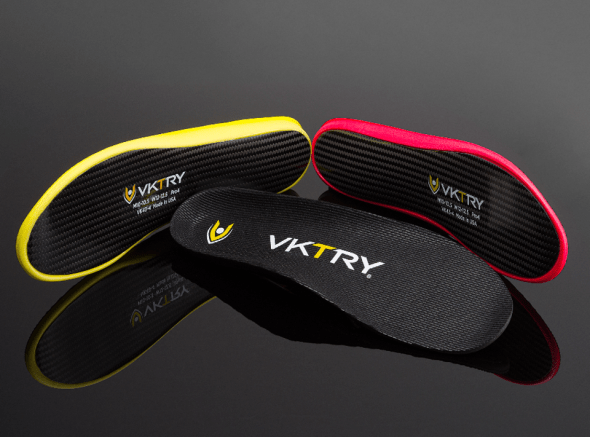
The carbon fiber is engineered with multiple layers of fibers in different lengths, makeups and directions to offer flexibility where needed and stability in other areas.
VKTRY was designed for use across multiple sports — major footwear brands from Nike to Asics have started employing carbon fiber in long-distance running shoes for linear benefits — and Wasik says they’ve seen adoption from football to baseball, but have found basketball and volleyball players especially enjoy the energy return for higher jumping ability and less force upon landing. “We hear some great stories from athletes who have suffered from sore knees or shin splints and the pain is gone,” he says.
The original bobsled design requiring the insole to fit in the tight confines of a spike helped create a product ideal for all athletes, Arciuolo says. “The challenge was not only getting something that worked in terms of propulsion, but also that fit in the shoe,” he says. The carbon fiber portion of the product weighs less than an ounce and is less than a millimeter thick. A proprietary polyurethane top cover provides additional comfort.

VKTRY isn’t a one-size fits all proposition, with Arciuolo calling it a “truly customized product.” It comes in five different “pro levels,” which are basically different flex levels. Lighter athletes with smaller feet require more flex than a 320-pound football player. To get the same propulsion performance, insoles require customization based on sport, weight and foot size, so an algorithm helps find the best flex level for each athlete. The insole is further customized by sport, using different thickness and sizes.
“The VK is the best combination of injury protection and performance I have ever seen in insoles,” Vitti says.
Endorsers of the brand also include Vladimir Guerrero Jr. of the Toronto Blue Jays, Anthony Miller of the Chicago Bears, Josh Norman of the Washington Redskins, Lexie Brown of the Minnesota Lynx, Myles Jones of Chaos Lacrosse Club, George Springer of the Houston Astros, CrossFit world champion Annie Thorisdottir and plenty more.
Creps says that “for the first time, athletes can experience stabilization, shock absorption and propulsion in a device that is specifically tailored to their size and weight. This is a game changer.”
Written by Tim Newcomb; Forbes
C8 Corvette ZR1 Will Get 900-HP, Twin-Turbo, Hybrid V8 Engine: Report


This is the first time that we’ve heard concrete news about a hybrid version of the C8, and their source has confirmed that it is indeed coming very soon. The supposed ZR1 will utilize the engine found in the Z06, a dual-overhead-cam V8 that happens to be flat-plane-crank and twin-turbo; similar to the one found in the C8.R race car. The hybrid system will be completely performance oriented, and will place an electric motor between the engine and transmission to increase output considerably to 900 horsepower. That’s not all, apparently, the C8 Stingray has some space in the front trunk that’s reserved for a pair of front-mounted electric motors that are said to increase performance and apply torque vectoring to aid the rear axle and its electronically controlled limited-slip diff, essentially meaning that the ZR1 will be all-wheel drive.
More Tiny C8 Details:
2020 Corvette Stingray Almost Had A Split Rear Window: Report
Furthermore, their source indicates that the rumor of the 4.2-liter Blackwing V8 engine from Cadillac being shared with Corvette models is false; GM gave Cadillac and Chevrolet the resources to design and develop two different V8s at the same time. The hybrid system also has the consequence of added weight and proper placement to retain performance and a low center of gravity, so your guess is as good as ours as to where Chevrolet plans to mount the entire system.
Corvette Chief Engineer Tadge Juechter is No. 4 on MotorTrend’s Power List for 2020


If you ever doubted the significance of the upcoming mid-engine Corvette, take a look at MotorTrend’s Power List for 2020, a compilation of the 50 most important names in the auto industry.
On the strength of leading the design of MotorTrend’s 2020 Car of the Year, the 2020 Corvette Stingray, Chief Engineer Tadge Juechter, unranked on the 2019 list, zoomed to the No. 4 spot in the 2020 ranking – ahead of two of his bosses, General Motors President Mark Reuss, who came in at No. 28, and GM Chairman and CEO Mary Barra, who ranked No. 6.
Said MotorTrend of Juechter:
“Juechter was able to squeeze the final dollops of power out of the C7 Corvette and then create a whole new beast: the long-awaited C8 with a mid-engine to increase power and performance. Despite all the tech, he engineered an affordable everyman’s supercar: 0 to 60 in 2.8 seconds for $60,000.”
Reuss, who moved up from No. 32 in 2019, earned the following praise from MT:
“Reuss is managing the day-to-day for an automaker as focused on the Corvette and Silverado as the goal to put 1 million electric vehicles on the road annually while developing autonomous vehicles and still making a profit. It means overseeing a leaner company going forward to fund the expensive tech.”
Barra, meanwhile, tumbled from the No. 1 spot in 2019 but still earned serious kudos from the magazine:
“Barra continues to be the tough, shrewd, and strategic leader that GM needs to remain profitable while investing heavily in electric and autonomous vehicles. Her decisive, no-nonsense approach has led to unpopular decisions to discontinue models, stop production, and cut jobs to meet long-term financial goals.”
Another GM leader, Chief Financial Officer Dhivya Suryadevera, was unranked in 2019 but made it to No. 23 for 2020.
MotorTrend says of her:
“In charge of GM’s finance department since 2018, Suryadevara is pivotal in achieving annual cost reductions of $4.5 billion through 2020—ensuring the automaker has the resources for ambitious EV and autonomous vehicle plans while keeping things running during a protracted labor strike.”
At the top of the 2020 list is MotorTrend’s Person of the Year, someone you may never have heard of, Peter Schreyer, President, Head of Design Management, for Hyundai Motor Group.
Writes MotorTrend of its No. 1 pick:
“Schreyer once said he wishes he could be a painter. The MotorTrend 2020 Person of the Year has taken a Korean canvas and created a masterpiece.”
Original source: Mitch Talley, CorvetteBlogger
How the C8 Corvette’s Dual-Clutch Has Changed Since We Drove the Car

The new Corvette has an eight-speed Tremec DCT. We weren’t crazy about it in the pre-production C8 we drove, but engineers tell us the final version will be better.

For the C8 Corvette, Chevrolet abandoned the traditional manual and torque-converter automatic for a new, eight-speed Tremec dual-clutch. And in our Performance Car of the Year testing, the gearbox was the weakest component in the pre-production C8 Stingray we had on hand. It’s part of why the Corvette didn’t win.
In automatic mode, the DCT dolled out nice, snappy shifts, but when using the paddles, it could be clumsy. Too often we found ourselves running into the rev limiter, or having downshifts denied after a paddle pull. But, the C8 we drove wasn’t a finished product. There’s been development work since we drove the car, and that work will continue for the foreseeable future. At a powertrain engineering seminar held by Chevy last week, we asked Glen Hoeflinn, controls program manager for the DCT, what will change from the car we drove.
“Maybe you get some humpy-bumpy shifts here, you get a little bit of that there. That all gets refined out,” Hoeflinn said. “It’s in final refinement, and then it’s in final checks and looking what we’re doing and making sure that it’s behaving exactly [how] we want.”
“That’s what we’ve done since the car that you had. Doing all that refinement and making sure it’s ready to go for everybody across the all the cars.”

A dual-clutch presents unique challenges, no matter what sort of car it’s in. “There’s a lot of pre-selection interaction that goes on in the background,” Hoeflinn said. “It’s the same choreography” between the engine and transmission, he added, but without the “luxury” of a torque converter, there’s a lot more programming work involved.
As you’d expect, the transmission has different automatic shift strategies for the various drive modes, which adapt in real time. The more aggressive, the more spirited you drive, the more aggressive the car’s going to respond,” Hoeflinn said. “As you start to relax, the car’s going to start to relax.”
The DCT uses latitudinal and longitudinal accelerometers, and looks at information like throttle position and steering angle to gauge how the car is being driven, and react accordingly. For example, in Track mode with the transmission set to automatic, the car will downshift aggressively when the driver is braking hard into a corner, and hold upshifts until corner exit.
The C8 has two manual modes. If you pull a paddle while in Drive, you get a temporary manual mode, which automatically times out, or can be exited sooner by holding the upshift paddle. In this mode, the car will automatically upshift at redline. If you press the M button in the center console, you get full manual mode. There’s no time out, and the car won’t upshift at redline.
There are two other neat tricks available for drivers to exploit. First, if you hold the downshift paddle, the DCT will serve up the lowest possible gear. Do that while braking, and the transmission will keep downshifting as engine speed allows. And second, pulling both paddles at the same time is equivalent to pushing in the clutch pedal on a manual car, which allows you to rev the C8’s new V-8 as much as you want.

In the C8, the paddles are directly wired to the transmission control module (TCM) for quicker response times. “In other applications, from the paddle, the wire will go to the body control module and then from the body control module back over to the transmission. You have obvious latency there,” Hoeflinn said.
“It could be 25, 30, 40 milliseconds from the time you pull, to the time that transmission actually got the message. When you wire them directly from the paddle straight to the TCM, we’re getting the message instantaneously.” This doesn’t mean the paddles will give you a downshift that over-revs the engine—the TCM prevents that—it just helps reduce delay.
One of the headline figures of the C8 Corvette is its incredible acceleration. We timed a pre-production Z51 Stingray as hitting 60 mph in 2.8 seconds and running the quarter-mile in 11.2 seconds at 122 mph. With the C8’s Performance Launch mode, the car will actually use the inertia of the engine coming down between revs to propel the car forward. Chevy calls these “Boosted Shifts,” and they’re only used with a Performance Launch. In any other mode, they make the car feel unsettled.
From a mechanical standpoint, this new Tremec transaxle isn’t a radical departure from other DCTs. There are concentric clutches and input shafts for the odd and even gears. The even gears and reverse live near the front of the transmission, while the odds are at the back. A limited slip-differential is integrated within the unit. Base Stingrays get a mechanical diff with a 4.89:1 final drive ratio while Z51-pack cars get an electronic LSD with a 5.17:1 ratio. The overall gear ratio spread of 8.8:1 is the same regardless of differential.

The packaging of the transaxle is such that there’s a common oil sump—filled with 11 liters of Pentosin FFL-4 fluid—for all components. A cooler mounted to the top of the transaxle assembly means there’s no need for additional hydraulic lines, while two filters keep things clean. An externally mounted pressure-side filter requires replacement every 20,000 miles, while the internal suction filter mounted to the sump is a lifetime part.
We asked about why the C8 team didn’t try to do a manual. Hoeflinn and the other engineers present gave us a similar answer to Corvette chief engineer Tadge Juechter, when we interviewed him before the car debuted. They’d need to develop a new manual just for the C8, and considering the stick-shift market is shrinking, it would be an expensive endeavor seemingly without much reward. There are packaging constraints with the Corvette’s central backbone tunnel, too, which would require a hole to accommodate the shifter and gear linkage, hurting structural rigidity. Juechter also said the pedalbox would be cramped with a clutch.
Our first experience with this DCT was less than positive, but this is a gearbox that shows a lot of promise. We look forward to driving the finished product.
Originally written by Chris Perkins; Road&Track
Highlights of the 2019 SEMA Show in Las Vegas

SEMA is the United Nations conference of all things aftermarket, and here’s some of the best stuff we spotted there.

1.Quintin Brothers Dodge Challenger
This 1000-hp Dodge Challenger went on a wild adventure after it arrived in Las Vegas. Vermont-based Quintin Brothers Auto & Performance had their truck and trailer stolen days before the show. Their custom Challenger was inside. Video surveillance helped track down the perp, but when Nevada state trooper Adam Whitmarsh tried to block the stolen Challenger into a parking space, the suspect rammed the Trooper’s Ford Explorer and escaped. After exiting the parking structure, the suspect smashed through a fence and drove the stolen Challenger across a nearby karting track—during a karting event. He eventually ditched the car and was later arrested. The Quintin Brothers and their Dodge Challenger arrived at the SEMA show wearing battle wounds from the wild chase.

2. Chevrolet E-10 Concept
It’s not an engine, it’s a motor. The Chevrolet E-10 concept is a 450-hp electrified C-10 pickup. Typically the only time a 1970s Chevy pickup is plugged into anything, it’s connected to a trickle charger. The E-10 has its batteries in the bed. The two electric motors seen here are called eCrate motors, a nod to the popular Chevy crate engines that can be found swapped into just about anything. GM claims the E-10 can complete a zero-to-60-mph run in about five seconds with a quarter-mile time in the high 13s. A Tesla P100D might be quicker, but it doesn’t look as cool.

3. Vibrant Performance Titanium Chair
Had Game of Thrones producers used Nissan Skylines or Toyota Supras instead of dragons as source material, this might be the Iron Throne. Vibrant Performance didn’t have to vanquish their enemies to build the thing, but they did use more than 50 pieces from their lineup of titanium exhaust products to construct what’s likely the most uncomfortable Adirondack chair on the porch. But it’s fun. Feeling exhausted? Have a seat.

4. Hyundai Veloster Grappler Concept
You’re unlikely to see a Hyundai Veloster on an off-road trail, let alone a dirt road, but this overland concept is out to change that. The Veloster Grappler concept is equipped with typical in-car camping accessories like a rear-hatch tent, solar panels, LED light bars, big all-terrain tires, and a roof basket to carry a spare. It’s still pretty low to the ground, and the tire clearance isn’t ideal for crawling, but it’s a concept. We’d pitch a tent with this thing.

5. Toyota Supra Wasabi Concept
Toyota’s Genuine Accessory Team cooked up a color for this concept that we hope will soon find its way onto a Camry. This Supra’s paint mimics wasabi paste and features white accents on the brake calipers, mirrors, stripes, and spoiler. The forged-aluminum wheels were designed at Toyota and have center caps with the original Toyota emblem. Ohlins coil-overs drop the Supra concept two inches. This was one of many Toyota Supras at the show.

6. AEV Jeep Gladiator
This Jeep Gladiator is equipped with all the proper get-dirty-quick gear. It has tough Bilstein dampers, a lifted suspension, and 37-inch tires. American Expedition Vehicles (AEV) is known for swapping big engines into off-road vehicles and then adding lift kits and other off-road accessories. They’re also responsible for the coolest parts of the Chevy Colorado ZR2 Bison. This year AEV brought three green machines to show off their latest accessories.

7. 1999 Honda Civic Si Super Street Build
Was this the car that sparked the movie The Fast and the Furious in 2001? It sure looks like it. Honda brought a handful of concepts to the show in celebration of its 60th year in North America, and what better way to do it by showcasing the Civic Si Super Street magazine modified for the Civic Si Challenge in 2000. If you collected buckets of Mattel die-cast cars as a kid (or shamelessly as adults, like us), this car might look familiar.

8. Nissan Frontier Desert Runner
The current-gen Nissan Frontier might be 16 years old, but this concept proves that Nissan knows what people at SEMA want in a truck: tons of suspension, awesome off-road tires, some type of light bar, and a 600-hp 5.8-liter V-8. In the meantime, we can only hope one of these ingredients get put to use on the upcoming Frontier refresh.

9. RTR Rambler Ford Ranger Concept
The RTR Rambler Ford Ranger does everything right without going too far. Ford chose 33-inch Nitto Ridge Grappler tires with custom RTR Tech 6 wheels, because they know anything bigger than that will be unnecessary in most cases. Three LED light bars are tastefully tucked into a custom front grille to complete an almost Ranger Raptor–like appearance. A two-inch suspension lift is installed as well as heavy-duty rock sliders, which act as both a step and as extra protection against rocky terrain. It’s a simple package done well, saving the flashy stuff like wild paint for the Insta-campers.

10. 1972 Honda N600
If it looks like this 1972 Honda N600 has a motorcycle engine under the hood, it’s because it does. This oddball is powered by a Honda VFR 800-cc V-4 motorcycle engine that puts power to the rear wheels. Although the car itself predates the era of high-revving VTECs, with the bike motor installed, this is likely the only N600 with a 12,000-rpm redline. This was one of several cars Honda showcased at the SEMA show.

11. Honda Civic Si Drift Car
This is a peek under the hood of a 926-hp Honda Civic Si. The engine is turned longitudinally and transforms a front-wheel-drive coupe into a rear-wheel-drive drift-spec machine. The work was done with help from Jeanneret Racing and Olson Kustom Works.

12. Chevrolet Silverado ZR2 Prototype
We saw this Chevrolet Silverado Desert race truck back in early October, when it competed in the Laughlin Desert Classic, a 17-mile race event in Nevada near the Arizona border. It was there for “engineering development,” but we still think it’s a preview of an upcoming Silverado Z
13. Honda Rally Passport

Honda R&D in Ohio built this rally-ready Honda Passport in their spare time. It has already survived a handful of rally competitions, finishing second in its class at the Southern Ohio Forest Rally. It has had typical safety additions like a roll cage, but other than that it’s unchanged except for tires, brake pads, wheels, and skid plates. Oh, there’s also the addition of a hand-operated hydraulic brake, for epic drift action.

14. 1968 Ford Bronco
There’s been plenty of buzz lately about the upcoming Ford Bronco, which is expected to debut in early 2020. A collaboration between Jay Leno and Ford, this Bronco has a supercharged 5.2-liter V-8 from the Ford Mustang Shelby GT500 and a five-speed manual transmission. The restoration maintained the simple beauty of original Bronco. The 18-inch steel wheels by Detroit Steel Wheels are a great combination of old style and modern needs. The Bronco’s Tonight Blue color would look great on a Mustang or F-150 Raptor.

15. Hyundai Veloster N Performance Concept
The Veloster N is quick, but this Veloster N Performance concept is quicker. Hyundai modified its hot hatch with carbon fiber for the front splitter, side skirts, rear diffuser, and spoiler while adding carbon fiber to each wheel’s center caps. The suspension is made up of Extreme Racing coil-overs and H&R coil springs with aluminum chassis bracing to add rigidity. Orange-accented interior bits stand out among more carbon-fiber pieces and an Alcantara dashboard.
16. SpeedKore Dodge Charger

Routed through the front fender of a 2019 Dodge Charger Pursuit is the exhaust from a 1525-hp Dodge Demon V-8. This project, put together by SpeedKore Performance Group and MagnaFlow, began as a police car. After fitting a carbon-fiber widebody kit, they turned it into something that would outrun police cars. The stock supercharged 6.2-liter V-8 was transformed into a twin-turbo engine and received an upgraded upper intake manifold designed to withstand the 26 psi of boost.
Written by: Austin Irwin, Car&Driver
2020 Corvette Stingray Shown at Spring Mountain’s SEMA Display

Spring Mountain Motor Resort and Country Club, home of the Ron Fellows Performance Driving School, is located less than hour from Las Vegas and they bring a continent of cars and people to the annual SEMA Show at the Las Vegas Convention Center.
Drivers for Ron Fellows School provide hot laps for the attendees which is hella fun if you have ever had the opportunity to catch a ride in one of the ZR1s they have. In addition to the hot laps, Spring Mountain also has booth display at SEMA and featured prominently is the 2020 Corvette Stingray wearing the Ron Fellows Driving School livery.
We asked Spring Mountain’s Todd Crutcher send us some photos of the 2020 Corvette on display as it’s the only place at SEMA outside the Chevrolet display where you catch the C8 Corvette in the flesh.

Chevy had displayed a C8 Corvette with the Ron Fellows door stickers at both the Woodward Dream Cruise and Corvettes at Carlisle, but the car on display at SEMA is much more representative of the Ron Fellows livery that also features the No. 01 car number on the front and back while Michelin stickers are also featured. A windshield banner completes the look.
This C8 Corvette is a Z51 model and 3LT trim package and inside is the two-tone Blue leather interior. The Stingray also shows off the visible carbon fiber roof panel that’s only been spotted a couple of times.

There has yet to be any kind of announcement regarding a driving school for owners of the C8 Corvette at the world-class driving school, but we’ve been told to stay tuned as things are progressing. We do know that a continent of cars will be built for the school and that they will be used as part of the official GM training for dealerships who are selling the new sports cars. While the strike has messed up the original timeline for the school to receive their cars, we expect some sort of announcement will be made in the near future.

If you have purchased a C7 Corvette in the last year, your time is limited to take advantage of the 2-day Corvette Owner’s School that’s heavily subsidized by Chevrolet. To find out more information about the Corvette Owner’s school, visit SpringMountainMotorsports.com or call Melinda or Donna for details 1-800-391-6891. All Corvette enthusiasts are invited!
Spring Mountain / Ron Fellows Driving School
Lake Placid picks up a second weekend of IBSF World Cup races


LAKE PLACID — The state Olympic Regional Development Authority will be hosting the first two International Bobsleigh and Skeleton Federation World Cups this year at Mount Van Hoevenberg, instead of only one as previously planned.
The season-opening BMW IBSF Bobsled & Skeleton World Cup originally scheduled at Park City, Utah from Nov. 25 to Dec. 1 was moved to Lake Placid for the weekend of Dec. 7 and 8, the IBSF announced on Nov. 2. The second World Cup race will be held as planned at the Olympic Sports Complex from Dec. 13 to 15.
“Due to the short time for preparation and in order to guarantee high level quality ice, the schedule for those two World Cup weeks had to be amended,” the IBSF stated in a press release.
There will be two, two two-man bobsled World Cup races held during the first week and two, four-man bobsled races held during the second week. There will also be women’s bobsledding and skeleton racing for men and women. The IBSF had not changed the schedule on its website by press time.
The IBSF cites technical issues with the refrigeration pump system on the Park City track as the reason for the rescheduling.

Pic 2 Bobsledder Codie Bascue rides through Curve 14 at Mount Van Hoevenberg on the men’s first run during the IBSF World Cup in February. (Enterprise file photo — Lou Reuter)
“Though the track management has acted immediately and tried to repair the system, it cannot guarantee that it will be ready by the time of the World Cup,” the IBSF stated. “In order to avoid any risk of not hosting the event it was decided to move it to Lake Placid.”
In its release, IBSF officials thanked Park City track management “for the swift and professional proceeding in this matter,” Jeff Potter at ORDA “for his support in taking over the event” and John Rosen of USA Bobsled & Skeleton “for coordinating the matter.”
“The immediate cooperation between the two track managements of Park City and Lake Placid shows their great commitment for bobsleigh and skeleton sports and we want to thank both Race Organizers,” the IBSF stated.
The Lake Placid races were announced by ORDA Tuesday as part of its winter schedule. After the first two World Cups are done, the circuit heads to Europe for World Cup racing Dec. 30 to Jan. 5 in Winterberg, Germany.
ORDA will host the Viessmann FIL Luge World Cup/BMW Sprint Cup from Nov. 29 to Dec. 1 at Mount Van Hoevenberg, giving Lake Placid three straight weeks of World Cup racing on the American teams’ home track. Both USA Bobsled & Skeleton and USA Luge are based in Lake Placid.
Original source: Andy Flynn, AndirondackDaily
OFFICIAL: The 2020 Corvette Stingray Goes 0-60 MPH in 2.9 Seconds; Runs Quarter Mile in 11.2 @ 121 MPH


Chevrolet today revealed the long-awaited performance figures for the 2020 Corvette Stingray. While the various magazines and websites have been releasing their numbers, we’ve finally gotten the official word straight from Chevrolet.
The 2020 Stingray with the Z51 package will hit 60mph in 2.9 seconds and run the quarter-mile in 11.2 seconds at 121mph. The base Stingray without Z51 performs the 0-60 sprint in 3.0 seconds and covers the quarter-mile in 11.2 seconds but at 123 mph. That’s a whole lot of boogity, boogity, boogity for just $60,000. But why is the base car faster than the Z51 in the 1,320? It’s the same reason the Z51’s top speed is lower than the base car – aerodynamics. All that aero that keeps the car planted in the corners holds it back at high speeds in a straight line.
“The performance of the 2020 Stingray has far exceeded our expectations,” said Alex MacDonald, Chevrolet vehicle performance manager. “Moving more weight over the rear wheels helps us get off the line quicker, but it’s the integration between the powertrain and chassis that really takes the performance to new levels.”

All that performance is the result of harmonization between the 495hp LT2 engine and the 8-speed Tremec DCT. The transmission is built at Tremec’s Wixom, MI facility utilizing components produced Belgium, Mexico, and other locales. The DCT itself is a complex unit that contains the rear differential, final drive unit, its controls system, various sensors, its lubrication system, and the cooling hardware. It’s a combination of all these items in addition to the inherent advantages of mid-engine architecture that allow the C8 to achieve its mighty performance.
“The goal from the beginning was to design a transmission worthy of an exotic supercar that is fun to drive everyday,” said Terri Schulke, GM global chief engineer of transmissions. “We achieved that goal by combining the best attributes of the LT2 and the DCT, and I think the impressive performance numbers speak for themselves.”
We expect to hear more details, including official fuel economy ratings, now through the car’s February start of production.

Chevrolet Confirms
2020 Stingray Quickest in its History
LT2 V-8 engine and dual-clutch
transmission combine for unprecedented performance
DETROIT — Jaws dropped when Chevrolet first announced the 2020 Chevrolet Corvette Stingray coupe would accelerate 0 to 60 mph in less than three seconds with the available Z51 Performance Package. Today, the brand confirms the sportscar with the available Z51 Package can reach 60 mph in 2.9 seconds and cross the quarter-mile mark in 11.2 seconds at 121 mph.
Even without the available Z51 Package, a base Stingray, starting at $59,995 (including destination charges, excluding tax, title, license, and dealer fees), can reach 60 mph in three seconds flat and cross the quarter mile mark in 11.2 seconds at 123 mph. Performance numbers may vary, as different climates, tire conditions and road surfaces may affect results.
“The performance of the 2020 Stingray has far exceeded our expectations,” said Alex MacDonald, Chevrolet vehicle performance manager. “Moving more weight over the rear wheels helps us get off the line quicker, but it’s the integration between the powertrain and chassis that really takes the performance to new levels.”
A full chart of the above performance specs is listed below:

This groundbreaking performance is achieved through a formula of rear weight
bias, tire technology, aerodynamics, chassis tuning and of course, the
powertrain. The 6.2L LT2 Small Block V-8 engine and eight-speed dual-clutch
transmission are in many ways the stars of the show.
Chevy’s Small Block Hits the Gym
The LT2 is the only naturally aspirated V-8 in the segment and is SAE-certified at 495 horsepower (369 kW) and 470 lb.-ft. (637 Nm) of torque when equipped with performance exhaust, making it the most-powerful entry Corvette ever.
“The LT2 is one of our best efforts yet in Corvette’s history of naturally aspirated high-performance Small Block V-8 engines,” said Jordan Lee, GM’s global Chief Engineer of Small Block engines. “This engine is incredibly powerful and responsive. Power is readily available when the driver needs it.”
The standard engine-mounted dry sump oil system boasts three scavenge pumps, which help make this the most track-capable Stingray in history. The LT2’s lubrication system keeps oil in the dry sump tank and out of the engine’s crankcase. It provides exceptional engine performance even at lateral acceleration levels exceeding 1g in all directions. The low profile oil pan is high-pressure die-casted – similar to some of Corvette’s large body structure parts – to reduce mass and is only 3.5 mm thick. The LT2’s pan-mounted oil filter and cooler assembly has cored oil and coolant passages, allowing for a 25 percent increase in cooling capacity over the LT1.
Much of the LT2’s additional power can be attributed to how much better it breathes. The intake system is a low restriction design and incorporates identical 210mm length intake runners and an 87mm throttle body. The performance header exhaust manifolds are also low restriction and feature a stylized four-into-one design with twisted runners to allow for thermal expansion. The camshaft now has 14mm gross lift on the intake and exhaust with an increased duration for both profiles, which helps the combustion system take advantage of the extra flow capacity. The LT2 retains variable valve timing, with 62 crank degrees of cam phasing authority.
The LT2 has a very low-profile oil pan. This allows the engine to be mounted low in the vehicle for a low center of gravity and improves handling and track performance. The DCT’s flywheel dampener was even reduced in diameter to allow for the lower engine position.
Bespoke DCT Puts the Power Down
Chevy’s first eight-speed dual-clutch transmission was designed to do two things – put the LT2’s power down and put a smile on every driver’s face. The bespoke, transaxle transmission was developed with Tremec to provide uninterrupted torque delivery whether setting a new lap record or heading out on a roadtrip.
“The goal from the beginning was to design a transmission worthy of an exotic supercar that is fun to drive everyday,” said Terri Schulke, GM global chief engineer of transmissions. “We achieved that goal by combining the best attributes of the LT2 and the DCT, and I think the impressive performance numbers speak for themselves.”
Engineering decided to use a dual-clutch design because it better supports the Stingray’s new mid-engine architecture and desired performance. The DCT aids vehicle performance with a very low center of gravity, enables desired weight distribution and offers maximum traction under acceleration. It is a highly integrated system, as it houses the differential, final drive, controls system, sensors, lubrication and cooling hardware.
The heart of the DCT uses dual concentric wet clutches that are opened by springs and closed by hydraulic pressure. The two clutches work in tandem for uninterrupted torque delivery as they toggle between gears. A separate lube circuit is used for on-demand clutch cooling to reduce parasitic losses. Holes in the outer housing allow for the wet clutches to operate moist instead of submerged. Gear ratios were engineered to be incredibly low-end biased for maximum acceleration. First gear takes advantage of the additional traction to get off the line quickly and reach 60 mph in 2.9 seconds with the Z51 Performance Package. The Z51’s 11.2 second quarter-mile acceleration is achieved by lightning-fast upshifts and excellent low-end torque. The gear ratios are:

The final drive and differential are integrated for the first time and make for
an incredibly efficient package. A mechanical slip differential is standard on
all 2020 Stingrays. The mLSD has an effective final drive ratio of 4.9:1 and is
intended for straight line acceleration and dynamic handling. An electronic
limited slip differential is offered on the Z51 Performance Package and has an
effective final drive ratio of 5.2:1. It is intended for ultimate control
during track driving and commands more authority than previous generation
eLSDs.
Though they have different purposes, the mLSD and eLSD were engineered together. They share a common ring and pinion gear ratio of 3.55:1. Their ring and pinion gears also use a zero offset spiral bevel as opposed to the typical hypoid arrangement, which allows for a common fluid to be used and benefits overall packaging.

Software Plays Key Role
Beyond hardware, the transmission software controls are really where customers will find the most tangible benefits. Most of these will feel familiar when toggling through varying driver modes:
- Tour: Moves to the background to provide quiet, smooth shifts for optimal ride comfort.
- Sport: Gives drivers altered up and downshifts for more spirited driving.
- Track: Maximizes vehicle performance with aggressive gear selection expected to keep the engine in a peak performance window.
A proprietary algorithm will influence gear selection if the car senses spirited driving. The level of aggressiveness will change with modes, but when sensed, the DCT can downshift early on hard braking, hold gears when lifting off the throttle and alter shifts points with lateral acceleration. All behaviors are intended to increase driving enjoyment and avoid unnecessary shifting.
To achieve peak acceleration numbers on the Stingray, drivers must initiate a performance launch. Once in Track mode, double pressing the traction control button will put the vehicle in Performance Traction Management for Magnetic Ride Control-equipped cars or Competitive driving mode for all others. Once prepared, the driver can then fully depress the brake and accelerator pedal together, and then release the brake pedal once 3,500 RPM are reached. Extensive work went into ensuring the DCT felt like the best of both worlds: the spirited, direct connected feeling of a manual and the premium driving comfort of an automatic. The magnesium steering wheel-mounted paddle shifters give a premium feel when pulled. For the most responsive shifts possible, the shift signal is sent directly to the transmission control module the moment the paddle pull begins. This avoids any communications delay through other modules and allows drivers precise control of their gear selection.
Unique features of the ergonomic paddles are:
- Double paddle declutch – pull both paddles simultaneously to simulate pressing a clutch pedal.
- Temporary manual – simply use either paddle while in Drive, and the vehicle will temporarily switch to manual mode.
- Lowest available gear – hold the downshift paddle and the transmission will shift to the lowest available gear for a quick burst of torque.
The 2020 Chevrolet Corvette Stingray coupe and convertible are available to order at certified Chevrolet dealerships nationwide or on Chevrolet.com.
Source:
Chevrolet.com
2019 Chevrolet Corvette ZR1 Review: Say Goodbye to the Bad Guy


Early-build C8 Corvettes are hard at work, ginning up enthusiasm for the biggest sea change in America’s sports car since the C2 dropped the stick axle. The 2020 Corvette is an extraordinary car that makes extraordinary numbers at an extraordinary price—and we would expect nothing less. But before we rush headlong into the mid-engine era, can we stop and appreciate the outgoing C7 one last time?
Because it seems unfair, really, that the 2019 Corvette ZR1 has already become a thing of history, just another Vette in the model’s long and storied line. This is the culmination of not just the most recent generation of Corvette, but also the entire 66 years of the front-engine paradigm. Certainly, it is the costliest Corvette ever (and the highest-priced vehicle GM currently sells), with our test car ringing the bell at $142,075.


You spend that money for more power than in a regular Stingray—300 horses more. This is not unlike having an extra V-6 Camaro engine bolted to the top of your Corvette’s 6.2-liter V-8. Except the ZR1 actually employs a supercharger, with which the big, bad LT5 can blow even the brick house down, making 755 horsepower and 715 lb-ft of torque. Chevrolet says all that power comes from using both direct injection and good, old-fashioned port injection, a trick that also helps the Silverado return better gas mileage.
At idle the ZR1 rumbles like a seismic event and its rips and crackles at full snort are the sounds of a natural disaster. Hang on and hope that you don’t do anything stupid, like keep your foot in it for too long or try to outsmart its eight-speed automatic. (A seven-speed manual is also available.) Things happen quickly in the ZR1 and there is no chance of running out of car before you run out of road. It may not produce the acceleration numbers of an all-wheel-drive Tesla Model S Performance, but the violence of internal combustion in the Corvette augments its own sensation of speed to produce a far more visceral drive.

Indeed, the ZR1 must rank among the baddest sports cars to ever roll on four tires. In this case, those are sticky Michelin Pilot Sport Cup 2s that owners should probably think about buying in bulk. Yet before the ZR1 was even launched, it was guaranteed to be overshadowed by the C8, just as it would be doomed to share most of its interior bits with the not-aging-so-well C7. Was it really only six years ago that this cabin seemed modern? But Chevy can’t really be blamed for spending money on interior upgrades for the new car rather than throwing good money after bad on this one-and-done special.


Behind the wheel, the view out over the vast hood of the ZR1 is like nothing likely to come again. The tops of its sharp fender creases still call to mind the outrageous C3, but they no longer seem like peaks compared to the mountain range in the center of the hood. The protruding carbon-fiber engine cover stands proud of the hood and is good for at least couple taps up on the power-seat adjuster. If the optional Competition Sport seats are too tight and the Track Performance package too stiff for the comfort of your average Corvette owner, well, those are items you add to your ZR1 when the pursuit of lap times render money no object.

Like its Z06 and Grand Sport siblings, the extra-wide ZR1 makes any road feel narrow, and makes narrow roads seem like goat paths. Thankfully its steering is prescient and immediate, giving the car an astounding athleticism. Talking about things like handling and grip after driving a ZR1 on the street is akin to holding forth on surgical techniques after binge watching Grey’s Anatomy. If the Cessna wing blocking access to the trunk isn’t a strong enough hint that exploring the limits of a ZR1 anywhere that doesn’t require a balaclava and helmet is a bad idea, maybe you’ve just sniffed too much of the ZR1’s resinous off-gassing. That cologne is yet another reminder that even at 218 percent of the price of a base Stingray, the ZR1 is still 100 percent C7.
With first tests of the C8 showing that it’s quicker to 60 miles per hour than the ZR1, the King of Corvettes has already abdicated its throne. It seems sea changes occasionally happen in the blink of an eye.


Originally written by Jeff Sabatini; Automobile
The C8 reviewed: The totally redesigned 2020 Chevy Corvette

It’s drop-dead gorgeous, with a few breaks in tradition

Oh boy, Chevrolet invited out the pitchforks with the reveal of the totally redesigned 2020 Chevrolet Corvette, or as it’s known inside Chevy: the C8. It’s a major leap of faith for those in charge at the bow tie brand. This marks the eighth generation of the iconic 2-seater. From the get-go, the introduction of every generational Corvette has been highly anticipated. So, what makes this launch any different? Well, nearly everything.
The first of two glaring changes is, for the first time since its original launch 67 years ago, the engine is located between the passengers and the rear axle. Yep, the 2020 Corvette is a midengine car. The second huge change is, it will no longer offer a manual transmission. What! That’s right, the only transmission available is an 8-speed dual-clutch automatic. A driver can still manually shift the transmission, but it’s by-wire technology. Also, for the first time, leaf springs won’t be a suspension component. Chevy went with coil springs at each wheel.
Clearly, Chevy has two key goals for the radically updated Corvette: Thrust it into the elite circle of supercars like Acura NSX, Audi R8 and McLaren 570, as well as appeal to a younger audience. In doing so, however, the threat is the loss of Corvette’s traditional owner base. Cue the pitchforks. If early orders already accounting for the first year’s production are any indication, though, Chevy doesn’t have much to fret about.

Forgetting the politics of such a sea change, while ignoring our own knee-jerk predispositions for maintaining Corvette traditions, we found our time behind the wheel to be a real revelation. Checking all the supercar boxes of performance, active suspension, midengine design and stunning exterior styling, the reimagined 2020 Chevrolet Corvette should win the hearts and minds of new generations of Corvette owners. As for the traditionalists, we think what the 8th-gen Corvette brings to the party will win over most of them, as well.
What’s new?
The Corvette is totally redesigned for 2020.
What we like
- The Corvette is totally redesigned for 2020.
- What we like
- Drop-dead gorgeous styling
- Radically improved handling
- A supercar that’s an everyday driver
- Sub 3-second sprint to 60 mph with Z51 package
- A $59,995 starting price
What we don’t
- Stingy cargo space
- Hard-to-appreciate steering-wheel design
- Will probably be in short supply for the first year or more
How much?
$59,995 to $73,040
Fuel economy
Filling the well behind the passengers is an updated version of last year’s LT1 engine. It’s the LT2 that’s a 495-horsepower 6.2-kiter V8 developing 470 lb-ft of peak torque. This is the most hp and torque on any entry-level ‘Vette yet. Chevy made a few changes, mostly to accommodate its amidships placement. One being that the air intake now originates in the rear.

Hustling engine output to the rear wheels is an 8-speed dual-clutch automatic transmission with steering wheel-mounted paddle shifters.
As already mentioned, Chevy is claiming a 0-to-60 mph time of less than three seconds with the $5,000 Z51 package.
No fuel economy government estimates were available as of this writing.
Standard features and options
The 2020 Corvette is available in three trims: 1LT, 2LT and 3LT. When it goes on sale early in 2020, there will also be a convertible version. All prices include the $1,095 factory delivery charge.
The Corvette 1LT ($59,995) comes with Brembo anti-lock brakes with black-painted calipers, a clear engine-compartment cover, 19-in front/20-in rear aluminum wheels, power outboard mirrors with integrated turn signals, LED headlights, a 12-in diagonal color driver information center, dual-zone automatic climate control, Mulan leather seating with perforated inserts, 8-way power-adjustable seats, cruise control, keyless open and start, remote start, a leather-wrapped power tilt-and-telescopic steering wheel, Teen Driver parental controls, an HD backup camera, rear park assist, Bluetooth connectivity, 4G LTE Wi-Fi hot spot capability, OnStar connected services capability, Infotainment 3 Plus System, an 8-in HD color touchscreen, a 10-speaker Bose audio system with HD radio and satellite radio capability.
To the 1LT features the 2LT ($68,390) adds heated/autodimming/power-folding outboard mirrors, a 14-speaker Bose Performance-Series audio system, cargo nets, upgraded 3 Plus infotainment system with navigation, HD front vision camera, a head-up display, a heated steering wheel, an inclination sensor, memory driver/passenger convenience package, power-lumbar and power seat-back bolster front seats, rear cross-traffic alert, blind spot monitoring, antitheft system and wireless charging.
Stepping up to the 3LT ($73,040) adds a custom leather-wrapped interior package, upgraded seats, Napa leather seating with perforated inserts and sueded microfiber-wrapped upper interior trim.
Some features standard on a higher trim are options on lower ones. Several options, though, are across the board, like the performance exhaust, Z51 Package, the body-color dual roof, the carbon fiber roof and the transparent roof panel. There are plenty of customizing touches, too, like different color calipers, seat belts, exterior accents, interior accents and red seating.
Safety
The updated Corvette has the usual safety features like four air bags, stability control, traction control and anti-lock brakes. Also standard across the trims is a backup camera, rear park assist and Teen Driver. Standard on the 2LT and 3LT are blind spot monitoring, rear cross-traffic alert and a front vision camera.
No third party has safety or crash tested the 2020 Corvette.
Behind the wheel
The first thing you notice when climbing into the driver’s seat is the uber-low seating position. Next is the oddly shaped steering wheel that’s more of a rectangle than a circle. This is a driver-centric cabin, surrounding the driver on three sides with controls and switches of one sort or another. Things not directly in front of the driver are canted toward him or her. This is not a cockpit engineered for trips to lover’s lane. You can see and speak with the passenger from the driver’s perch, but anything beyond patting your passenger’s head is another matter entirely. The center tunnel is huge.

Enough about the color of the drapes. We like the options Corvette provides to the driver to make the experience his or her own. There are four driver settings (Tour, Sport, Track and Weather) to dial in performance to suit the current conditions. There’s even another setting for the driver to customize things to personal taste.
At the end of the day, what the Corvette is all about is the driving experience. Thanks to the midengine arrangement, not only is the weight more evenly distributed front and rear, the engine sits lower for a lower center of gravity. The car feels more planted and predictable. You really feel in control. A function of 470 hp and a svelte 3,500 pounds of mass, acceleration is as neck snapping as you want it to be.
Chevy made every effort to make the new Corvette more rigid, which translates into better control and cornering. Whether cruising along the freeway or attacking a few curves, the 2020 Corvette is every inch the supercar Chevrolet hoped it would be. And, we still think it’s the best performance bang for the buck.
Other cars to consider
2020 Acura NSX — Don’t let the fact the NSX has a hybrid powertrain fool you. This is still a performance midengine car with impressive acceleration and excellent handling.
2020 Audi R8 — Even without Tony Stark’s endorsement, the R8 is a terrific car. Enjoying a little more horsepower and torque for 2020, it performs as well as it looks.
2020 Porsche Cayman — Hey, it’s a Porsche . Timeless styling and an available 2.5-liter turbo engine that delivers as much as 365 hp.
Autotrader’s Advice
How can you go wrong picking any combination of Corvette trims and options? Having said that, we’d recommend sticking with the 1LT and adding the Z51 Package. It keeps the price about as low as possible, but provides serious performance.
This story originally ran on Autotrader.com.
This Is What Formula 1 Will Look Like in 2021

Formula 1 is going to see a bunch of changes in 2021. The series is implementing some major shifts to the rules, with new car designs and a budget cap for teams, all with the goal of increasing competition and making races more exciting. For the first time, we’re able to see what the 2021 F1 cars will look like.
Formula 1 revealed the finalized car design at a press conference today, outlining all the new rules and regulations that will go into effect come 2021. The cars will be slightly heavier, and wear 18-inch wheels, which should allow for bigger brakes.

The aerodynamic package is what’s most important, however, because it’ll reduce disruption through the air, allowing for closer battles and more passing opportunities, which should mean more exciting racing. There are major changes to the front and rear wings, as well as the floor of the car. The suspension has been simplified, and wheel-wake control devices have been added to smooth out flow. In August, Formula 1 said this new design will have a 45-percent decrease in airflow disruption.
One thing that isn’t getting a significant update is the powertrain layout—2021 cars will still be using a 1.6-liter hybrid-assisted turbo V-6.


Of course, the car isn’t the only thing that’s been overhauled. The series is standardizing more parts, while restricting how many times certain components can be replaced or upgraded during a race weekend. There’s also a budget cap for every team for how much can spend on performance development, set at $175 million per season. The series says it’s contracted an independent regulator to make sure the spending limit is enforced.
That’s not all. There are changes being made to the race weekend schedule as well, with the pre-race press conference now happening on Friday, right before the first practice session. Furthermore, all teams must run at least two practice sessions per year with drivers who have completed two Grands Prix or fewer. This is done to give new drivers a change to show their worth.
Formula 1 has uploaded a video summarized all of the changes in a video below.
Source: Brian Silvestro, Road&Track