
Garcia: “Big Steps” to Come With Corvette C8.R at Roar


Corvette Racing drivers on anticipation of Roar Before Rolex 24 with new mid-engined C8.R…
Antonio Garcia believes there will be “big steps” to come in the Chevrolet Corvette C8.R’s development as the new-for-2020 mid-engined GT Le Mans class contender makes its public debut in this weekend’s Roar Before the Rolex 24.
The Pratt & Miller-built Corvette, along with Porsche’s 2019-spec 911 RSR, are the two all-new GTE-spec cars set for their first official competitive outings in IMSA WeatherTech SportsCar Championship competition during the three-day mandatory test.
While having already completed private testing at the 3.56-mile oval/road course, Garcia believe every lap will matter in their plan for the weekend.
“There is a lot to discover and develop,” Garcia said. “Usually your starting point is better than what you previously had.
“But this is completely different. We are still in the early stages with this new Corvette.
“There will be big steps for sure.
“I don’t know when we will get to the point where we will start making little steps. We need to run this car and we need to race it to find out where we are against our competition.
“We are concentrating on our own work. Whenever it becomes race time, we will know where we actually are.”
Garcia’s new full-season co-driver Jordan Taylor said they won’t necessarily be concerned about pace at the Roar, which will also set the pit lane and garage allocations through a qualifying session on Sunday morning.
The 28-year-old, who makes the switch from his family’s Wayne Taylor Racing operation, said little things, such as driver changes, will be a focal point as well once they achieve the targeted baseline.
“As many laps as we can get at the Roar and going through the program, getting all the drivers on the same page from a setup point of view and then the little things like pit stops and driver changes will be different than what we’ve had in the past,” he said.
“The car is a little more tricky to get in and out.
“Understanding that muscle memory of the process of getting in and out, where the seatbelts go, where the drinks bottle is, where the air hose goes… those little details that we haven’t refined that were refined with the C7.R are things that will show up in a 24-hour event, so those are things we will need to check off the list at the Roar.”
Gavin: “Very Structured” Plan for Weekend
Team veteran Oliver Gavin, who returns to the No. 4 entry alongside Tommy Milner, said that coming away with achieving 60 or 70 percent of their list will be considered a “big win” over the weekend.
“The team is going to have a very structured plan,” Gavin said. “And that’s one of the things that’s so good about Corvette Racing. We plan our time and fundamentally understand what all we have to work through and the list of things we need to achieve.
“The third drivers will need time in the car. We’ll all have to work through that program and procedure as best we can.
“Certainly we’ll learn a huge amount every time we go on track just with how certain tires work, how the braking package works, the aero setup, weight placement… all kinds of different thoughts that the team will look to work through.
“We know that of that list of 50 things we want to try and achieve, the chances are that if we can come away with 60 or 70 percent of that done, it’s a pretty big win.”
Original Source; John Dagys. Sportscar365
Why the C8 Corvette Stingray Is So Quick

The mid-engine Corvette hits 60 mph in 2.8 seconds. Here’s how.

We could forever debate the philosophical implications of the Chevrolet Corvette’s switch to a mid-engine layout, but when it comes to physics, the repercussions are clear: moving the Corvette’s heaviest component behind the driver has a dramatic effect on the car’s ability to accelerate.
The Z51-package C8 and the outgoing Z51 C7 have similar weight-to-power ratios, yet the new car can sprint to 60 mph almost a second sooner. To understand why, you have to remember that a tire’s grip is related to the mass it carries. To maximize a powerful car’s ability to accelerate, you want weight over the driven wheels—but only enough so that the car can put its power to ground. Once you’ve accelerated and upshifted to a speed where traction isn’t a concern, weight is acceleration’s enemy. The trick to making a powerful car quick, then, isn’t to make it heavy. It’s to manage where the weight lies.

The front-engine, rear-drive C7 had a front-to-rear weight distribution of 49/51 percent—roughly 1750 pounds on its rear tires when the car wasn’t moving. The mid-engine, rear-drive C8 carries less of its mass on the nose—there are 2210 pounds on the rear tires when stationary. That’s 460 pounds more, which means considerably more available traction at the rear wheels.
Because weight shifts rearward under acceleration, that figure only improves as the car gains speed. To take advantage of this additional traction, Corvette engineers fulfilled their God-given purpose: they sent more torque to the rear wheels. Compared with the automatic-transmission C7, the C8’s first gear is a massive 21 percent shorter—the new car’s rear wheels experience a torque increase of more than 20 percent from that change alone. When you factor in the 10 lb-ft bump from the new V-8, the LT2, the C8’s rear wheels receive an additional 1350 lb-ft. No wonder the new Corvette wears 305-section rear rubber in place of the C7’s 285s.
Those gearing changes alone would account for almost half of the C8’s amazing 0-to-60 gap over the old car—a 1.0-second advantage. The rest, of course, is a function of the available traction at the rear tires, the LT2’s 35 additional horsepower, and finally, the dual-clutch transmission. Which can both shift without interrupting power delivery and perform a perfectly violent launch-control clutch dump.
And violent it is. The C8’s peak acceleration is just over 1.0 g, occurring almost a second after launch. That figure dwarfs the C7’s 0.7-g peak. And in case you’re wondering, at those respective peaks, the C8’s rear tires are under 2900 pounds of load, and the C7’s carry only 2150. The same dynamic weight distribution affects braking. Additional weight on the rear of a C7 would even out braking performance—under 1.0 g of deceleration, the car’s front wheels carry 66 percent of the car’s total mass, while the C8’s deal with just 57 percent. This means the braking components up front can be made smaller, and indeed they were. Front rotors shrank from 13.6 to 13.3 inches, and the rears grew, from 13.3 inches to 13.8.
Braking distances didn’t really change relative to the C7, but the C8’s switch to a brake-by-wire setup (there is no direct, physical connection between brake pedal and hydraulic system) carries a number of advantages. GM says the change allows for the deletion of the traditional brake booster and vacuum pump, moves that give more front-trunk space and better sightlines.

Those are certainly benefits, but they’re unlikely to be the real reason for the switch. Consider the by-wire system a tacit admission of a forthcoming hybrid Corvette. (Hybrids and most electric vehicles use blended brake systems that can continually shift braking duties between electric regenerative braking and the conventional friction brakes. The drawback is inconsistent and unusual pedal feel. A by-wire pedal eliminates this.)
Once we start thinking about a hybrid Corvette, the mid-engine layout really starts to pay dividends. Namely, the possible installation of electric motors on the front wheels, to provide all-wheel drive. Another traction path that would not have been possible with a front-mounted engine.
Finally, the mid-engine car’s added rear traction will be a huge benefit to the inevitable high-output internal-combustion variants. Like our C8 test car, the base C7 easily put its power to the ground. Only the supercharged Z06 and ZR1 models had trouble—and the next ones will have less. Add in electric all-wheel drive with torque vectoring across the front axle and it’s clear why the Corvette switched to a mid- engine layout.
Hang tight, my little puppy dogs, because this is going to be one hell of a thrill ride.
MISSING THE MANUAL
There’s only one reason to celebrate the death of the manual transmission in the Corvette: the C7’s seven-speed was geared so long that it sapped the punch out of holeshots. Able to achieve more than 50 mph in first (56 mph on C7s without the Z51 package), the front-engine car’s off-the-line acceleration wasn’t nearly as brisk as its mid-engine successor’s. First gear in the C8’s twin-clutch automatic multiplies torque by an extra 50 percent compared with the old manual—in fact, second is almost as long as the manual’s first. Gearing a manual C8 with ratios similar to those of the dual-clutch would slow the 0–60 sprint by the time it takes to make the two shifts between a standstill and 60. The delta would likely be about half a second.
I don’t know about you, but I’d be fine with a manual-transmission C8 capable of 3.2 to 60. On second thought, there’s no reason to celebrate the death of the Corvette’s manual transmission. Now get off my lawn.
Source; Jason Cammisa- RoadandTrack
Chevy Corvette C8 vs. Ford Mustang Shelby GT500: A Track Comparison


Forget Mustang vs. Camaro. Ford’s Shelby GT500 is ready to challenge Chevrolet’s flagship C8
Mustang vs. Corvette? Go ahead, pinch your thumb and index finger to the bridge of your nose, squint your eyes, and blink hard. When you look again, the words on the page won’t have changed.
Rarely has MotorTrend conducted (or concocted) such a bold comparison. But it’s a mad, mad new world we’re in now. Forget the Blue Oval’s sacrosanct rivalry with Camaro, which had always left the Corvette to chase the elusive, pricier Porsche 911.
Oh sure, the base pony car models will still compete, same as always. But the top-end Mustang GT500 is so excellent it deserves higher-octane competition. The final piece of evidence: The Mustang Shelby GT500 costs more than Chevrolet’s new mid-engine Corvette supercar when similarly equipped. Game on.
The C8 Corvette and Shelby GT500 have stirred up more buzz than anything else that’s come from the Motor City in recent memory. After decades of teases and concepts, the ‘Vette finally slides the engine back in the chassis to join the transaxle aft of the driver’s derriere. And after the extremely successful Shelby GT350, which finished a sharply creased second place in our 2019’s Best Driver’s Car, Ford brought in even heavier artillery with a load more horsepower and torque.
These two contenders offer different kinds of appeal, both inspiring great desire in the high-performance enthusiast world. Both offer capabilities that measure well against far pricier foreigners, without the kind of sacrifices that used to come with the label “Made in America.” Gone (mostly) are the long-muttered utterances about cheap features and fixtures, crude handling, and lack of refinement.
Of course, when you look inside these two cars, there’s an immediate difference. The Corvette is an American interpretation of a mid-six-figure European supercar; the Shelby has nearly the same interior as that rental Mustang convertible at the Hertz counter at LAX—albeit with better seats and some minor brightwork tacked on to disguise its cheesy rotary shift knob and plasticky switchgear. Ford’s interior guys still have some work to do before they can declare their Shelby variants to be world-class premium.

But this is not a comparison test for value shoppers who peruse our Buyer’s Guide, niggling over inches of legroom and warranty coverage.
This is a track test—the literal interpretation of where the rubber meets the road.
The C8 Corvette has come of age—finally, I might add—with a style and behavior that bring to mind a word like “sophistication.” The Corvette’s new shape will sit well with the German and Italian exotica in the valet lot at the country club.
The Shelby GT500 comes from another, more purely American place, the pony car. But since the arrival of the S550 chassis in 2015, the muscular Mustang and its more powerful derivatives have risen above the hot rods of yore, to compare well with European icons.
The ‘Vette excels with exotic appearance, precise and agile handling, and balanced power with a nice rush of strong, smooth, jetlike urge. The Muscle-tang crushes like a bodybuilder with brains. Its huge forward forces do not overwhelm its chassis, as in many of the beloved classics we’ve known before.
The C8 Stingray carries a lithe, striking new shape that will grab attention from a block away. Its lines do a terrific job of conveying more of a sense of value and beauty, yet it’s still imbued with a half-century-plus of genetic identifiers. I predict this car will generate more than a few “Oh, wow!” reactions from the public long after it has gone on sale.
The Mustang is a beefed-up beast with bulging biceps, based on our well-known sporty coupe. It will light up the pony car crowd, certainly. But among the elites, the Shelby’s familiar muscle-bound shape may still result in upturned noses, window-rattling V-8 rumble or not. Where the Mustang scores more points in this contest is in its competence in motion.

At speed, the ‘Vette’s strongest dynamic assets are described in a list of two: first, low polar moment, and second, forward traction. Chevy engineers have created a machine that benefits in exactly the ways it should: more centralized mass and the resulting rearward weight bias.
The Corvette has long been the bad boy of the racetrack, the Bart Simpson of supercars: rude, loud, cheap, unpredictable, and hard to handle, but fast and fun in its own brash way. Now, the Corvette has finally grown up. The C8 Corvette is more sophisticated, capable, and mature.
When the majority of the weight in a chassis is nearer the center of gravity, the car will change direction more eagerly. Formerly carried way up front under those arching fenders, the big engine actually resisted the steering tires as they tried to pull that hunk of metal around to face the apex of a turn. The amidships engine makes the steering feel responsive, more direct, and more precise. It’s less work. The new ‘Vette slices its way into a bend in a most delightful way.
Too much, sometimes—and this is the tricky part of the setup. Quick response can overwork the rear tires and create oversteer. In several high-speed tests, and again here at Virginia International Raceway, we have found some of that in the C8’s track personality. It really will point to the apex entering a corner and sometimes overdo it and end up sideways, with the widely adjustable stability control switch fully off (thank you for providing us with that choice, Chevy).
But when you apply your American V-8 torque, then you find the greatest improvement in driving the American Sports Car: It puts ponies to pavement. The C8 hooks up. Chevy has taken advantage of placing the engine over the rear wheels, and that loading successfully creates forward thrust far better than any Corvette before. The new ‘Vette launches hard from a slow corner or a stoplight/dragstrip. Check out that 0-60 time, beating cars with far higher power ratings and even some with all-wheel drive. That, my friends, is traction.

In fact, the ‘Vette transfers weight rearward so well that it sometimes goes into another kind of slide: understeer. The front loses grip a bit prematurely as a result of the light front loads. What to do? Is it bad? No, but this is a brand-new baby, and there’s still something to be learned. We believe we will see the C8 Corvette improve further as the Chevy team learns more about this all-new mid-engine phenomenon.
In street-tuned mode dashing around VIR, the ‘Vette revealed deliciously instant steering response. It was quick and stable as I carved into a corner, and it revealed snappy trailing-throttle oversteer when I released the brake. Both are clearly influences of the mid-engine low polar moment.
As I accelerated off slow corners, like VIR’s Oak Tree, the C8’s ground-gripping traction rockets the car forward, and it remains well balanced even though it feels like it might wheelie. I found a consistent gradual side slip in third and fourth gears exiting faster sweepers. The C8 has more power oversteer at 80 mph than it does at 40, which is unusual.
The new Corvette’s braking was strong and stable with moderate nose dive. There was some isolation, if not the degree of e-pedal numbness I feared, and the brakes were cooled with some really nice Z51 brake ducts. Last, there was no more float, better suspension damping, but not harsh.

Crawling under the hood, we then adjusted the C8’s suspension to its track settings—which simply comes down to much more negative camber, front and rear. When added to the 8 degrees of caster (the same in Street or Track mode), the Corvette creates camber gain when the wheels are turned, which is especially good for tight turns, and a strong self-centering force for stability and good on-center feel.
High caster will also cross-weight a chassis because the outside wheel swings in an arc upward as the inside wheel swings down. These will both typically work to reduce the understeer that we squawked about in earlier tests.

The effect of the added camber was much improved grip everywhere, reducing but not eliminating traits of midcorner understeer and drop-throttle oversteer and raising speeds with better manners. The basic traits of midcorner understeer and trailing-throttle oversteer were still there, just not as much.
In Track setup, the Corvette’s lap times improved by 2 to 3 seconds with less falloff and better grip on a long run. Tying this all together was an eight-speed dual-clutch transmission that worked quite well at full chat, completing the performance of a much improved product. Far more than deserving of the title, this fresh offering is a 21st century new chapter, with more room to improve. One step back with the engine is a giant leap forward for the Stingray.
The GT500, on the other hand, has sprung from the loins of another highly regarded thoroughbred, the GT350. As such it comes from a known source that has been developed for years. It shows on track, especially.

Whereas the C8 is precise, the GT500 hoons. Toss it around. Grab it by the scruff of the neck. This pony encourages aggression. Its version of refinement manifests in confidence for the driver. And the GT500 works in both standard and Carbon Fiber Track Pack form. It is beautifully balanced on track. The steering stays alive all the way through a corner. Quick turn-ins show no evil twitches. Pouring on the ponies rockets it down the straights, and slides come slow and controllably. Within reason.
There’s that word again: reason. Use it when you squeeze down the Shelby’s accelerator. The supercharged cross-plane Coyote-based V-8 clearly makes all of its advertised 760 horsepower. This is another step into the Brave New World of high technology, and overeagerness with that gas pedal will be rewarded with jail and/or hospital time.

Every one of those ponies made themselves known as the Mustang devoured the long back straight at VIR, touching nearly 170 mph, lap after lap. No power fade here, unlike some other American blown V-8s making similar numbers.
The Coyote belts out a stirring bellow or calms to quiet as a mouse with just a switch of the electronic valves in the dual exhaust, allowing you to decide whether to wake the neighbors.
All that thrust goes through a new Tremec dual-clutch seven-speed that exhibited fine behavior on the street and flat out. Manual shifting during a hot lap is just a distraction, and the GT500’s auto mode rivals Porsche’s PDK (yes, really) and does everything I would do, anyway. It even had the savvy to hold a higher gear in places rather than constantly throw out raucous downshifts.
On straights, there’s a rewarding “over-torque” feature that gives a little extra shove on each shift, like a manual power shift. Yet in corners, I felt the Tremec smooth those out. Impressive. The track program is really dialed in. The Ford team should be proud.
This thrust twists a trick carbon-fiber driveshaft into a Torsen gear-type limited-slip differential—a good choice for a front-engine chassis because it doesn’t lock up much off power. This helps get the GT500 pointed into the turn, and it’s also a non-wear item, unlike the clutch-type diffs.

If the driver remains very responsible with the right pedal, the Shelby is responsive and stable. The MagneRide shock system soaked up the curbs and bumps, but it floated a bit under the loads of pro speeds. Happily, though, when the PS4S tires did break loose, it was mostly a gradual, even enjoyable experience. The GT500 has that magic combination of steering response at the limit: the ability to tighten its line while loaded laterally in the middle of a corner, without losing grip at the back.
The Shelby handles this great grunt very well—even with its traction/stability control fully disengaged. (I don’t recommend this unless you’ve completed several professional driving schools, one of which Ford offers with the purchase of a GT500, or have won Daytona at least once.) It’s an incredible thrill, breathtaking, to lay the pedal to the metal. But it requires skill to handle that thrill.
Stopping this rig were perhaps the largest rotors (16.5 inches) and Brembo calipers I’ve yet to experience. Although the big Shelby could dive deep, deep into the tight corners VIR presents at the culmination of its long straights, it was here I could find my only real complaint: a bit of a long brake pedal, which was a little disconcerting at 170 mph. No fade but some squish. They even bled the brakes for me, yet both test Shelbys felt spongy. This was surprising because I recall complaining that the GT350’s brakes were too strong, requiring only a big toe. Perfect would be somewhere in between
The incredible performance capability of the new Shelby (especially with the Carbon Fiber Track package) moves the Mustang into the supercar realm, it pleases me to claim. Both Shelby models provide such thrills that they represent good value even at these prices—driving with confidence-inspiring and consistent speed that is rare to find at any price.
So, to the numbers: Lap times for the C8 Z51 and the standard GT500 were quite comparable, though achieved in different ways. The Shelby evaporates the straights; the C8 carves the corners.
The Shelby carries the load of your family, so in spite of its fantastic, predictable balance, the Corvette can leave it in the twisties, driven precisely.
Once we tried the GT500 equipped with the Carbon Fiber Track package, however, it was all over for the street ‘Vette. The CFTP Shelby is magic on the racetrack, wearing R-compound Sport Cup 2s, carbon wheels, lower and firmer springs/bars/shocks, a proper wing and hell-yes-they-work aero fitments, and much more. Fire it up, and the Shelby is long gone in a blaze of glory.
So here’s the greatest difference between these fantastical motorcars. Shelby: raging, proficient power. C8 Corvette: precision, potential, and style. The price, similar. The choice, yours. The pleasure, ecstatic.

Source; Randy Pobst: MotorTrend
This Corvette achieved supercar-rivaling speed without a single drop of gasoline


Several companies are developing electric supercars but, for now, the fastest one of all is a modified Corvette.
Maryland-based Genovation Cars built an electric Corvette called the GXE, and that car just hit 211.8 mph at the Kennedy Space Center in Florida. That’s the same as a Ferrari SF90 Stradale. Genovation claims that is also a world record for a street legal electric supercar, but the company was competing against itself. The GXE set the previous record of 210.2 in September 2019.
The GXE boasts 800 horsepower, which is 45 hp more than the 2019 Corvette ZR1 — the most powerful production Corvette ever. The GXE is also based on the same C7-generation Corvette platform as the ZR1, rather than the mid-engined Corvette C8. However, the GXE is a hair shy of the ZR1’s 212-mph top speed — for now, at least. Genovation claims the electric car is capable of more than 220 mph. It will need that kind of speed to beat an upcoming crop of electric supercars.
Croatian firm Rimac claims its Concept Two will reach 258 mph, while the Japanese Aspark Owl boasts a claimed top speed of 248 mph. Running prototypes of both cars exist, but no customer cars have been built, and their manufacturers’ top-speed claims have not been independently verified. The second-generation Tesla Roadster has a claimed top speed of 250 mph, but the car hasn’t gone into production yet. The same goes for the Lotus Evija, which will surpass 200 mph, according to its maker.
The Bugatti Chiron remains the fastest car in the world, having achieved 304 mph in August 2019. A handful of other automakers are eyeing the 300-mph barrier, but with gasoline rather than electric power. While electric motors can produce absurd amounts of horsepower (of the cars listed above, the GXE is the least powerful), heavy battery packs put electric cars at a disadvantage when it comes to weight.
The GXE isn’t exactly a stripped-down track car, either. It comes with adaptive suspension, a 10-speaker JBL audio system, and 10.4-inch central touchscreen. Genovation plans to build a limited production run of 75 cars, with the first customer deliveries expected in 2020. The company previously quoted a price of $750,000, which could buy you 12 gasoline-powered 2020 Corvettes.
Source; Digital Trends– Stephen Edelstein
Hennessey Performance Offers First Look at Packages to Tune the C8 Corvette Up to 1200 HP


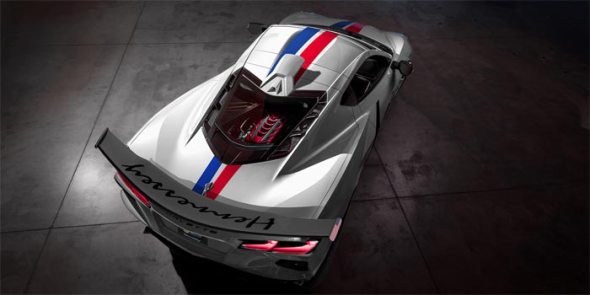
Texas tuning shop Hennessey Performance has shared some initial information and photos today as they begin to detail their plans to tune the 2020 Corvettes with the top package offering a whopping 1200 HP.
The HPE1200 package will feature a specially-built twin-turbo LT2 V8 with upgraded internals including forged aluminum pistons and forged steel connector rods. The HPE1200 Twin Turbo C8 Corvette will also see its factory dual-clutch transmission upgraded and fortified to handle the additional power.
“We expect the new C8 Corvette to be an excellent platform from which our clients can further personalize their cars, which obviously includes adding more power and performance,” said company founder and chief horsepower evangelist, John Hennessey. “Over the past several months we have had hundreds of inquiries from C8 buyers wanting to know what we will be offering for the new Corvette. Thus, we created an online questionnaire and have received over 250 completed forms and getting more every day. The customers are telling us what they want and big surprise – they want more power!”
Not just content to tune the engine, Hennessey’s C8 Corvette packages will also offer its signature “CarbonAero” carbon fiber body upgrades that includes a front splitter, air dam, and a rear carbon fiber wing. HPE will also offer an upgrade to the Brembo brake systems, as well as an upgraded Penske suspension, and wheel/tire upgrades.

Hennessee says a stainless-steel exhaust system upgrade is also in the works as well as a 700-hp supercharger system once the car’s computer can be accessed for tuning.
“We are very excited about the new C8 Corvette and have big plans for it,” said Hennessey. “From mild to wild, we plan to offer a wide variety of track-tested parts and upgrades that come with a warranty. We’ve modified over 500 C7 Corvettes since 2013 and expect to upgrade many more C8 Corvettes starting in 2020!”

Hennessey has a form on their website to gauge customer interest in their HPE packages for the C8 Corvette, so if you’re interested, head over to HennesseyPerformance.com.
Original source Hennessy Performance
The 2020 Chevrolet Corvette is Here! And the BEST C8 Content is at MotorTrend


The 2020 Chevrolet Corvette is one of the most anticipated vehicle reveals of the century so far–are you as excited as we are? For the first time, the production-spec Corvette will be a mid-engine car, opening possibilities to a much higher level of performance than we’ve ever seen from the ‘Vette. But you know all that. You’re here for world-class, comprehensive 2020 Corvette coverage and photos you can only find at MotorTrend.
So be sure to check back frequently, as we’ll be adding Corvette content after the C8’s reveal. Enjoy!
Motor Trend links:
- EXCLUSIVE: C7 vs. C8 Corvette on the Track! Pro Racer Randy Pobst Drives Both (W/Video)
- The Chevrolet Corvette is the 2020 MotorTrend Car of the Year
- 2020 Chevrolet Corvette Pros and Cons Review: Setting a New Standard
- The 2020 Corvette C8 Beats These 10 Amazing Cars in our Figure-Eight Test
- The 2020 Chevrolet Corvette C8 is Faster-Accelerating Than These 10 Pricier Cars (W/Video)
- 2020 Chevrolet Corvette vs. 2020 Porsche 911 Comparison: Two Icons on Equal Footing (W/Video)
- EXCLUSIVE: 2020 Chevrolet Corvette Stingray First Test: The C8 Keeps Its Promises (W/Video)
- Refreshing or Revolting: 2020 Chevrolet Corvette Stingray (W/ Video)
- 2020 Corvette C8.R First Look: Think of it as a Mid-Engine C8 Z06 Teaser
- Exclusive: What Are All Those Buttons in the 2020 Corvette C8? (W/Video)
- Exclusive: Hear and Watch the C8 Corvette Start, Rev, and Launch (W/ Video)
- Exclusive: Testing the C8 Corvette As Seen From the Driver’s Seat (W/ Video)
- Exclusive: 6 Cool 2020 Chevrolet Corvette C8 Easter Eggs (W/Video)
- Exclusive: What Can You Fit in the 2020 Corvette C8? We Find Out! (W/Video)
- How Much Will the 2020 Chevy Corvette C8 Cost to Insure?
- How to Buy One of the First 2020 C8 Corvettes in America
- Corvette vs. Fighter Jet! Racing a ZR1 Against a U.S. Navy F/A-18 Hornet!
- Exclusive: We Drive Mid-Engine Chevrolet Corvette (Historic) Prototypes
- 1967 Shelby GT500 vs 1967 Chevrolet Corvette Sting Ray 427
- 9 Times We Put a Mid-Engine Corvette on the Cover of MotorTrend
- What the Mid-Engine Corvette Must Learn from the C7 Corvette Stingray
- 2014 Chevrolet Corvette Visits Legendary NASA Space Sites
- This Special ‘69 Chevrolet AstroVette is What You Drive to a Saturn V
CORVETTE CONVERTIBLE

- Refreshing or Revolting: 2020 Chevrolet Corvette C8 Coupe vs. Convertible
- Can the 2020 Chevrolet C8 Corvette Convertible Hold as Many Golf Clubs as the Coupe?
- Chevrolet Corvette Convertible: A History in Photos From C1 to C8
- Refreshing or Revolting: 2020 Chevrolet Corvette C8 Convertible
- What are the Differences Between the 2020 Corvette C8 Convertible and Coupe?
- What The Corvette Convertible Can Teach Us About Z06 and ZR1
- 2020 C8 Corvette Convertible: Here’s How We’d Build Ours
- REVEALED: 2020 Chevrolet Corvette C8 Convertible First Official Photos, Info
- Chevrolet Corvette C8 Convertible Gets First-Ever Power Hard Top for 2020
- 2020 Chevrolet Corvette C8 Convertible Price Sees Huge Price Bump
OMG NEW CORVETTE
- Corvette C8 Coupe Tops Out at $106,205—$10K More Than the C7 Z51!
- GM-UAW Strike Further Extends Wait for 2020 C8 Corvette Stingray
- Your Guide to the C8 Corvette’s Digital Gauges (W/Video)
- How to Use Launch Control and Burnout Mode in the C8 Corvette (W/ Video)
- Chevrolet Corvette C8 Convertible Weighs 102 Pounds More Than Coupe
- REVEALED! Mid-Engine 2020 Chevrolet Corvette Stingray Makes 495 Horsepower (W/Video)
- We Ride in a 2020 Chevrolet Corvette Stingray Prototype! (W/Video)
- Supercar Bargain! 2020 Chevrolet Corvette Stingray to Start Below $60,000
- 2020 Chevrolet Corvette Interior Review: What’s Different Inside the C8 (W/Video)
- Can the New 2020 Chevrolet Corvette Really Hold Two Golf Bags? (W/Video)
- Build Your Dream 2020 C8 Mid-Engine Corvette in Chevrolet’s Mobile Showroom (W/Video)
- The 2020 Chevrolet Corvette C8’s Exterior Styling in Detail (W/Video)
- We See You: 2020 Chevrolet Corvette Convertible Peeks Out at Coupe Reveal
- Mid-Engine 2020 Corvette Basics: What You Need to Know
C8 ENGINE AND TECH
- LT2 vs. LT1: 8 Ways the C8 Corvette’s LT2 Engine Bests the C7’s LT1 (W/Video)
- How Much Power Does the 2020 Chevrolet Corvette Really Make? We Take it to the Dyno and Find Out (W/Video)
- C8 Corvette Dyno Test Follow-Up: What Really Happened (W/Video)
- 2020 Chevrolet Corvette C8: 4 Tech Triumphs
- 2020 Chevrolet Corvette: Three Challenges the Mid-Engine Car Presented
- Why Did the 2020 Chevrolet Corvette C8 Move its Engine? (W/Video)
- Take a Tour of the Mid-Engine 2020 Chevrolet Corvette’s Powertrain (W/Video)
FUN STUFF
- Track Test: Will the Chevrolet Corvette Z51 in Track Alignment Erase Understeer?
- How to Launch (JUMP) a 2020 Chevrolet Corvette in 5 Easy Steps
- The Chevrolet C8 Corvette Stingray Is a Loss Leader
- World Series MVP Wins 2020 Chevy Corvette, Has to Wait for His Like the Rest of Us
- 2020 Chevrolet Corvette C8 vs. C8.R: Here’s How the Race Car is Different
- Hear the Corvette C8.R’s Flat-Plane DOHC V-8 Sing for the First Time
- What Do the Corvette Codes Z51, Z06, and ZR1 Mean?
- First Production 2020 Chevrolet C8 Corvette Headed to Auction
- How Does the 2020 C8 Corvette Drive? How Fast is it? Find Out Next Week!
- Watch the 2020 Chevy Corvette Hit 194-MPH Top Speed in New Video
- Source: The C8 Corvette Z06 is Getting a Flat-Plane-Crank Twin-Turbo V-8!
- Surprise! 2020 Chevrolet Corvette C8.R Race Car Debuts at C8 Corvette Convertible Event
- Here’s What the C8 Chevrolet Corvette Z06 Could Look Like
- What the Mid-Engine Corvette Can Learn From the Pontiac Fiero
- 2020 Corvettes at Carlisle 2019 Bring Strong Reactions from 60K Hardcore Fans
- Top 10 Greatest American Cars of All Time
- 8 Mid-Engine Corvettes That Never Made it to Production
- How Chevrolet Corvette Wheel Designs Have Changed, From 1953-1996
- 2019 Genovation GXE Review: A Record-Setting Electric Corvette
- Chevrolet Corvette Photos: Tracking Corvette History In Photos
- A Look Back at the C7 Chevrolet Corvette as We Get Ready to Say Goodbye


Original source: Motor Trend
2020 Corvette Stingray Convertible in Shadow Gray on Display at GM’s Detroit Headquarters


Photo Credit: Kevlar Bike- Corvette Forum
Inside General Motors’ headquarters known as the Renaissance Center in downtown Detroit is a large turntable that is currently featuring all eight generations of the Chevrolet Corvette. The new eighth-generation iteration of America’s Favorite Sports Car is a 2020 Corvette Stingray Convertible painted in Shadow Gray Metallic.
A Youtuber named portcarlingboats captured a minute of video as the new C8 Convertible spins by him on the turntable.
The visible cues on this Corvette show that it’s a non-Z51 model but it’s loaded with some great looking options that include the two-tone Natural and Black seats, Spectra Gray Trident Wheels and red brake calipers. We also prefer the bright Corvette emblems to the the darker versions on this exterior.
From portcarlingboats via YouTube:
Corvette C8 convertible on display at the GM Headquarters in Detroit Michigan on Sat Nov 23 2019; part of 8 generations of corvette convertibles on a rotating display from 1953 to today; C8 supercar, exotic car, european sports car; this is the car that will change the automotive for years to come; can’t wait for the all electric version to come- No sound
On his original post on the Corvette Forum, Kevlar Bike tells us he is Canadian and that the C8 Corvette on display inside the GM’s HQ is the closest C8 Corvette on display so he made the trip to check it out.
Shadow Gray is one of those colors that change drasticly when viewed in the direct sunlight and the lightings inside the RenCen does nothing to show-off the varying hues within. As a comparision, here is a quick walkaround of a Shadow Gray Metallic C8 at the NCM earlier this year from CorvetteBlogger contributor Jeremy Welborn:
Source:YouTube via MidEngineCorvetteForum.com