
Blaser leads USA Skeleton in fifth career World Cup


IGLS, Austria (Jan. 17, 2020)– Andrew Blaser (Meridian, Idaho) led the U.S. in this morning’s men’s skeleton World Cup in Igls with an 18th place finish. It was the first time Blaser has raced in Igls. Austin Florian (Southington, Conn.) and Alex Ivanov (Carlisle, Mass.) finished 26th and 28th, respectively.
This is Blaser’s World Cup debut season, and his first time racing the European tracks. Today was the fifth World Cup race of Blaser’s career, and the first time he’s qualified for the second heat. Blaser was the only North American to make the top 20 today.
“We knew it was going to be a development year for me,” Blaser said. “It was my first time in La Plagne (France), my first time in Winterberg (Germany), my first time here– I’m getting those first runs under my belt this season. It was overwhelming at first, but it’s exciting and things are starting to come together over time.”
The Igls track favors fast starters, which gave Blaser a boost today. He posted a first run start time of 5.01 seconds, which was 10th best of the field, and raced to the finish in 53.27 seconds for 19th place to qualify for the second heat. Only the top 20 athletes after the first heat are granted a second run.
“I was elated,” Blaser said.
He nearly matched his first run start time in heat two with a push of 5.02, and moved up a spot with a downtime of 53.05 seconds. Blaser finished 18th with a combined time of 1:46.32.
When USA Skeleton Head Coach Tuffy Latour handed Blaser the phone for this interview, his first reaction was, “Did my mom get Tuffy’s number?”
“This is all new to me,” Blaser said.
Latvian Martins Dukurs was today’s winner in 1:44.50. Reigning Olympic champion Sungbin Yun of Korea was a distant 0.42 seconds behind in second place with a total time of 1:44.92. Russia’s Alexander Tretiakov claimed the bronze medal in 1:44.94.
Florian and Ivanov both missed the top 20 cutoff for the second heat. Florian clocked the 22nd best start time of 5.11, and slid to the finish in 53.63 seconds for 26th. Ivanov was 28th fastest off the start with a push time of 5.17, and he maintained 28th place at the finish with a downtime of 53.74.
The women’s skeleton race is up next at 2 p.m. local time. NBC Sports and Olympic Channel will have broadcast and digital streaming coverage of the Igls races. Fans can catch all the action in spectacular high definition via NBC Sports online at NBCSports.com/Live, or through the NBC Sports app. Additional coverage will be available on OlympicChannel.com and the Olympic Channel app.
Please contact USABS Marketing & Communications Director Amanda Bird at 518-354-2250, or amanda.bird@usabs.com, with media inquiries.
Results
1. Martins Dukurs (LAT) 1:44.50 (52.34, 52.16);
2. Sungbin Yun (KOR) 1:44.92 (52.66, 52.26);
3. Alexander Tretiakov (RUS) 1:44.94 (52.53, 52.41);
18. Andrew Blaser (USA) 1:46.32 (53.27, 53.05);
26. Austin Florian (USA) (53.63, DNS);
28. Alex Ivanov (USA) (53.74, DNS):
About USA Bobsled & Skeleton
USA Bobsled & Skeleton (USABS), based in Lake Placid, N.Y., is the national governing body for the sports of bobsled and skeleton in the United States. USABS would like to thank its sponsors, suppliers and contributors for their support: BMW of North America, Under Armour, Omaze, Kampgrounds of America, BiPro, Boomerang Carnets, Hudl, Tesa Tape, PVS International, Ferris Mfg. Corp, Machintek, deBotech and Carpenter.
Ro leads USA Skeleton in North American Cup finale with two gold medals


LAKE PLACID, N.Y. (Jan. 7, 2020)– USA Skeleton athletes captured two spots in the top-three North American Cup standings, and collected five medals in the Lake Placid finale this week. Mystique Ro (Nokesville, Va.) led the way for the women’s team with two gold medals and wrapped up her season ranked third overall. Chris Strup (Defiance, Ohio) concluded a successful North American Cup tour ranked second overall in the men’s field, and secured two silver medals in Lake Placid. Daniel Barefoot (Johnstown, Pa.) earned the fifth medal this week for USA Skeleton by claiming silver in today’s finale.
Two single-heat races were held yesterday, and a two-heat race concluded the skeleton North American Cup season today.
Ro struggled in yesterday’s opening heat, finishing sixth with a run of 55.96 seconds. She said one-heat races are tough because you have “one shot, so you have to make it count.”
“Once that was in the books, I had to scrap it and move on,” Ro said.
Kellie Delka of Puerto Rico won with a run of 55.50 seconds. Yuxi Li from China claimed silver with a time of 55.52, and Korean Eunji Kim was third with a downtime of 55.60. Ro was the highest U.S. finisher in sixth.
Ro rebounded in yesterday’s second one-heat race, posting the fastest run of 55.69 seconds to capture her first victory of the week by 0.01 seconds over Kim. Canadian Jaclyn Laberge earned bronze in 55.82.
In today’s two-heat competition, Ro was in third position after a first heat time of 56.03 seconds. She made up nearly half a second to overtake the lead with a second run of 55.83, earning another gold medal with a combined time of 1:51.86.
“The second win is a great feeling,” Ro said. “I tried to play it safe during my first run, but I made some mistakes. I talked to Matt (Antoine) between heats and made the adjustment before I went down for my final run. I think this was crucial for me to learn that I can be confident in my training and in the knowledge I have gained to be able to put two runs together in competition. The support of my teammates and coaches has been great. I’m excited to continue training and see how we all progress.”
Laberge finished second to Ro with an aggregate time of 1:52.06, followed by Kim in third with a total time of 1:52.18.
Ro’s Lake Placid performances helped her secure third place overall in North American Cup points, despite missing three of the eight races this season while racing the European Cup. Kim claimed the title with 373 points. Nicole Rocha Silveira from Brazil finished second overall with 301 points, while Ro was close behind in third with 290 points.
Lauren McDonald (Fairfield, N.J.) had strong performances in her first-career competitive season. The up-and-coming competitor finished 12th and eighth yesterday, and 12th again today. McDonald and Ro are two of the fastest starters on the tour. McDonald pushed a start time of 5.32 seconds yesterday, and Ro pushed a 5.33. McDonald finished the season ranked fourth with 287 points.
Michelle Toukan (Central City, Neb.) placed 19th and 10th yesterday, and wrapped up her season with an impressive sixth place finish today. She is ranked fifth overall with 271 points. Emily Schelberg (Annapolis, Md.) was 18th and 14th yesterday, and she did not finish today’s competition after a crash in the first heat.
In the men’s field, Strup cracked into the top-six in the final stop season, earning two silver medals and a fourth-place finish. Strup claimed double silver medals in yesterday’s single-heat races. His first silver medal was earned with a run of 53.89 seconds. Wenhao Chen from China was victorious in 53.52, while Ander Mirambell from Spain was third in 54.15 seconds.
Strup claimed silver again in yesterday’s second competition with a downtime of 54.33 seconds. Wenhao was golden in 53.73, and Zilong Zhu from China earned bronze in 54.37.
Strup narrowly missed the medals today, finishing a mere one-hundredth of a second from bronze with a combined time of 1:49.04 for fourth place. Strup finished the season ranked second overall with 346 points.
Barefoot was today’s men’s medalist for the U.S. The Intercontinental Cup competitor posted the fastest run of 53.98 seconds in the first heat, and fell back by just 0.06 seconds in the second heat to finish with the silver medal. Wenhao swept the men’s races. He won today with a combined time of 1:48.24, followed by Barefoot with a 1:48.30, and Zilong in third with a cumulative time of 1:49.03.
“I knew that I’ve had enough runs here to win, but I would have to be at my best,” Barefoot said. “I think that self-inflicted pressure caused some unnecessary tension, but I’m glad to have experienced that and learned how to handle it. Just a couple big mistakes spoiled my runs for races six and seven, so I was pretty happy to clean them up a bit and dip into the 53’s on an overall slower day in race eight. I’m most excited about how much our team is improving overall. Everyone is making significant progress and walking with a little confidence their steps! It’s pretty cool to be around.”
Mirambell claimed the overall title with 370 points. Strup was second, and Nathan Crumpton from American Somoa finished third with 345 points.
Barefoot was fourth and fifth yesterday, and he finished the North American Cup season ranked seventh overall. He spent most of his time racing the Intercontinental Cup, thus missed points from three North American Cup races.
Kyler Sultemeier (Fredericksburg, Texas) concluded his first competitive season ranked 14th. He finished 12th in both of yesterday’s races, and 10th today. Hunter Williams (Carnegie, Pa.) also finished his first racing season. Williams finished 17th, 14th, and 17th, and is ranked 21st.
The North American Cup will officially conclude tomorrow with three four-man bobsled competitions in Lake Placid. Please contact USABS Marketing & Communications Director Amanda Bird at 518-354-2250, or amanda.bird@usabs.com, with media inquiries.
Results
Women’s skeleton race #1
1. Kellie Delka (PUR) 55.50;
2. Yuxi Li (CHN) 55.52;
3. Eunji Kim (KOR) 55.60;
6. Mystique Ro (USA) 55.96;
12. Lauren McDonald (USA) 56.93;
18. Emily Schelberg (USA) 57.65;
19. Michelle Toukan (USA) 59.13;
Women’s skeleton race #2
1. Mystique Ro (USA) 55.69;
2. Eunji Kim (KOR) 55.70;
3. Jaclyn Laberge (CAN) 55.82;
8. Lauren McDonald (USA) 56.59;
10. Michelle Toukan (USA) 56.78;
14. Emily Schelberg (USA) 57.42;
Women’s skeleton race #3
1. Mystique Ro (USA) 1:51.86 (56.03, 55.83);
2. Jaclyn Laberge (CAN) 1:52.06 (55.78, 56.28);
3. Eunji Kim (KOR) 1:52.18 (55.90, 56.28);
6. Michelle Toukan (USA) 1:53.43 (56.56, 56.87);
12. Lauren McDonald (USA) 1:54.49 (56.80, 57.69);
Emily Shelberg (USA) (DNF)
Men’s skeleton race #1
1.Wenhao Chen (CHN) 53.52;
2. Chris Strup (USA) 53.89;
3. Ander Mirambell (ESP) 54.15;
4. Daniel Barefoot (USA) 54.21;
12. Kyler Sultemeier (USA) 55.32;
17. Hunter Williams (USA) 55.95;
Men’s skeleton race #2
1.Wenhao Chen (CHN) 53.73;
2. Chris Strup (USA) 54.33;
3. Zilong Zhu (CHN) 54.37;
5. Daniel Barefoot (USA) 54.62;
12. Kyler Sultemeier (USA) 55.95;
14. Hunter Williams (USA) 56.30;
Men’s skeleton race #3
1.Wenhao Chen (CHN) 1:48.24 (54.17, 54.07);
2. Daniel Barefoot (USA) 1:48.30 (53.98, 54.32);
3. Zilong Zhu (CHN) 1:49.03 (54.67, 54.36);
4. Chris Strup (USA) 1:49.04 (54.40, 54.64);
10. Kyler Sultemeier (USA) 1:51.21 (55.60, 55.61);
15. Hunter Williams (USA) 1:52.46 (56.25, 56.21);
About USA Bobsled & Skeleton
USA Bobsled & Skeleton (USABS), based in Lake Placid, N.Y., is the national governing body for the sports of bobsled and skeleton in the United States. USABS would like to thank its sponsors, suppliers and contributors for their support: BMW of North America, Under Armour, Omaze, Kampgrounds of America, BiPro, Boomerang Carnets, Hudl, Tesa Tape, PVS International, Ferris Mfg. Corp, Machintek, deBotech and Carpenter. For more information, please visit the USABS website at www.usabs.com.
Ro leads USA Skeleton with sixth place finish in Koenigssee’s European Cup


KOENIGSSEE, Germany (Dec. 15, 2019)– Mystique Ro (Nokesville, Va.) finished sixth in the women’s skeleton European Cup race in Koenigssee today as the top U.S. finisher. It was Ro’s career-best European Cup finish, besting her former personal record by three places.
“This has been a trip with a lot of new information flooding in every week,” said Ro, who’s never raced on the European tracks before this season. “It’s been challenging, but fun. Koenigssee has definitely been a track that has tested my confidence. I had some rough training runs, so I watched sleds for six-plus hours a day throughout the week. It was nice to see things click at the end of the trip and to end with a solid personal record.”
Ro has a huge advantage at the start, and she gave herself the lead right off the block today with push times of 5.08 and 5.04 seconds. Both runs of 53.86 and 53.31 seconds were sixth best of each heat. Mystique’s total time of 1:47.17 placed her in sixth.
The European Cup took place in conjunction with the Intercontinental Cup, and Ro said she enjoyed having teammates with her who were also learning the foreign tracks for the first time.
“I’m glad I had the support and encouragement of my teammates as a majority were sliding here for the first time and having similar issues,” Ro said. “Matt (Antoine) has been great at keeping us focused and very encouraged throughout training.”
Ro was ninth yesterday with a combined time of 1:49.11. She clocked starts of 5.13 and 5.06 for runs of 54.96 and 54.15 seconds, respectively.
Kristen Hurley (Columbia, Conn.) just missed yesterday’s top-20 cutoff for the second heat with a run of 56.98 seconds, which placed her in 21st. She moved up four spots today to 17th with a total time of 1:50.43 after clocking runs of 55.67 and 54.76.
British competitor Amelia Coltman claimed gold yesterday in 1:46.21. Germans Josefa Schellmoser and Hanna Staub earned silver and bronze with total times of 1:46.83 and 1:47.42, respectively. Endija Terauda from Latvia was today’s winner in 1:45.78. Luisa Hornung from Germany claimed silver in 1:45.94, while Coltman secured bronze in 1:46.46.
Austin McCrary (Colleyville, Texas) was the sole men’s competitor in Koenigssee. He finished 10th yesterday with a combined time of 1:44.78 and 12th today in 1:43.85. McCrary’s best push time over the two days was 4.99 yesterday, and he posted the sixth-best time of yesterday’s second heat to show his potential on the German track.
Please direct media inquiries to the USABS Marketing and Communications Director Amanda Bird at amanda.bird@usabs.com.
Results
Women’s skeleton race #1
1. Amelia Coltman (GBR) 1:46.21 (53.39, 52.82);
2. Josefa Schellmoser (GER) 1:46.83 (53.47, 53.36);
3. Hanna Staub (GER) 1:47.42 (53.85, 53.57);
9. Mystique Ro (USA) 1:49.11 (54.96, 54.15);
21. Kristen Hurley (USA) (56.98, DNS);
Women’s skeleton race #2
1. Endija Terauda (LAT) 1:45.78 (52.93, 52.85);
2. Luisa Hornung (GER) 1:45.94 (53.27, 52.67);
3. Amelia Coltman (GBR) 1:46.46 (53.46, 53.00);
6. Mystique Ro (USA) 1:47.17 (53.86, 53.31);
17. Kristen Hurley (USA) 1:50.43 (55.67, 54.76);
Men’s skeleton race #1
1. Felix Seibel (GER) 1:43.37 (51.77, 51.60);
2. Lukas David Nydegger (GER) 1:43.45 (51.74, 51.71);
3. Krists Netlaus (LAT) 1:43.71 (51.66, 52.05);
10. Austin McCrary (USA) 1:44.78 (52.68, 52.10);
Men’s skeleton race #2
1. Amedeo Bagnis (ITA) 1:42.35 (50.97, 51.38);
2. Cedric Renner (GER) 1:42.48 (51.35, 51.13);
3. Krists Netlaus (LAT) 1:42.50 (51.44, 51.06);
12. Austin McCrary (USA) 1:43.85 (52.02, 51.83);
About USA Bobsled & Skeleton
USA Bobsled & Skeleton (USABS), based in Lake Placid, N.Y., is the national governing body for the sports of bobsled and skeleton in the United States. USABS would like to thank its sponsors, suppliers and contributors for their support: BMW of North America, Under Armour, Kampgrounds of America, BiPro, Boomerang Carnets, Hudl, Tesa Tape, PVS International, Machintek, deBotech and Carpenter. For more information, please visit the USABS website at www.usabs.com.
World Cup racing resumes in Lake Placid on Friday


World Cup racing resumes in Lake Placid on Friday
LAKE PLACID, N.Y. (Dec. 12, 2019)– The second week of bobsled and skeleton World Cup racing begins tomorrow at the Olympic Sports Complex in Lake Placid. This weekend will feature skeleton races for the women and men, a women’s bobsled competition, and double four-man bobsled races.
The detailed schedule is as follows, with all times listed in EST:
Friday, Dec. 13
10 a.m.: Women’s skeleton heat #1
11:30 a.m.: Women’s skeleton heat #2
2 p.m.: Men’s skeleton heat #1
3:45 p.m.: Men’s skeleton heat #2
Saturday, Dec. 14
10 a.m.: Four-man bobsled heat #1
11:45 a.m.: Four-man bobsled heat #2
2 p.m.: Women’s bobsled heat #1
3:45 p.m.: Women’s bobsled heat #2
Sunday, Dec. 15
10 a.m.: Four-man bobsled heat #1
11:45 a.m.: Four-man bobsled heat #2
Savannah Graybill (Denver, Pa.), Megan Henry (Roxbury, Conn.) and Kendall Wesenberg (Modesto, Calif.) will represent Team USA in the women’s skeleton competition, while Andrew Blaser (Meridian, Idaho), Austin Florian (Southington, Conn.) and Alex Ivanov (Carlisle, Mass.) will compete in the men’s race.
Wesenberg led USA Skeleton last weekend with a sixth place finish, while Florian was the top men’s finisher in 14th. Henry, Blaser, and Ivanov made their World Cup debuts last weekend. The team is eager to medal on home ice before the tour heads to Europe.
Two American sleds are entered into the women’s bobsled race. Three-time Olympic medalist Kaillie Humphries (Carlsbad, Calif.) and Olympic silver medalist Lauren Gibbs (Los Angeles, Calif.) will once again team together. Humphries and Gibbs aim to repeat their gold medal performance from last weekend’s season opening race. Brittany Reinbolt (Searcy, Ark.) and Sylvia Hoffman (Arlington, Texas) narrowly missed the top-six last weekend, and are hungry to podium on Saturday.
Hunter Church (Cadyville, N.Y.) put together two strong fifth place finishes in last weekend’s double two-man races, and the 23-year-old is eager to get back on ice in four-man, which he considers his specialty. Josh Williamson (Lake Mary, Fla.), Jimmy Reed (Garmisch, Germany), and Kyle Wilcox (Tampa, Fla.) will compete with Church in both races.
Codie Bascue (Whitehall, N.Y.) continues to battle back from a hamstring injury sustained during team trials. He will race with Blaine McConnell (Tacoma, Wash.), Adrian Adams (Reidsville, N.C.), and Kris Horn (Pembroke, Mass.) in the first race, and with McConnell, Chris Kinney (Stockbridge, Ga.), and Horn in the second competition.
Geoff Gadbois (Milton, Vt.) is scheduled to race with Chris Avery (San Diego, Calif.), Kinney, and Dakota Lynch (Boise, Idaho) on Saturday, and Avery, Adams, and Lynch on Sunday.
Please contact USABS Marketing & Communications Director Amanda Bird at 518-354-2250, or amanda.bird@usabs.com, with media inquiries. Media interested in attending either weekend of racing can apply for a credential at https://www.whiteface.com/media.
About USA Bobsled & Skeleton
USA Bobsled & Skeleton (USABS), based in Lake Placid, N.Y., is the national governing body for the sports of bobsled and skeleton in the United States. USABS would like to thank its sponsors, suppliers and contributors for their support: BMW of North America, Under Armour, Kampgrounds of America, BiPro, Boomerang Carnets, Hudl, Tesa Tape, PVS International, Ferris Mfg. Corp, Machintek, deBotech and Carpenter. For more information, please visit the USABS website at www.usabs.com.
2020 Corvette Stingray Convertible in Shadow Gray on Display at GM’s Detroit Headquarters


Photo Credit: Kevlar Bike- Corvette Forum
Inside General Motors’ headquarters known as the Renaissance Center in downtown Detroit is a large turntable that is currently featuring all eight generations of the Chevrolet Corvette. The new eighth-generation iteration of America’s Favorite Sports Car is a 2020 Corvette Stingray Convertible painted in Shadow Gray Metallic.
A Youtuber named portcarlingboats captured a minute of video as the new C8 Convertible spins by him on the turntable.
The visible cues on this Corvette show that it’s a non-Z51 model but it’s loaded with some great looking options that include the two-tone Natural and Black seats, Spectra Gray Trident Wheels and red brake calipers. We also prefer the bright Corvette emblems to the the darker versions on this exterior.
From portcarlingboats via YouTube:
Corvette C8 convertible on display at the GM Headquarters in Detroit Michigan on Sat Nov 23 2019; part of 8 generations of corvette convertibles on a rotating display from 1953 to today; C8 supercar, exotic car, european sports car; this is the car that will change the automotive for years to come; can’t wait for the all electric version to come- No sound
On his original post on the Corvette Forum, Kevlar Bike tells us he is Canadian and that the C8 Corvette on display inside the GM’s HQ is the closest C8 Corvette on display so he made the trip to check it out.
Shadow Gray is one of those colors that change drasticly when viewed in the direct sunlight and the lightings inside the RenCen does nothing to show-off the varying hues within. As a comparision, here is a quick walkaround of a Shadow Gray Metallic C8 at the NCM earlier this year from CorvetteBlogger contributor Jeremy Welborn:
Source:YouTube via MidEngineCorvetteForum.com
Most Expensive 2020 Chevy Corvette Convertible Costs $113,955

Configurator with pricing info is up, so we’ve decided to max it out.
We’ve been periodically checking Chevy’s website for the Corvette C8 Convertible configurator ever since it went up at the beginning of October to see if there’s pricing available. You can finally know how much the desired spec is going to set you back as the configurator now has all the pricing details included. Much like we did with the coupe a few weeks ago, we’ve decided to max out the online builder in an attempt to find out how much a fully loaded Stingray Convertible costs.
We’re not going to go through each and every option as we did in the previous post because most of them are identical. It’s worth pointing out the convertible commands a $7,500 premium over the coupe and it starts at $67,495 for the entry-level 1LT. Go for the better-equipped 3LT and the price jumps to $78,945, and then you can add this $995 Long Beach Red Metallic Tintcoat paint and a dual racing stripe also priced at $995.


The most expensive options available for the C8 Convertible are the $5,000 Z51 Performance Package and the $4,850 Grounds Effect Kit, but on top of these, you can also add the $2,095 grille insert and $1,145 side mirror caps both finished in visible carbon fiber. Another pricey option is the $2,695 wheel set measuring 19 inches up front and 20 inches at the rear, with a five-spoke design and a Performance Pewter-painted finish.
If you truly want to go all out with the configurator, Chevy will be more than happy to provide you with a two-piece leather travel bag set for $1,450 as well as indoor and outdoor car covers each priced at $460. Inside, a carbon fiber trim adds $1,500 to the final bill, while the Competition Sport bucket seats are an additional $500.
With all the boxes ticked, you’re going to end up with a 2020 Corvette Stingray Convertible that costs $113,955, plus an additional $110 worth of dealer-installed
As you’re probably aware by now, production of the C8 has been delayed until February 2020, so it’s going to be a long wait to park the new Corvette in your garage.
Hit the source link below to play with the configurator and see if you can beat our price.
Hit the source link below to play with the configurator and see if you can beat our price.
Original source: Adrian Padeanu; Motor1
VKTRY Performance Insoles Embrace Carbon Fiber For Energy Return


If just a touch of carbon fiber can provide benefits for athletes, then VKTRY founder Matt Arciuolo figured engineering a full-length carbon fiber insole had a range of untapped potential. Following nearly a decade of research and development, all sparked by an effort to provide the USA Olympic bobsled team more explosiveness on their starts, Arciuolo patented a carbon fiber footwear insole customizable to provide performance benefits for athletes far beyond the bobsled.
VKTRY, now four years beyond that patent and three years since producing its first commercial insoles, has made inroads in major college and professional sports the country over, gaining backing from LSU’s director of athletic training Jack Marucci, now-retired Lakers trainer Gary Vitti, Red Sox doctor James Creps and a handful of professional athlete endorders.
“Insole inserts are passive devices designed to absorb shock, but they don’t generate energy or return energy to the athlete,” Arciuolo says. “Instead of a passive device, I designed this carbon fiber insole to store energy and return it.”

The process works in four steps, all using the impressive strength-to-weight ratio of carbon fiber. When the heel hits the ground, the VKTRY insole absorbs the shock of the heel strike and returns it like a trampoline, Arciuolo says. When the second phase of an athlete’s gate moves their full body weight over the middle of the insert, the arched design deflects and adds cushioning. “The third phase is where the magic happens,” he says. When athletes pick their heel up to take a step or jump, the carbon fiber stores the energy at the ball of the foot, returning it in the toe-off phase — phase four — “where all the energy stored in the first three phases is returned.” The insole isn’t generating energy on its own, instead using an athlete’s energy and returning it to them for efficiency and explosion.
Using independent studies, including one from Southern Connecticut State University, VKTRY CEO Steve Wasik says science backs that claims, showing the company’s insoles provide over a 9 percent rate of force development, basically explosiveness, than not using the product.
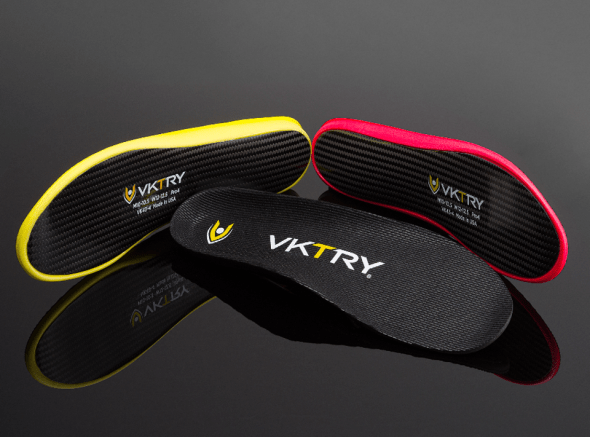
The carbon fiber is engineered with multiple layers of fibers in different lengths, makeups and directions to offer flexibility where needed and stability in other areas.
VKTRY was designed for use across multiple sports — major footwear brands from Nike to Asics have started employing carbon fiber in long-distance running shoes for linear benefits — and Wasik says they’ve seen adoption from football to baseball, but have found basketball and volleyball players especially enjoy the energy return for higher jumping ability and less force upon landing. “We hear some great stories from athletes who have suffered from sore knees or shin splints and the pain is gone,” he says.
The original bobsled design requiring the insole to fit in the tight confines of a spike helped create a product ideal for all athletes, Arciuolo says. “The challenge was not only getting something that worked in terms of propulsion, but also that fit in the shoe,” he says. The carbon fiber portion of the product weighs less than an ounce and is less than a millimeter thick. A proprietary polyurethane top cover provides additional comfort.

VKTRY isn’t a one-size fits all proposition, with Arciuolo calling it a “truly customized product.” It comes in five different “pro levels,” which are basically different flex levels. Lighter athletes with smaller feet require more flex than a 320-pound football player. To get the same propulsion performance, insoles require customization based on sport, weight and foot size, so an algorithm helps find the best flex level for each athlete. The insole is further customized by sport, using different thickness and sizes.
“The VK is the best combination of injury protection and performance I have ever seen in insoles,” Vitti says.
Endorsers of the brand also include Vladimir Guerrero Jr. of the Toronto Blue Jays, Anthony Miller of the Chicago Bears, Josh Norman of the Washington Redskins, Lexie Brown of the Minnesota Lynx, Myles Jones of Chaos Lacrosse Club, George Springer of the Houston Astros, CrossFit world champion Annie Thorisdottir and plenty more.
Creps says that “for the first time, athletes can experience stabilization, shock absorption and propulsion in a device that is specifically tailored to their size and weight. This is a game changer.”
Written by Tim Newcomb; Forbes
FAMILY OF STEVEN HOLCOMB RECEIVES OLYMPIC SILVER MEDALS IN HIS HONOUR

Late USA driver in two-man and four-man bobsleigh teams upgraded from bronze at Sochi 2014 after disqualification of Russian medallists
Two and a half years after his untimely death, the family of bobsleigh driver Steven Holcomb will receive two silver medals from Sochi 2014.
Holcomb piloted the USA two-man and four-man bob teams which finished third at the Games.
But they were promoted to silver in both events after Alexandr Zubkov, the driver of Russia’s original four-man and two-man gold medal sleds, was disqualified for doping offences with brakeman Alexey Voevoda also subsequently excluded.
Holcomb, who led his country to its first four-man title in 62 years at Vancouver 2010, died in his sleep at the Olympic training centre in Lake Placid in May 2017 aged 37.
Steven Langton, brakeman in the two-man and a pusher in the four-man, are also set to receive two silver medals at Tuesday’s Team USA Awards in Los Angeles with pushers Chris Fogt and Curt Tomasevicz collecting four-man silvers.
USA’s greatest bobsledder of his generation
A native of Park City, Utah, Holcomb started out as a ski racer before switching to sliding in his late teens.
He was originally a pusher and was part of Brian Shimer’s team ahead of the 2002 Games in his hometown of Salt Lake City before a hamstring injury at the worst time saw him replaced by Dan Steele.
Holcomb then switched to driving but there was a problem – his eyesight.
After laser surgery in 2000 had failed to make a difference, he was diagnosed with the incurable degenerative eye disease keratoconus which leads to the thinning of the cornea.
Deciding not to tell anyone, Holcomb wore hard contact lenses and ahead of Turin 2006 found that his sight was getting progressively worse to the point that he thought he could go blind.
In his autobiography, ‘But Now I See: My Journey From Blindness to Olympic Gold’, Holcomb admitted he should have said something sooner but that “because the only lengthy conversations I’d had about my disease had been with myself, I always came up with the most horrific scenarios for what would happen if I confessed now”.
Having managed to pass a vision test for international competition by memorising the letters on the eye chart, he took sixth place in the four-man bob and 14th in the two-man in his first Olympic Games.

But his eyesight soon deteriorated to the point that contact lenses were not up to the task making cornea transplants in both eyes, and four years out of the bob, the only feasible course of action.
Faced with that prospect, Holcomb’s already fragile mental health worsened and he attempted suicide by taking multiple sleeping pills washed down with bourbon whiskey.
Incredibly, he survived and decided to come clean about his sight issues.
His team-mates and coaches set to work and put him in touch with Calfornia doctor Brian Boxer Wachler who fitted special implants in 2008 which improved his vision markedly without surgery.
The procedure soon became known as the Holcomb C3-R.
Holcomb was able to return to the circuit and became world champion a year later at Lake Placid before securing his greatest triumph at the Vancouver Games of 2010, piloting the ‘Night Train’ – with pushers Tomasevicz, Justin Olsen and Steve Mesler – to gold.
Popular with his team-mates and bobsleigh crowds for his outgoing manner, and his ‘Holcy Shuffle’ dance, Holcomb built on his Olympic title with three golds at the 2012 Lake Placid World Championships – two-man, four-man and mixed team.
USA retained that mixed team title a year later before Holcomb headed to Sochi for his third Games.
Bronze medals in both the four-man and two-man saw Holcomb join Pat Martin as his nation’s most decorated Olympic bobsledder.
The next couple of seasons were not quite as successful, although Holcomb was ranked second in the 2016-17 two-man World Cup standings thanks in part to a victory over Canada’s subsequent PyeongChang 2018 two-man gold medallist Justin Kripps at Lake Placid.
He was still on course to pilot a Team USA sled at PyeongChang but in May 2017 his best friend, world champion skeleton racer Katie Uhlaender, broke into his room at the training centre in Lake Placid having not heard from him for two days and discovered his body.
Holcomb was later found to have alcohol and prescription sleeping tablets in his system having appeared to have passed away in his sleep.
His 60 World Cup, 10 World Championship and three Olympic medals made him one of the most decorated drivers in the sport’s history.

Medal reallocation from Sochi 2014
Six months after Holcomb’s death, Zubkov was stripped of his medals from Sochi 2014 for doping offences.
And in March this year, following the application of the Olympic Medal Reallocation Principles, the teams below Russia were promoted with Holcomb’s two-man and four-man teams upgraded to silver.
Langton, Tomasevicz and Fogt released a statement at the time saying, “It’s unfortunate that our results were not official in February of 2014 and that we’ve had to endure the long process to see justice finally served.
“We are happy that we now can celebrate and be proud of the silver medal accomplishments.”
Latvia’s four-man team, piloted by Oskars Melbardis, were upgraded to the nation’s first ever Winter Olympic gold medal with John Jackson’s Great Britain sled promoted from fifth to third with Russia 2 also disqualified for doping having been originally fourth.
Jackson said, “Disappointingly, it is a medal we should have received on an Olympic podium in 2014. Cheats have cost us that moment, along with other nations too.”
In the two-man, Switzerland’s Beat Hefti and Alex Baumann were awarded gold with Melbardis and Daumants Dreiskens taking bronze after Russia 2 were also excluded for doping.
