No words can ever express the gratitude to our military and
their families for the sacrifices they have endured in representing and
defending our country.
They are remembered everyday! deBotech, Inc. has great
respect and possesses great pride in knowing and supporting our employees,
their spouses and family members who are veterans in our local community and
nationwide.
We are so thankful for their service!
As Thanksgiving approaches, it is natural for us to feel a
great appreciation for all that is special in our lives.
Remembering our veterans who have served our country is
something we are grateful for everyday and in November our hearts are filled
with great pride and thanks.
So, on Veterans’ Day and every other day, we extend a Big THANK YOU!
Meet our Veterans
Brian Meadows works in our Lamination department. He served in the Army for 4 years and 6 months. His rank was E4 and he traveled to Korea. We asked what Brian learned from his service and he shared “teamwork, and that things could always be worse”. Thank you Brian! Meet Broderick Doby who is also in our Lamination department. He served in the United States Coast Guard for 2 years. While talking with Brock he said he was getting into trouble as a young boy, and decided to join the Coast guard. This experience turned him into a man and taught him assertiveness, character and responsibility. Thank you for your service Brock!
Meet Raymond Freeman from our Cutting department. Raymond served 3 years in the United States Army his rank was SPC. He traveled to California, and El Paso, Texas. He learned from his experience to “embrace the suck and that nothing is handed to you.” Thank you for your service Raymond!
Meet William Labor from our Demold department. Will served 8 years in the United States Marines, rank E5 Sears during his time he learned leadership skills. These skills are shown in his work daily. Thank you for your service Will!
Meet John Lovell from R&D! Johnny has been with deBotech since the beginning. He served 6 years in the United States Army and his biggest take away was that he “grew up” and he traveled to Panama, Alaska, and most of the lower 48. Thank you for your service Johnny!
Meet Gerald Stevens, our new Production Supervisor. Gerald served for a total of 22 in a half years. He served 4 years in the United States Marine Corps and 18 years in the United States Army. Gerald traveled for 62 foreign countries and was glad to be able to serve and come back in one piece. Thank you for your service Gerald!
Meet Nolan Givens deBotechs Process Coordinator. Nolan served in the United states Navy rank E7 Chief Petty Officer for 9 years. Nolan learned work ethic and discipline. Thank you for your service Nolan!
Meet David Laws our Production Supervisor. He served 8 years in the United States Air Force. David learned work ethic, leadership skills and most importantly he learned integrity from his service. David, we thank you for your service!
Spring Mountain Motor Resort and Country Club, home of
the Ron Fellows Performance Driving School, is located less than hour from
Las Vegas and they bring a continent of cars and people to the annual SEMA Show
at the Las Vegas Convention Center.
Drivers for Ron Fellows School provide hot laps for the
attendees which is hella fun if you have ever had the opportunity to catch a
ride in one of the ZR1s they have. In addition to the hot laps, Spring Mountain
also has booth display at SEMA and featured prominently is the 2020 Corvette
Stingray wearing the Ron Fellows Driving School livery.
We asked Spring Mountain’s Todd Crutcher send us some photos of the 2020 Corvette on display as it’s the only place at SEMA outside the Chevrolet display where you catch the C8 Corvette in the flesh.
Chevy had displayed a C8 Corvette with the Ron Fellows
door stickers at both the Woodward Dream Cruise and Corvettes at Carlisle,
but the car on display at SEMA is much more representative of the Ron Fellows
livery that also features the No. 01 car number on the front and back while
Michelin stickers are also featured. A windshield banner completes the look.
This C8 Corvette is a Z51 model and 3LT trim package and
inside is the two-tone Blue leather interior. The Stingray also shows off the
visible carbon fiber roof panel that’s only been spotted a couple of times.
There has yet to be any kind of announcement regarding a
driving school for owners of the C8 Corvette at the world-class driving school,
but we’ve been told to stay tuned as things are progressing. We do know that a
continent of cars will be built for the school and that they will be used as
part of the official GM training for dealerships who are selling the new sports
cars. While the strike has messed up the original timeline for the school to
receive their cars, we expect some sort of announcement will be made in the
near future.
If you have purchased a C7 Corvette in the last year, your
time is limited to take advantage of the 2-day Corvette Owner’s School that’s
heavily subsidized by Chevrolet. To find out more information about the
Corvette Owner’s school, visit SpringMountainMotorsports.com or call
Melinda or Donna for details 1-800-391-6891. All Corvette enthusiasts are
invited!
Kendall Wesenberg begins her second run in the women’s World Cup skeleton race in February at Mount Van Hoevenberg. After USA Skeleton National Team trials races ended in Lake Placid on Sunday, USA Bobsled & Skeleton announced that Wesenberg will be part of the 2019-2020 World Cup team, competing as USA 1. (Enterprise file photo — Lou Reuter)
LAKE PLACID — The state Olympic Regional Development
Authority will be hosting the first two International Bobsleigh and Skeleton
Federation World Cups this year at Mount Van Hoevenberg, instead of only one as
previously planned.
The season-opening BMW IBSF Bobsled & Skeleton World Cup
originally scheduled at Park City, Utah from Nov. 25 to Dec. 1 was moved to
Lake Placid for the weekend of Dec. 7 and 8, the IBSF announced on Nov. 2. The
second World Cup race will be held as planned at the Olympic Sports Complex
from Dec. 13 to 15.
“Due to the short time for preparation and in order to
guarantee high level quality ice, the schedule for those two World Cup weeks
had to be amended,” the IBSF stated in a press release.
There will be two, two two-man bobsled World Cup races held
during the first week and two, four-man bobsled races held during the second
week. There will also be women’s bobsledding and skeleton racing for men and
women. The IBSF had not changed the schedule on its website by press time.
The IBSF cites technical issues with the refrigeration pump
system on the Park City track as the reason for the rescheduling.
Bobsledder Codie Bascue rides through Curve 14 at Mount Van Hoevenberg on the men’s first run during the IBSF World Cup in February. (Enterprise file photo– Lou Reuter)
Pic 2 Bobsledder Codie Bascue rides through Curve 14 at
Mount Van Hoevenberg on the men’s first run during the IBSF World Cup in
February. (Enterprise file photo — Lou Reuter)
“Though the track management has acted immediately and tried
to repair the system, it cannot guarantee that it will be ready by the time of
the World Cup,” the IBSF stated. “In order to avoid any risk of not
hosting the event it was decided to move it to Lake Placid.”
In its release, IBSF officials thanked Park City track
management “for the swift and professional proceeding in this matter,” Jeff
Potter at ORDA “for his support in taking over the event” and John
Rosen of USA Bobsled & Skeleton “for coordinating the matter.”
“The immediate cooperation between the two track managements
of Park City and Lake Placid shows their great commitment for bobsleigh and
skeleton sports and we want to thank both Race Organizers,” the IBSF
stated.
The Lake Placid races were announced by ORDA Tuesday as part
of its winter schedule. After the first two World Cups are done, the circuit
heads to Europe for World Cup racing Dec. 30 to Jan. 5 in Winterberg, Germany.
ORDA will host the Viessmann FIL Luge World Cup/BMW Sprint Cup from Nov. 29 to Dec. 1 at Mount Van Hoevenberg, giving Lake Placid three straight weeks of World Cup racing on the American teams’ home track. Both USA Bobsled & Skeleton and USA Luge are based in Lake Placid.
Chevrolet today revealed the long-awaited performance
figures for the 2020 Corvette Stingray. While the various magazines and
websites have been releasing their numbers, we’ve finally gotten the official
word straight from Chevrolet.
The 2020 Stingray with the Z51 package will hit 60mph in 2.9
seconds and run the quarter-mile in 11.2 seconds at 121mph. The base Stingray
without Z51 performs the 0-60 sprint in 3.0 seconds and covers the quarter-mile
in 11.2 seconds but at 123 mph. That’s a whole lot of boogity, boogity, boogity
for just $60,000. But why is the base car faster than the Z51 in the 1,320?
It’s the same reason the Z51’s top speed is lower than the base car –
aerodynamics. All that aero that keeps the car planted in the corners holds it
back at high speeds in a straight line.
“The performance of the 2020 Stingray has far exceeded our expectations,” said Alex MacDonald, Chevrolet vehicle performance manager. “Moving more weight over the rear wheels helps us get off the line quicker, but it’s the integration between the powertrain and chassis that really takes the performance to new levels.”
All that performance is the result of harmonization between
the 495hp LT2 engine and the 8-speed Tremec DCT. The transmission is built at
Tremec’s Wixom, MI facility utilizing components produced Belgium, Mexico, and
other locales. The DCT itself is a complex unit that contains the rear
differential, final drive unit, its controls system, various sensors, its
lubrication system, and the cooling hardware. It’s a combination of all these
items in addition to the inherent advantages of mid-engine architecture that
allow the C8 to achieve its mighty performance.
“The goal from the beginning was to design a transmission
worthy of an exotic supercar that is fun to drive everyday,” said Terri
Schulke, GM global chief engineer of transmissions. “We achieved that goal by
combining the best attributes of the LT2 and the DCT, and I think the
impressive performance numbers speak for themselves.”
We expect to hear more details, including official fuel economy ratings, now through the car’s February start of production.
Chevrolet Confirms
2020 Stingray Quickest in its History LT2 V-8 engine and dual-clutch
transmission combine for unprecedented performance
DETROIT — Jaws dropped when Chevrolet first announced the
2020 Chevrolet Corvette Stingray coupe would accelerate 0 to 60 mph in less
than three seconds with the available Z51 Performance Package. Today, the brand
confirms the sportscar with the available Z51 Package can reach 60 mph in 2.9
seconds and cross the quarter-mile mark in 11.2 seconds at 121 mph.
Even without the available Z51 Package, a base Stingray,
starting at $59,995 (including destination charges, excluding tax, title,
license, and dealer fees), can reach 60 mph in three seconds flat and cross the
quarter mile mark in 11.2 seconds at 123 mph. Performance numbers may vary, as
different climates, tire conditions and road surfaces may affect results.
“The performance of the 2020 Stingray has far exceeded our
expectations,” said Alex MacDonald, Chevrolet vehicle performance manager.
“Moving more weight over the rear wheels helps us get off the line quicker, but
it’s the integration between the powertrain and chassis that really takes the
performance to new levels.”
A full chart of the above performance specs is listed below:
This groundbreaking performance is achieved through a formula of rear weight
bias, tire technology, aerodynamics, chassis tuning and of course, the
powertrain. The 6.2L LT2 Small Block V-8 engine and eight-speed dual-clutch
transmission are in many ways the stars of the show.
Chevy’s Small Block
Hits the Gym
The LT2 is the only naturally aspirated V-8 in the segment
and is SAE-certified at 495 horsepower (369 kW) and 470 lb.-ft. (637 Nm) of
torque when equipped with performance exhaust, making it the most-powerful
entry Corvette ever.
“The LT2 is one of our best efforts yet in Corvette’s
history of naturally aspirated high-performance Small Block V-8 engines,” said
Jordan Lee, GM’s global Chief Engineer of Small Block engines. “This engine is
incredibly powerful and responsive. Power is readily available when the driver
needs it.”
The standard engine-mounted dry sump oil system boasts three
scavenge pumps, which help make this the most track-capable Stingray in
history. The LT2’s lubrication system keeps oil in the dry sump tank and out of
the engine’s crankcase. It provides exceptional engine performance even at
lateral acceleration levels exceeding 1g in all directions. The low profile oil
pan is high-pressure die-casted – similar to some of Corvette’s large body
structure parts – to reduce mass and is only 3.5 mm thick. The LT2’s
pan-mounted oil filter and cooler assembly has cored oil and coolant passages,
allowing for a 25 percent increase in cooling capacity over the LT1.
Much of the LT2’s additional power can be attributed to how
much better it breathes. The intake system is a low restriction design and
incorporates identical 210mm length intake runners and an 87mm throttle body.
The performance header exhaust manifolds are also low restriction and feature a
stylized four-into-one design with twisted runners to allow for thermal
expansion. The camshaft now has 14mm gross lift on the intake and exhaust with
an increased duration for both profiles, which helps the combustion system take
advantage of the extra flow capacity. The LT2 retains variable valve timing,
with 62 crank degrees of cam phasing authority.
The LT2 has a very low-profile oil pan. This allows the
engine to be mounted low in the vehicle for a low center of gravity and
improves handling and track performance. The DCT’s flywheel dampener was even
reduced in diameter to allow for the lower engine position.
Bespoke DCT Puts the
Power Down
Chevy’s first eight-speed dual-clutch transmission was
designed to do two things – put the LT2’s power down and put a smile on every
driver’s face. The bespoke, transaxle transmission was developed with Tremec to
provide uninterrupted torque delivery whether setting a new lap record or
heading out on a roadtrip.
“The goal from the beginning was to design a transmission
worthy of an exotic supercar that is fun to drive everyday,” said Terri
Schulke, GM global chief engineer of transmissions. “We achieved that goal by
combining the best attributes of the LT2 and the DCT, and I think the
impressive performance numbers speak for themselves.”
Engineering decided to use a dual-clutch design because it
better supports the Stingray’s new mid-engine architecture and desired
performance. The DCT aids vehicle performance with a very low center of
gravity, enables desired weight distribution and offers maximum traction under
acceleration. It is a highly integrated system, as it houses the differential,
final drive, controls system, sensors, lubrication and cooling hardware.
The heart of the DCT uses dual concentric wet clutches that are opened by springs and closed by hydraulic pressure. The two clutches work in tandem for uninterrupted torque delivery as they toggle between gears. A separate lube circuit is used for on-demand clutch cooling to reduce parasitic losses. Holes in the outer housing allow for the wet clutches to operate moist instead of submerged. Gear ratios were engineered to be incredibly low-end biased for maximum acceleration. First gear takes advantage of the additional traction to get off the line quickly and reach 60 mph in 2.9 seconds with the Z51 Performance Package. The Z51’s 11.2 second quarter-mile acceleration is achieved by lightning-fast upshifts and excellent low-end torque. The gear ratios are:
The final drive and differential are integrated for the first time and make for
an incredibly efficient package. A mechanical slip differential is standard on
all 2020 Stingrays. The mLSD has an effective final drive ratio of 4.9:1 and is
intended for straight line acceleration and dynamic handling. An electronic
limited slip differential is offered on the Z51 Performance Package and has an
effective final drive ratio of 5.2:1. It is intended for ultimate control
during track driving and commands more authority than previous generation
eLSDs.
Though they have different purposes, the mLSD and eLSD were engineered together. They share a common ring and pinion gear ratio of 3.55:1. Their ring and pinion gears also use a zero offset spiral bevel as opposed to the typical hypoid arrangement, which allows for a common fluid to be used and benefits overall packaging.
Software Plays Key Role
Beyond hardware, the transmission software controls are
really where customers will find the most tangible benefits. Most of these will
feel familiar when toggling through varying driver modes:
Tour: Moves to the background to provide quiet,
smooth shifts for optimal ride comfort.
Sport: Gives drivers altered up and downshifts
for more spirited driving.
Track: Maximizes vehicle performance with
aggressive gear selection expected to keep the engine in a peak performance
window.
A proprietary algorithm will influence gear selection if the
car senses spirited driving. The level of aggressiveness will change with
modes, but when sensed, the DCT can downshift early on hard braking, hold gears
when lifting off the throttle and alter shifts points with lateral
acceleration. All behaviors are intended to increase driving enjoyment and
avoid unnecessary shifting.
To achieve peak acceleration numbers on the Stingray,
drivers must initiate a performance launch. Once in Track mode, double pressing
the traction control button will put the vehicle in Performance Traction
Management for Magnetic Ride Control-equipped cars or Competitive driving mode
for all others. Once prepared, the driver can then fully depress the brake and
accelerator pedal together, and then release the brake pedal once 3,500 RPM are
reached. Extensive work went into ensuring the DCT felt like the best of both
worlds: the spirited, direct connected feeling of a manual and the premium
driving comfort of an automatic. The magnesium steering wheel-mounted paddle
shifters give a premium feel when pulled. For the most responsive shifts possible,
the shift signal is sent directly to the transmission control module the moment
the paddle pull begins. This avoids any communications delay through other
modules and allows drivers precise control of their gear selection.
Unique features of the ergonomic paddles are:
Double paddle declutch – pull both paddles
simultaneously to simulate pressing a clutch pedal.
Temporary manual – simply use either paddle
while in Drive, and the vehicle will temporarily switch to manual mode.
Lowest available gear – hold the downshift
paddle and the transmission will shift to the lowest available gear for a quick
burst of torque.
The 2020 Chevrolet Corvette Stingray coupe and convertible
are available to order at certified Chevrolet dealerships nationwide or on
Chevrolet.com.
Early-build C8 Corvettes are hard at work, ginning up enthusiasm for the biggest sea change in America’s sports car since the C2 dropped the stick axle. The 2020 Corvette is an extraordinary car that makes extraordinary numbers at an extraordinary price—and we would expect nothing less. But before we rush headlong into the mid-engine era, can we stop and appreciate the outgoing C7 one last time?
Because it seems unfair, really, that the 2019 Corvette ZR1 has already become a thing of history, just another Vette in the model’s long and storied line. This is the culmination of not just the most recent generation of Corvette, but also the entire 66 years of the front-engine paradigm. Certainly, it is the costliest Corvette ever (and the highest-priced vehicle GM currently sells), with our test car ringing the bell at $142,075.
You spend that money for more power than in a regular Stingray—300 horses more. This is not unlike having an extra V-6 Camaro engine bolted to the top of your Corvette’s 6.2-liter V-8. Except the ZR1 actually employs a supercharger, with which the big, bad LT5 can blow even the brick house down, making 755 horsepower and 715 lb-ft of torque. Chevrolet says all that power comes from using both direct injection and good, old-fashioned port injection, a trick that also helps the Silverado return better gas mileage.
At idle the ZR1 rumbles like a seismic event and its rips and crackles at full snort are the sounds of a natural disaster. Hang on and hope that you don’t do anything stupid, like keep your foot in it for too long or try to outsmart its eight-speed automatic. (A seven-speed manual is also available.) Things happen quickly in the ZR1 and there is no chance of running out of car before you run out of road. It may not produce the acceleration numbers of an all-wheel-drive Tesla Model S Performance, but the violence of internal combustion in the Corvette augments its own sensation of speed to produce a far more visceral drive.
Indeed, the ZR1 must rank among the baddest sports cars to ever roll on four tires. In this case, those are sticky Michelin Pilot Sport Cup 2s that owners should probably think about buying in bulk. Yet before the ZR1 was even launched, it was guaranteed to be overshadowed by the C8, just as it would be doomed to share most of its interior bits with the not-aging-so-well C7. Was it really only six years ago that this cabin seemed modern? But Chevy can’t really be blamed for spending money on interior upgrades for the new car rather than throwing good money after bad on this one-and-done special.
Behind the wheel, the view out over the vast hood of the ZR1 is like nothing likely to come again. The tops of its sharp fender creases still call to mind the outrageous C3, but they no longer seem like peaks compared to the mountain range in the center of the hood. The protruding carbon-fiber engine cover stands proud of the hood and is good for at least couple taps up on the power-seat adjuster. If the optional Competition Sport seats are too tight and the Track Performance package too stiff for the comfort of your average Corvette owner, well, those are items you add to your ZR1 when the pursuit of lap times render money no object.
Like its Z06 and Grand Sport siblings, the extra-wide ZR1 makes any road feel narrow, and makes narrow roads seem like goat paths. Thankfully its steering is prescient and immediate, giving the car an astounding athleticism. Talking about things like handling and grip after driving a ZR1 on the street is akin to holding forth on surgical techniques after binge watching Grey’s Anatomy. If the Cessna wing blocking access to the trunk isn’t a strong enough hint that exploring the limits of a ZR1 anywhere that doesn’t require a balaclava and helmet is a bad idea, maybe you’ve just sniffed too much of the ZR1’s resinous off-gassing. That cologne is yet another reminder that even at 218 percent of the price of a base Stingray, the ZR1 is still 100 percent C7.
With first tests of the C8 showing that it’s quicker to 60 miles per hour than the ZR1, the King of Corvettes has already abdicated its throne. It seems sea changes occasionally happen in the blink of an eye.
It’s been a bit of a rollercoaster since Chevrolet first
starting accepting orders in September for the 2020 Corvette Stingray
Coupe.
After the first order consensus in September, Chevrolet
scheduled the first wave of retail production to begin in early December. But
then came the nearly 6-week long UAW strike which shut everything down. As the
strike was ongoing, the Target Production Weeks (TPW) for those early builds
were pushed back into mid-to-late January.
Once the strike ended, we were hoping for some positive news about the TPWs as they all disappeared from the GM Order System late last week. But then they came back and we are finding out that retail production of the 2020 Corvettes will most likely start on February 3rd.
We do not have official confirmation on this, but that’s
what we are hearing from our dealers as well as customers with current TPWs. I
have seen a TPW posted on the Corvette Forum that indicated a 1/27 start and
that could also be possible depending on when Chevrolet does a run of CTF
cars for marketing and other purposes.
Chevrolet does have a graduated roll-out planned for
the C8 Corvette which we’ve also talked about previously. Originally the plan
was to build 2LT and 3LT cars first (with certain options and colors) and then
begin to add additional colors and options until all models, colors and options
were available. The 1LTs were originally scheduled to begin 10 weeks after the
start of production but included in that original 10 week period was the
two-week Christmas/New Years shutdown, and so we estimate the 1LTs will most likely
start in early April.
And then that brings us to the Convertibles which were
originally supposed to start in February. Our best guess is that the start of
production for the Convertible Stingrays would also begin sometime in
mid-to-late April or even early May as well.
During the strike, the order consensus for October which was
supposed to cover weeks 3-5 of production was canceled. The next order
consensus for the 2020 Corvettes will pick back up this month. When that
happens, we’ll have a constraint report to bring everyone back up to
date.
Production of the new mid-engine 2020 Corvette Stingray was
expected to start the week of December 2nd. But then the UAW strike happened,
which pushed the earliest TPWs (Target Production Weeks) for those buyers with
accepted orders back to January 20th at the earliest. Others have reported that
updates to their TPWs pushed the start of their cars into February.
But now that the strike is over and the Corvette Assembly Plant has reopened, things are starting to get back to normal. After several days to assess their current situation, the Corvette team may be getting ready to make new adjustments to the current Corvette orders.
Over the last two days, we’ve heard from customers and
dealers alike who have reported that current orders no longer have any Target
Production Weeks attached them. Dealers are saying there are no TPWs in the
order system.
This sounds like good news to us.
The Corvette Assembly Plant still has to knock out the
remaining C7 orders, and plant spokesperson Rackel Bagshaw confirmed
earlier this week that the plant will be down from November 18th –
December 6th for C8 retooling.
If that’s the case, then perhaps we’ll see the first TPWs shifted back to December 2019. That would be fantastic news as then the strike would have only delayed the start of C8 production by just a week. Of course, the flip side is that TPWs could be moved even further into 2020 which is a very real possibility as well. Stay tuned on this and for those of you with orders, be patient!
Crowning the Road & Track Performance Car of
the Year is not an easy task. Each fall, we gather every new or revised
performance car that we can get our hands on. While some of these candidates
naturally worm into our hearts, this is more than a popularity contest—the
award doesn’t simply go to the machine we like the most or the one we think is
the coolest. PCOTY is about looking to the future and finding the car that
provides the most hope for the enthusiast: a machine that offers everything you
expect of a modern vehicle yet still tugs at the heart.
To pick a winner, we used the following criteria:
Outright speed and testing numbers are part of the package, but they don’t determine the winner. Beyond sheer pace, a car has to bring emotion to the table.
The car must embrace track duty while still being enjoyable on the road.
Technology has to be used in service of the driver, not just added speed. Feedback and sensation via complexity is great, but complexity alone doesn’t cut it.
Lastly, we ask ourselves, would any other manufacturer build it? Does the car feel uniquely of its story and brand, with a personality all its own?
This year’s test saw 11 cars join us for two days at Northern California’s Thunderhill Raceway Park. A staff vote at the end of our track time cut the field to six contenders. Those six were then road-tripped on a winding, demanding test route through the Sierra Nevada, ending at Lake Tahoe. A final vote at the end of the journey determined the winner.
You might be wondering why we elected to conduct track testing
first this year. Past PCOTY contests have tested cars on the road first, then
trekked to a closed course. Our current method gave the staff a chance to drive
every car in similar conditions, learning their limits in a safe, controlled
environment.
When it came to lap times, we enlisted a licensed club racer with
no Thunderhill experience: me. We did this for a reason, and it wasn’t to build
my ego. Most of our readers are not pro drivers. When you buy a new car, a
professional’s lap time at any track is an interesting metric, but it’s rarely
reflective of a normal person’s experience. We wanted to stress accessibility
and adaptability. How easy is it to get up to speed in a given car? How communicative
is the car? Is it hard to learn the quirks? Under the watchful eyes of our
testing staff, every PCOTY contender got a quick warm-up session to set tire
pressures, then no more than seven timed laps. Just enough to establish a
representative lap and suss idiosyncrasies, not enough to set a record.
Of course, no method is perfect. Ambient temperature during our
lapping day started at around 85 degrees Fahrenheit and eventually hit 107.
That kind of heat doesn’t help lap speed, and it ensured that late runners
needed shorter stints, as times immediately dropped off. While I made every
attempt to, as one of our contributors once said, “underserve all the cars
equally,” most amateur drivers will get faster over the course of a day at a
track they had never before seen, learning the pavement’s nuances, and I am no
exception. With those caveats in mind, it’s best to view the lap times as
bellwether, not absolute. A loose guide to judge the spectacular machinery on
these pages.
In the end, that’s the key. We hold PCOTY testing each year as
reason to celebrate the future of the performance car, not lament it. The
industry is undergoing transformation. More than ever, regulations try to force
automakers into a box. Consumer trends lean toward amorphous appliances.
At Road & Track, we drive hundreds of new cars each year, which
means our affection for hydraulic steering, natural aspiration, lightweight
efficiency, and a good, old-fashioned stick shift is tested on a regular basis.
Yet look at the field we have here. These cars are proof that
there’s still plenty to be excited about. None of them fade into the background
or aim to remove you from the experience. In a time when we’re told that the
driverless car is around the corner, these machines put the driver squarely at
the front of the experience. As it should be.
—Travis Okulski
Frequently Asked Questions
What is this PCOTY thing?
One of this magazine’s crown jewels: A racetrack. A multi-day road
route covering hundreds of miles. A king anointed among the year’s most
significant new sports and exotic cars. Our priorities are emotion, engineering
cohesion, relevance, and price, in that order. Plus beef jerky. (It’s a road
trip. There’s always beef jerky.)
Sounds expensive.
It’s not cheap. While fast cars have to work in cities, they’re
most effectively and safely tested in the middle of nowhere. In this case, that
meant shipping employees and equipment to a remote location, then orchestrating
hotels, food, support vehicles, data collection, and two photographers. (Plus
we spent $5 on giant stick-on googly eyes.)
Googly eyes?
That was senior editor Zach Bowman. Never give a Tennessean a
corporate card in a Walmart.
Did you stick them on something?
One of the dim-looking minivans we use for chase and photography.
What did that poor van do to you?
Not much. But Bowman did walk out of that Walmart with a CD copy
of Black Sabbath’s 1970 masterpiece Paranoid, because he wanted to
hear “War Pigs” at ear-bleed level while wearing aviator sunglasses and doing
van burnouts at stoplights.
That sounds awfully specific.
PCOTY is all about specifics. And generals gathered in their
masses.
I’m sure nothing went wrong.
One staffer “ran out of pavement” (his words) and put the McLaren
off at Thunderhill. (No one was hurt, and the car was fine.) The Lexus and
Lotus got flat tires. And one of our vans was broken into in San Francisco—they
took deputy editor Bob Sorokanich’s backpack, but not the copy of Paranoid.
Editor-at-large Sam Smith left an open bag of Haribo gummy bears in the van
during the break-in and then grumped for a bit because the bag had broken glass
in it.
Was Bob upset?
Smith was heartbroken.
Who are the other mooks here?
Staff mooks joined by contributing mooks! Some adept at track
driving, others with a penchant for sussing out a car’s foibles on the road.
While a few fancy themselves engineers, others have actual engineering
know-how. But all love sports cars and have strong opinions about which end of
the Corvette should house the engine. You could say each participant brought a
very particular set of skills.
Like Liam Neeson in Taken.
Only with more Lamborghini. And Bob, a professional editor who
intimidates approximately nobody, speaking calmly about his backpack theft. (“I
have a particular set of skills with… adjectives.”)
Why Thunderhill Raceway Park?
It’s a perfect arena. Demanding of both driver and car, modern,
safe. Plus great roads in spitting distance.
The mid-engine Corvette: how’d you get a car so rare and new?
We asked to borrow a preproduction C8 from GM. They said yes, with
caveats. The Corvette had minders, and they took the car back each night,
checking it over. We also had to agree to an embargo, keeping drive impressions
confidential for weeks.
What a peek behind the curtain! Got any more secrets?
Maybe! Ask Matt Farah about his superpower. Ask Bowman why he had an obsession with Gatorade Limon Pepino. And whatever you do, don’t ask Smith and Jason Cammisa what happens when Gladys Knight’s “Midnight Train to Georgia” hits the radio on a road trip. They will demonstrate. And you will regret it.
Notable Absences
This
year’s PCOTY field was one of our strongest, but as with every year, there were
notable absences. The absentees generally fall into one of three categories:
the car you’re thinking of wasn’t launched as a new vehicle in the year
preceding PCOTY testing (and was thus ineligible), the manufacturer wouldn’t
lend us one (privately owned test cars are impractical), or the car in question
just isn’t any good. Here are the models that received invitations but couldn’t
make the party.
2019 Aston Martin DBS Superleggera: A
lightweight DB11 with 715 hp. Aston elected to not participate in the test.
2020 Audi R8: The first facelifted R8s
arrived in the U.S. a week before our test. Sadly, there wasn’t enough time to
get one shipped to Thunderhill.
2020 BMW M8: The new flagship M car was first shown in
June, but BMW only made it available for review (in Europe) the same week as
PCOTY.
2020 Ferrari F8 Tributo: The 710-hp V-8 from
the wild, track-focused 488 Pista, in a more road-oriented package. Ferrari
couldn’t provide one during our test window.
2020 Ford Mustang Shelby GT500: Supercharged V-8 and
hellacious speed, but Ford didn’t provide test cars to journalists until a
month after PCOTY testing.
2019 Mercedes-AMG GT R Pro: A track-attack version of a car already known for circuit prowess.
Only hitch: the first GT R Pros didn’t cross the Atlantic until the tail end of
2019, after this issue shipped to the printer.
2020 Polestar 1: A 600-hp, hybrid,
carbon-bodied GT from Volvo’s new electric-performance offshoot. Polestar
wasn’t ready to let us borrow one, but don’t worry—we’ll drive it soon.
2020 Porsche 718 Cayman GT4: On paper,
a PCOTY front-runner. Which is a shame, because Porsche had no test cars in the
country.
2020 Subaru WRX STI S209: The WRX STI might be a few
years old, but the S209 promises to be the best version yet. Subaru held a
media test event for the car during PCOTY week, so its loaner 209s were all
tied up.
HYPERCARS
We love bleeding-edge science experiments from companies like
Bugatti, Koenigsegg, Pagani, and Rimac, but hypercars just don’t fit the spirit
of this particular test. Mostly because of their near-unattainable prices.
We’ve made exceptions in the past, due to circumstance or serendipity (last
year’s PCOTY included a McLaren Senna, for example), but in this case, we
preferred to avoid the archetype.
—Chris Perkins
Where We Drove
We
based the 2020 Performance Car of the Year test out of Willows, California,
mostly for the town’s proximity to Thunderhill Raceway. The staff of this magazine
spent two days there, setting lap times and evaluating the competitors in the
rolling grass north of Sacramento.
Two
days at any track is a blessing, but turning laps is less than half of what
makes a sports car compelling. Everything about a Lotus or a McLaren hints at
where the machine might take you, the lines of the thing whispering how the two
of you might burn a tank of fuel. Or three.
We
were aiming for gold country. Those mountains played stage to the 1800s boom
that brought more than 300,000 people to Northern California in search of a
fortune. By 1855, the rush had largely turned to bust, the masses vanishing as
quickly as they had appeared. Those people left plenty behind—mostly vestigial
towns dotting the hills, but also a spiderweb of wagon-route roads connecting
them. On a map, the highways look like sports-car catnip. We only had to get
there.
The
farmland around Willows is flat and drab, fruit orchards aligned in dusty
grids. Our unlikely caravan shot through it in the morning, over Highway 162, a
thin needle across the state’s Central Valley, from Willows to Oroville. It’s
strange and beautiful, home to the Gray Lodge Wildlife Area. Great egrets loped
through the wetlands on either side of the highway. They chased their
reflections for one slow-motion moment, then turned skyward.
Whatever envy we felt only lasted as long as it took us to make
our way to Highway 70. The two-lane runs vaguely northeast, winding up and
through a fir forest from Oroville. A year ago, the Camp Fire, California’s
deadliest and most destructive wildfire, devoured the landscape, and the place
still shows the scars of it. Gutted stone homes, black tree trunks like
charcoal scrawls. But that road is a work of art, the pavement stitched to the
north fork of the Feather River as it pools and falls down the mountain.
The water runs through the core of California’s mother lode, a
seam of gold-rich land just three miles wide but more than 120 miles long. John
Bidwell found gold in the Feather in 1848 just outside Oroville, creating what
would become Bidwell’s Bar, one of the richest mines in the area. Three years
later, the place was home to 2000 miners, each aimed at digging money from the
ground.
The radio crackled. It was contributor Matt Farah.
“I don’t know who picked this road, but it’s spectacular.”
Farah is a Californian, an East Coast transplant who lives in
Venice Beach. He’s a journalist and R&T contributor who
spends his days driving around the state, and there we were, on a stretch of
pavement he’d never seen. Proof that a hundred lifetimes wouldn’t show you
every inch of California. When we stopped for a driver change, the judges
gathered on the side of the road. We’re all prone to big gestures and loud
voices, but something about that place, the sound of the water and the
stillness of those trees, kept us quieter than usual, our vocabularies sapped
by the sight of Northern California at its finest. Editor-at-large Sam Smith
looked down at the Feather, a coil of green basins. “I can’t believe this is in
the same state as Los Angeles.”
Some of our favorite roads are wedded to water, and Highway 70 is
one of the best. We chased it upstream for better than an hour. It was already
autumn in the hills, the light sharp and clear as it filtered through the trees
and splashed over our windshields. Far below, sunbathers and fishermen sat on
the banks in the sunlight, oblivious to our passing as the road writhed over
steel-trestle bridges and through old stone tunnels.
We paused in Quincy for fuel, the cars jockeying for pumps. The
day before, in Willows, it had been 107 degrees, but we’d been gaining
elevation with every switchback, and the air now sat closer to 50. None of us
dressed warmly enough, but we didn’t care. Every convertible had its top back
and the heat cranked, an idiot grin glowing from the driver’s seat. We left the
gas station and took off toward Quincy’s main street, then hung a right on
Highway 119. The road abandoned the river and climbed further into the ragged
mountains.
Up there, teetering snow poles marked the shoulder, placed to
guide plows through the winter. They towered over the cars. Suddenly, the sepia
photos we saw in every convenience store made sense: 1930s Fords and ’40s
Buicks parked beside 20-foot walls of ice and snow.
Highway 119 spilled onto the long, windswept Bucks Lake, and we
arrived in a blink, settling into the gravel lot at Lakeshore Resort, a small
restaurant and lodge on the shore. With the cars tucked in next to local pickups,
we headed inside for lunch. The restaurant’s back patio was drenched in that
crackling sunlight that seems so particular to Northern California afternoons.
Iced tea arrived by the pitcher, and we washed down burgers as bald eagles
circled the lake.
Senior editor Kyle Kinard looked out over the water, whitecaps
forming on the surface, whipped up by a far-off wind. He had planned the route,
arriving weeks before to scout the path and lay out a map.
“I don’t know how to say this without overselling what’s coming,
but it gets better from here.”
After lunch, we turned onto Highway 120 toward La Porte, another
wonder. Tighter even than the climb to Bucks Lake, the pavement ascending
thousands of feet. In some spots, the road narrowed to one lane, the pavement necking
between sheer rock walls and thick stands of trees. One moment, we dived into a
set of wooded hairpins. The next, we broke into a clearing above a
thousand-foot drop. Kinard was right.
The rest of the day carried on the same. A series of exclamation
points. After the mountain, the road unwound, Highway 120’s tight bends making
way for a river of fresh tarmac. The trees thinned, replaced by golden fields
and stocky barns covered in flaking red paint. The caravan dropped into high
gear, enjoying a few miles of lazy pace as the sun set.
Night descended as we made our way toward Tahoe, parading through one camp town after another. We caught Highway 49 through Tahoe National Forest, the trees turning to dark pillars in the fading light. The cooler air made for eager engines, exhausts popping and echoing through the woods. The group spread out, and it wasn’t until we caught up to each other at a stop sign, leading onto a highway, that someone noted we had all been running windows down, stereos off.
We called it a night outside Truckee, filling the garage and
driveway of an Airbnb house with more than half a million dollars of sports
cars. Editor-in-chief Travis Okulski stood in the drive for a moment, hands in
his pockets, surveying the cars as everyone gathered luggage.
“This whole day has been like a movie,” he said.
It was true. We’d run through a series of driving bests. We had
watched the roads spiral and contract, fell head over heels for a corner of
California as the sun sank low. How many perfect days behind the wheel do you
get, really? Sports cars demand so much from your life. Time. Space. Money.
They don’t fit the family. They cannot brave a Costco run. Most spend their
days slogging through a commute or languishing in a garage. But a good run up a
clear bit of asphalt can wipe all that away. A day of it is the stuff of
fantasy.
When we woke the next morning, we found ourselves with a pile of
sports cars in the heart of some of the country’s best driving. We loaded up
again and pointed at Donner Pass. California can be an insufferable place.
Expensive and full of itself, but also so gorgeous it hurts, packed with more
perfect roads per mile than anywhere else in the nation. The route up the pass
felt as precious as all that ore Bidwell and his miners pulled out of those
ridges. From up there, Donner Lake shone in the sun, reflecting that unreal
California sky back at itself. We parked the cars and marveled.
Installation Lap
You
rip toward Turn 1. The straight is shorter than it looks. Fourth gear, though,
at the end. Then into the first corner, a tight left-right combo. Looks like a
needle-thread: Huck the car in, all the brake for the right, trailing it,
maybe, to keep the nose under you in the corner’s second half. Don’t put it in
the grass; people put it in the grass here. (Remember the old saw: don’t look for
the wall, or you’ll find it.)
Uphill
to the right after that. Turn 2, a third-gear left that goes on forever,
painted across a hill. Camber will probably make the car push wide in the
midcorner, the nose indifferent and light, and then the front tires set, third
or fourth gear as the corner opens into the downhill straight that follows, the
tail on casters.
Delicacy!
Two corners in, it’s obvious: this place wants finesse.
Turn
3 leaps into your face. Overslowing will happen, because it looks tighter than it
is. Mountains to the west, filling the windshield. The first time through 3,
you realize you can straight-line the sucker, ripping over the curb. Some cars
fly a wheel or two. Then the track changes again, blind, Turns 4 and 5,
undulating pavement and no camber where you need it, big grassy berms on exit.
The car doesn’t turn, then it turns too much. Turn 5 pinches down and seems to
want you in that dirt. It’s a quick transition, but you have to keep your hands
tidy or the car won’t settle enough to stay on the pavement.
A
breath. Bit of a break, the track seems to open up here.
Six seems
normal. It’s not. Your first time through here is also a wake-up, a realization
as the pavement appears: 6 connects to 7! So you place the car properly or run
out of road when you least expect, committed to a line you can’t see, the exit
over a hill. There are divots in the grass at the exit, bites in the dirt where
people have tried to hit it early, snipe a little more speed on entry, a little
more room on the way out.
Seven
is a tight left, arm over arm. Doesn’t feel right and probably can’t. Eight and
9 are waiting games. You go up and over the blind-right 8, cresting a hill at
the apex, taillights light. Down into a tight, grippy right for 9, and finally
the slow, hard left of 10, a release onto the straight.
It
feels like walking through an open door—all that paved runoff, hands unwound as
soon as you can, right mirror almost kissing the tires stacked next to the
wall. The car yelling its guts out, waiting for 1 again. Lot going on here, you
think, passing the flag stand. Do it better next time, your inner voice says,
as you wrap that first lap.
And
with every one after.
—Sam Smith
Lap Times
Mazda Miata RF 1:34.64
Hyundai Veloster N 1:31.44
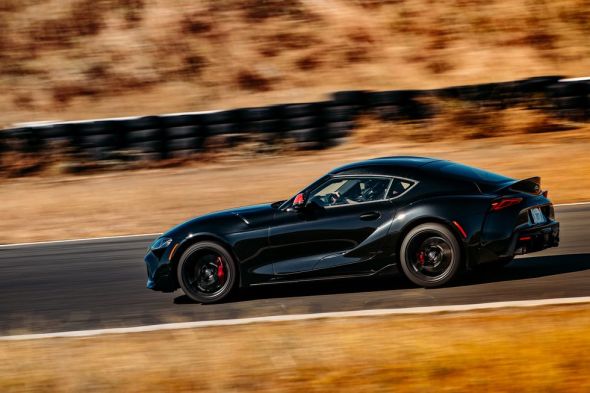
Toyota Supra 1:28.93
Lexus RC F Track 1:27.56
BMW M2 Competition 1:26.91
Lotus Evora GT 1:25.35
Nissan GT-R Nismo 1:23.80
Porsche 911 Carrera S 1:23.08
Chevrolet Corvette 1:22.83
McLaren 600LT 1:20.42
Lamborghini Huracán Evo 1:20.00
We Chose a Hyundai
A
Hyundai hatchback, over some of the most significant supercars of our era. Over
the second coming of the Toyota Supra, an all-new Porsche 911, and even that
beast of myth and legend, the mid-engine Corvette.
It
seems impossible. But before you set this magazine on fire and use it to light
a pitchfork-lined path to our door, understand that the Hyundai was not the
convenient answer.
Politics
and popular opinion all but demanded we hand our laurels to a brand with a
dusty pedigree. Over the course of PCOTY testing, each of our judges squirreled
away feelings on the hatchback, guarding them from others for fear of ridicule
or expulsion. But the truth is simple: the 2020 Hyundai Veloster N is a greater
celebration of the philosophies we treasure than any other new vehicle.
Let
me explain.
There were 11 cars, handpicked and brilliant. They had to prove
capable and engaging on the two undulating miles of Thunderhill Raceway Park’s
West track before we’d set them loose on our demanding public-road test route.
After two days of track time, only six cars would be allowed to join us on the
street drive.
The job should have been easy work for machines like the McLaren
600LT, the Lamborghini Huracán Evo, and the Nissan GT-R NISMO, but 2019 was a
big year for sports cars. The Supra has returned. The Chevrolet Corvette is
mid-engine for the first time. And the Porsche 911 has entered an all-new
generation, a sharper, stronger iteration of the world’s most versatile fast
car. The others were no less honed, representing every facet of performance,
from affordable gems like the Mazda Miata RF Club and the Hyundai, to serious
hardware like the sleeper BMW M2 Competition, the bristling Lexus RC F Track,
and the exotic, focused Lotus Evora GT.
We’ve never had such a competitive or disparate group of vehicles,
each with an honest shot at taking home the prize. This isn’t an
editor’s-choice award or a lap-time sprint for gold. Road & Track’s
Performance Car of the Year must work well on a track, but it can’t be a
one-trick pony; excellent apex behavior must give way to on-road competence.
And most of all, a PCOTY winner has to use its technology in service of driver
emotion, not just loftier speed. Automakers are increasingly occupied with
deleting humanity from the automotive experience, and these days, speed is
easy. The harder job is building a car worth driving.
So the Supra should have won, right? It’s a fast, ultra-modern
coupe pointed directly at people like us. The Supra nameplate, with its long
and storied history, is now engineered in concert with a company—BMW—that rose
to prominence selling “the Ultimate Driving Machine.”
Except the Toyota didn’t win. Our judges voted it out, almost
unanimously, in the initial cut. The car didn’t leave the track.
Why? How? The Supra is a magnet, low and small and absolutely
electric, our testers trying to hide their excitement at simply seeing the
thing, let alone driving it. But there’s not much Supra here—none of the name’s
legendary solidity and brawn—or even much Toyota. The chassis and driveline are
shared with the BMW Z4; the badge on the hood has a BMW part number. The
interior smells like a BMW. And despite the Toyota-specific suspension and
driveline tune, the car suffers from the same maladies that plague most modern
BMWs.
Not that it isn’t seriously fast. Editor-in-chief Travis Okulski
took the Supra to a ripping 1:28.93 around Thunderhill West, only a few tenths
slower than the more powerful RC F Track. Much of the Supra’s time came from
its spectacular front-end grip and precision, the front tires responsive and
predictable, though filtered through dead steering. But the real problem is in
how the thing does its job. At the limit, it can be twitchy and distant.
“The Toyota somehow manages to be joyless,” editor-at-large Sam
Smith said, after his first session. “There’s no reward for focus, no incentive
to be a hooligan… It doesn’t feel like any fast Toyota I’ve driven. None of the
confidence or unflappability of a second- or third-generation Supra.”
Some of this likely lies at the feet of the car’s maker—without
undoing a single fastener, we counted 28 separate uses of the word “BMW,” or
the BMW logo, under the Supra’s hood. For a few years now, the Bavarians have
been content to turn out cars the mechanical equivalent of the music student
who can hit every note at recital but still miss the point of a piece. No
surprise, then, that the BMW M2 Competition suffers some of the Supra’s
pitfalls, despite clocking an impressive 1:26.91. With 405 hp, the 3600-pound
M2 is far from slow, but BMW seems to have worked hard to isolate the driver.
All that hustle occurs through a cotton filter. The steering is light and
vague. The extra grunt and suspension stiffness over the discontinued, 365-hp
base M2 are part of a wholesale trade, exchanging a bit of that car’s talk for
straight-line speed and a willingness to drift.
“I have mixed feelings,” contributor Ross Bentley said. “It’s not
a bad car, just not what it should be. Good brakes, a little too much
understeer. It gives confidence because it’s not going to do anything bad.”
A shame, because nearly everyone praised the M2’s slick gearbox and
perfectly positioned pedals. Proof that deep down, BMW still remembers the
pleasure of a manual transmission. Unfortunately, that wasn’t enough to make
the cut for the road portion of the test. Heartbreaking for a group of judges
packed with BMW owners.
And those cars weren’t alone. PCOTY always carries a few surprises
and underdogs. The Lexus RC F was out of its depth in this company, but we
adored the car’s audacity, its snorty V-8 and too-stiff chassis. It’s a perfect
caricature of a Dodge Challenger: great and hilarious, but unrefined and
outshined.
Nothing paints a clearer picture of the field’s competitiveness
than the strengths of the vehicles left behind. Five cars had to go, and the
Lexus was too flawed to stay. Same for the Nissan GT-R NISMO. Who cares that
the GT-R is now in its 12th model year? The Nissan is effortlessly fast and
laugh-out-loud entertaining. Of all the six-digit cars on hand, it was also the
only one that didn’t come with an army of factory minders. Just one guy in a
Nissan Armada carrying an extra set of tires. When we asked him if we should
make any concessions for the test’s 107-degree heat, maybe bleed off tire
pressures, he just shrugged and smiled.
“Nah, it’ll be fine.”
It was. Despite being the heaviest car in the running, the
3865-pound GT-R popped a 1:23.80, less than a second behind both the Porsche
and the Corvette. Nissan has improved the car almost every year since its 2007
launch, taking it from distant missile to talkative weapon. The NISMO feels
like an old friend, but this year’s updates weren’t enough to keep its head
above water. A great car outdone by exceptional ones.
The Lamborghini was also glorious, but it didn’t leave the track,
either. Prior to PCOTY, most of us had only experienced the 630-hp,
V-10-powered Huracán Evo on public streets, where phrases like “involuntary
manslaughter” and “reckless endangerment” shackle you to what’s possible.
Unleashed on a closed circuit, the Evo proved its abilities. Miraculous and
terrifying ones, mostly. Violent shifts that echo like small-arms fire.
Acceleration that rummages through your stomach to see what you had for lunch.
That all-wheel-drive system performs the unnatural with a shrug, thanks partly
to a front end that feels stitched to the ground. And when you think you’ve
come to the edge of that ocean of traction, the Lamborghini digs around in its
cupboard and produces another pitcher of the stuff. Trip into a slide, the car
almost catches itself, despite feeling big as a city block.
The Evo was hands-down the fastest car around the course. The
sound chased it from corner to corner, a Doppler flag marking position. In a
field packed with muted and turbocharged exhaust notes, that barking, naturally
aspirated engine could not have stood further apart.
“Lamborghinis are supposed to be all style and no substance,” said
contributing editor Jason Cammisa. “This has both in equal measure.”
Okulski had just stepped from the car after his laps when Smith
cornered him, curious.
“Yeah. Sublime. Nothing wrong with it,” Smith said.
“This is better.”
The only problem lurked on pit lane in white paint. A cannon that
bumped the Lamborghini from the list of finalists despite being slower around
the track. From its nonsensical doors and carbon-fiber buckets to its airy
cockpit and turbocharged, theatrical V-8, the McLaren 600LT managed to out-occasion
the Huracán at every turn. The LT had the same lightning acceleration, just
married to a lithe chassis and the most tactile steering in the business.
Switching from McLaren to Lamborghini was like trading skin and
bone for a pattern of pixels. And while the ever-stable Huracán seems to always
have a guiding hand on your back, the McLaren could not care less if you chased
your dumbest instincts. Drop the hammer in a second-gear hairpin and it does
exactly what a 592-horse rear-driver should: spit you sideways in smoke and
noise, the limiter kicking at your skull. The British car accomplished as much
as the Italian but said more in the process, pushed you to greater heights.
Shouted messages to your spine where the Huracán was all murmurs. And when it
came down to it, that was the common thread through our six finalists—a hint
that someone in R&D did more than tick boxes.
So we left that Lamborghini behind. The McLaren led the pack on
the way out of Willows as we hopscotched a series of slow-moving 18-wheelers.
The Veloster was next, followed by the 911 and the Corvette. The Miata bopped
along behind, the Lotus and its supercharged bark last in line. We worked our
way east, toward Tahoe.
Passing in a 600LT is a profanity. Tap the left paddle twice,
check the oncoming lane, then plant your right foot and wait for England to put
a boot to your chest. For all of our braying about speed’s irrelevance, there’s
plenty to be said for a straight road. And while the McLaren’s capabilities are
far past the legal limit, the car has other tricks. You can fold the hardtop or
roll down the back cabin glass to let that V-8 gasp in your ear.
Before you die, try to execute at least one full-throttle rip
through a mountain tunnel in a 600LT with the roof peeled back. It’ll make the
best-of when your life flashes before your eyes.
Our stops turned into mini conferences, judges gathering to point
and pick at the cars.
“I cannot believe they just let regular people buy these,”
contributor Matt Farah said, gesturing at the McLaren. “It’s so obscenely fast.
Feels like the craziest engine on Earth is bolted to your spine.”
“It’s the car Lotus wishes they could build,” deputy editor Bob
Sorokanich added. “It simply disappears underneath you.”
The Corvette, too, had a way of vanishing in your hands. Few
vehicles have felt so uniquely crafted to flip our switches. Our test car, a
pre-production unit supplied by GM, brought caveats. For the record, this is
not generally how we like to do things. There can be wide gulfs between a car’s
test-build performance and job one, and judging a nearly complete effort isn’t
always fair. But the eighth-generation Vette is the most significant sports car
in recent memory, and GM said that if we wanted that icon in this year’s PCOTY,
we had to accept a prepro car.
No one cared when they rolled it out of the trailer. The Chevrolet
turned us into children, pointing and crawling over it even as it was backed
from the hauler. The C8 is a weird cocktail of familiar and foreign. It smells
like Corvette inside, that faint whiff of glue. The valve covers are sparkly,
bass-boat red. You can stuff a live human into the cavernous rear trunk. A
single individual can remove and stow the roof panel. You sit so far forward,
all but atop the front axle. Which is partly why the steering feels
instantaneous.
The Corvette has been nipping at supercar heels for years, and it
finally seems poised to take a proper bite. The C8 is a brilliant car. “Some
elements—engine blueprint, sound, power delivery—are emphatically Corvette,”
said senior editor Kyle Kinard. “Others—seating position, turn-in,
rotation—aren’t.” As Smith pointed out, the Corvette has always been centered
on the democratization of an experience: an affordable version of the European
sports car in the 1950s, of the cocaine-cruiser highway vibe of BMW and
Mercedes-Benz in the 1980s, and in recent years, Porsche-besting performance
with a Silverado price tag. Viewed through that lens, as a Lamborghini for
Lubbock, it is pure success.
But there are kinks. The C8’s
cabin felt more claustrophobic than that of the front-engined C7, and someone
in the General Motors chain of command decided that this car, mid-engine for
the first time, needed to drive a lot like the old one. Steering aside, it
feels very much like a C7, minus a bit of balance. We missed the liveliness and
poise of other mid-engine cars, the nose grip. The delta prompted a question:
if you’re going to scrap 66 years of brand precedent and abandon the manual
transmission altogether, why look back? Go for broke.
Still, you could make an argument that such things are irrelevant.
So the Corvette doesn’t pirouette like a European supercar costing twice as
much. Who cares? In Okulski’s lapping, the Chevrolet was still quicker than its
longtime rival, the 911, beating the German by a quarter of a second.
And on the road to Tahoe, it was as good as a Corvette has ever
been. Comfortable and relaxed when you wanted, eating miles with that V-8
barely breathing. Or sharp and alive, dicing through switchbacks.
When we stopped for fuel, curious strangers lingered near the
fleet, making slow passes on their way to the cashier. The Corvette was king,
onlookers ignoring the McLaren and 911 for a better look at the C8. In that
crowd, certain cars simply vanished, the Veloster N and Miata RF all but
invisible. Win some, lose some.
The hitch, sinking the C8, was the transmission. A twin-clutch
automatic, Corvette’s first. In automatic mode, on track or the street, it is
perfectly adept, handing out shifts quicker than thought. But manual mode is a
half step behind the competition, denying downshifts or letting the engine bash
the limiter, unsure of how much intervention to provide.
If you must take our clutch pedals, at least swap them for a
transmission that wants to play. GM benchmarked the PDK dual-clutch in the 911
while developing the Vette’s transaxle, and it’s clear why. There is no more
satisfying or evolved two-pedal gearbox. The PDK in the new 911 Carrera S is
quicker and more focused than any human, but it doesn’t rub your nose in it or
rap your knuckles when you slip up. Lap after lap, the trans works with you to
be a little quicker, covering your tail when you miss a shift and dropping a
gear if it thinks you can gain a tenth.
Maybe the Corvette’s production gearbox will be better.
Regardless, the disparity was instructive. The 911 and Vette come from
different schools of thought. Chevrolet used to know how to subtly refine a
product while guarding its identity; Porsche still does. This new-generation
911 fully embraces its rear-engine heritage, and on track, you can feel that
delicious weight imbalance, the car’s strengths helping to fire you off each
apex.
“This thing is so good, it’s almost impossible to hate,” Farah
said. “Who could ask for more power? Who could ask for better steering or more
grip? How do you argue with PDK? The only real problem is that you don’t need
to spend nearly as much to go this quick, if you don’t want a Porsche. But the
911 is still the Swiss Army knife of sports cars.”
That’s no small compliment. The Porsche’s back seats are large
enough to stow a couple kids or a few small pieces of luggage. And when you
don’t have the car by the scruff, it fades from your mind, so you can wrestle
with what’s for dinner instead of struggling to see out the back window.
On the other hand, maybe that’s the 911 curse. As Cammisa noted,
at commuting speeds, the car turns into a Panamera Coupe, Porsche’s luxury
sedan, always in the background.
No one accused the Lotus of blending into anything. The car seemed
to have dropped in from a different dimension. Or at least a different time.
The Evora GT is a snapshot of sports cars from 10 years ago, bare and alive, a
minor evolution of a relatively simple platform that debuted in 2009.
It’s weirdly bad at being a car. The seats are mounted a bit too
high. The stereo is an aftermarket afterthought. The ignition sequence is an
annoying secret handshake—a series of unintuitive button presses to disable the
factory alarm—designed to make you look like an idiot at the valet. The
rearview mirror provides a spectacular view of the engine’s wastegate actuator
and nothing else. It’s loud. And none of that mattered, because the Evora is
that good. The GT’s supercharged 3.5-liter V-6 is the same Toyota engine Lotus
has used for years, but it sings. As I chased the Corvette up Northern
California’s Donner Pass in second gear, roadside granite bluffs bounced the
noise back through the open windows, the blower whine crawling around in my
lap. On track, the gears felt a little long, the cable-shifted six-speed too
clunky for quick shifts, but on the street, the gearbox was divine. It’s the
car most of us would have in our garage.
“Fast, winding canyons are like sailing or skiing or ice-skating,”
Smith said. “Just dancing. You choose the flow and the Lotus serves it up on a
platter.”
There is magic here, and not from electronic trickery. No
electronically adjustable shocks or computer-controlled differentials, just
careful geometry and tuning. The stuff that has long made Lotus, Lotus. Unlike
others in this group, the Evora demanded something of the driver. Skill was
necessary for quick laps, but the car never punished a lack of it. You need
more than a pulse to make an Evora circle a road course. But that was also true
of another machine.
By cold logic, the Mazda Miata RF Club, the slowest and least
powerful car at Thunderhill, should not have made the final cut. The RF is
essentially an ordinary Miata with a folding steel hardtop in place of the base
model’s soft convertible top. Unlike the convertible, however, the RF cannot
meet most track-day roll-over inspections without substantial modifications.
But Miatas are not logical cars, and those downsides were trumped by the simple
fact that the Mazda is a kid’s birthday party behind the wheel, all sugar and
pony rides and bliss. The yards of suspension travel and narrow tires make it
the perfect forgiving trainer, intentions shouted through body roll. Much of
the good came from the Mazda’s new engine, a rev-happy, 181-hp 2.0-liter. That
four is best within a whisper of redline, and while most of us loved using
every ounce of its performance, some judges were less interested in thrashing a
tiny four-cylinder.
At a stop, Farah held up the Miata key, shaking it.
“I don’t like the Mazda much if you’re not caning the hell out of
it,” he said. “Those transitions when you’re passing a semi, say. You have to
go from sixth, to fifth, to fourth, to third.”
“Oh, I dig that,” Okulski grinned. “I was behind the Miata earlier, and every time it had to make a pass, you could tell the driver was ripping off downshifts. Looked fun.”
“You have to be comfortable owning a car you have to beat the hell
out of all the time,” Farah said. “It’s not fun if you’re going slow and the
whole thing is vibrating. It’s buzzy.”
Several other judges met him with cocked eyebrows. Cammisa spoke
up. “A car that can rip off a 5.8-second 0-to-60 isn’t slow for most people.”
“Well, I still don’t fit in the damned thing,” Farah laughed.
Either way, the power differential was inconsequential in the
Plumas National Forest. That was the Miata’s playground. Tight corners, short
sightlines, and the Mazda’s accelerator bolted to the floor—those high-dollar
cars couldn’t use their power, and they had nowhere to run. There are moments
in our driving lives when everything clicks, and the Miata has long been a
reliable key for opening that door. The current RF is the same. Even with some
of the world’s most athletic vehicles on hand, the Miata was never left behind,
carrying its momentum without spilling a drop.
As we sat around a table discussing the week, competitors dropped
from contention one by one. The McLaren, for all its supercar glory, could be
simultaneously dull and exhausting at a public pace. Gearbox complaints felled
the Corvette from grace; every judge wanted an honest manual in place of the
dual-clutch, in part because the manual C7 in similar trim was more joyous and
alive. And the 911, so close to perfect, still felt big on those back roads.
The Lotus, with its wailing V-6, missed the mark in refinement and, like the
GT-R, is an old car trying to stay young, not so much moving the sports-car
game forward as preserving it in amber. Even the Miata came up short, hamstrung
by a folding hardtop that makes installation of a proper roll bar difficult—necessary
hardware if you want to take the car to the track.
Only one machine garnered rave reviews all week, painting every
driver’s face with a mile-wide grin. Only one gathered an almost unanimous
vote.
The Veloster was an
outlier—outgunned and outclassed by nearly every other car in this test. A
gawky front-drive hatch, zero brand pedigree, in a field of slinky sports cars.
But the Hyundai’s behavior quickly set it apart from the crowd. Hyundai’s head of
performance development, Albert Biermann, spent 30 years working for BMW, back
when the German company built a different sort of car. It shows, because the
Hyundai is a love letter to folks like us. After a few happy miles at
Thunderhill, Cammisa took to a logbook to remind us that front-wheel-drive cars
famously fall apart on a road course—stumbling over themselves, running out of
brake, drowning in understeer. But if that’s a universal truth, no one told
Biermann. His work behaves like a front-wheel-drive greatest-hits album: want
the savagery of a John Cooper Works Mini with the fleetfoot bliss of a Ford
Fiesta ST? Turn-in is immediate, the steering precise and bubbling with
feedback. The Hyundai has a more sorted front end and more cohesive feel than cars
costing three times as much.
“This is a $30,430 car that makes a Volkswagen Golf R irrelevant,”
Cammisa said.
What he did not say: The Golf R, one of history’s great
hatchbacks, costs around 10 grand more and feels numb by comparison.
Because the Veloster N is so cheap, anyone with a nine-to-five can
sign a note and ride off with one of the sharpest cars on the market. But it
was more than price. Pressing the “N” button on the steering wheel changed the
car dramatically. We tend to turn up our noses at drive modes on fun cars: Why
does a Lamborghini need a Sport setting? Didn’t you buy the expensive loud one?
The button makes perfect sense here, switching the car from quiet and
comfortable daily driver to snotty hot hatch, the exhaust popping and snapping
with more authority than anything the Corvette could muster. It is so
fantastically neutral, pivoting at your hips, the throttle and brake yaw
rheostats.
No front-drive car should work this well, but the Veloster is
eager, urging you to run up and stick a pin in some expensive supercar’s ego.
To watch it deflate as you fill their mirrors.
“It doesn’t care how you treat it,” Kinard said. “You can drive it
on its tippy toes, like someone who knows what they’re doing. Or you can drive
it like me, a ham-fisted Colin McRae wannabe. The thing rewards you.”
“That’s what the Civic Type R should have made people say,” Smith
agreed.
There are flaws. The engine has all the character of an ink-jet
printer, and the gas and brake pedal occupy different zip codes. But after five
minutes, it doesn’t matter. As we chased the new Corvette away from our lunch
stop on the final day of testing, the Hyundai had that mid-engine thing’s
number, dancing and playing but forever confident. Kinard called it a bucket of
puppies, but that’s not quite right. I’ve never met a puppy that can run down a
McLaren on a back road.
For all their bluster and power, their lap times and displacement,
most of the carmakers at this test made a deal with the devil—they traded what
once made them great in the search for outright speed. Never has the disparity
been greater between the capabilities of a modern fast car and what is legally
possible. The new definition of performance isn’t what a car can do, but what
it will do on a good road.
The Veloster N is what a great front-wheel-drive car should feel
like. A delight that welds a smile to your face every time you drive it. It
cheers you on, treating you like the hero. And it came from a company that had
no reason to build it. Chevrolet has to make a Corvette; Porsche, a 911. Short
of a giant meteorite or nuclear winter, those names will always exist. Cars
like the Veloster N are more special, crafted not of obligation, but for the
sheer joy of driving. That’s why the Hyundai Veloster N is Road &
Track’s 2020 Performance Car of the Year.
It’s drop-dead gorgeous, with a few breaks in tradition
Oh boy, Chevrolet invited out the pitchforks with
the reveal of the totally redesigned 2020 Chevrolet Corvette, or as it’s
known inside Chevy: the C8. It’s a major leap of faith for those in charge at
the bow tie brand. This marks the eighth generation of the iconic 2-seater. From
the get-go, the introduction of every generational Corvette has been
highly anticipated. So, what makes this launch any different? Well, nearly
everything.
The first of two glaring changes is, for the first time
since its original launch 67 years ago, the engine is located between the
passengers and the rear axle. Yep, the 2020 Corvette is a midengine car. The
second huge change is, it will no longer offer a manual transmission. What!
That’s right, the only transmission available is an 8-speed dual-clutch automatic.
A driver can still manually shift the transmission, but it’s by-wire
technology. Also, for the first time, leaf springs won’t be a suspension
component. Chevy went with coil springs at each wheel.
Clearly, Chevy has two key goals for the radically updated
Corvette: Thrust it into the elite circle of supercars like Acura
NSX, Audi R8 and McLaren 570, as well as appeal to a younger
audience. In doing so, however, the threat is the loss of Corvette’s
traditional owner base. Cue the pitchforks. If early orders already accounting
for the first year’s production are any indication, though, Chevy doesn’t have
much to fret about.
The new Corvette is priced from $59,995 to $73,040.
Forgetting the politics of such a sea change, while ignoring
our own knee-jerk predispositions for maintaining Corvette traditions, we found
our time behind the wheel to be a real revelation. Checking all the supercar
boxes of performance, active suspension, midengine design and stunning exterior
styling, the reimagined 2020 Chevrolet Corvette should win the hearts and minds
of new generations of Corvette owners. As for the traditionalists, we think
what the 8th-gen Corvette brings to the party will win over most of them, as
well.
What’s new?
The Corvette is totally redesigned for 2020.
What we like
The Corvette is totally redesigned for 2020.
What we like
Drop-dead gorgeous styling
Radically improved handling
A supercar that’s an everyday driver
Sub 3-second sprint to 60 mph with Z51 package
A $59,995 starting price
What we don’t
Stingy cargo space
Hard-to-appreciate steering-wheel design
Will probably be in short supply for the first
year or more
How much?
$59,995 to $73,040
Fuel economy
Filling the well behind the passengers is an updated version of last year’s LT1 engine. It’s the LT2 that’s a 495-horsepower 6.2-kiter V8 developing 470 lb-ft of peak torque. This is the most hp and torque on any entry-level ‘Vette yet. Chevy made a few changes, mostly to accommodate its amidships placement. One being that the air intake now originates in the rear.
The 2020 Chevrolet Corvette is all about the driving experience.
Hustling engine output to the rear wheels is an
8-speed dual-clutch automatic transmission with steering wheel-mounted
paddle shifters.
As already mentioned, Chevy is claiming a 0-to-60 mph time
of less than three seconds with the $5,000 Z51 package.
No fuel economy government estimates were available as of
this writing.
Standard features and options
The 2020 Corvette is available in three trims: 1LT, 2LT and
3LT. When it goes on sale early in 2020, there will also be a convertible
version. All prices include the $1,095 factory delivery charge.
The Corvette 1LT ($59,995) comes with Brembo anti-lock brakes with black-painted calipers, a clear engine-compartment cover, 19-in front/20-in rear aluminum wheels, power outboard mirrors with integrated turn signals, LED headlights, a 12-in diagonal color driver information center, dual-zone automatic climate control, Mulan leather seating with perforated inserts, 8-way power-adjustable seats, cruise control, keyless open and start, remote start, a leather-wrapped power tilt-and-telescopic steering wheel, Teen Driver parental controls, an HD backup camera, rear park assist, Bluetooth connectivity, 4G LTE Wi-Fi hot spot capability, OnStar connected services capability, Infotainment 3 Plus System, an 8-in HD color touchscreen, a 10-speaker Bose audio system with HD radio and satellite radio capability.
To the 1LT features the 2LT ($68,390) adds heated/autodimming/power-folding outboard mirrors, a 14-speaker Bose Performance-Series audio system, cargo nets, upgraded 3 Plus infotainment system with navigation, HD front vision camera, a head-up display, a heated steering wheel, an inclination sensor, memory driver/passenger convenience package, power-lumbar and power seat-back bolster front seats, rear cross-traffic alert, blind spot monitoring, antitheft system and wireless charging.
Stepping up to the 3LT ($73,040) adds a
custom leather-wrapped interior package, upgraded seats, Napa leather seating
with perforated inserts and sueded microfiber-wrapped upper interior trim.
Some features standard on a higher trim are options on lower
ones. Several options, though, are across the board, like the performance
exhaust, Z51 Package, the body-color dual roof, the carbon fiber roof and the
transparent roof panel. There are plenty of customizing touches, too, like different
color calipers, seat belts, exterior accents, interior accents and red seating.
Safety
The updated Corvette has the usual safety features like four
air bags, stability control, traction control and anti-lock brakes.
Also standard across the trims is a backup camera, rear park assist and Teen
Driver. Standard on the 2LT and 3LT are blind spot monitoring, rear
cross-traffic alert and a front vision camera.
No third party has safety or crash tested the 2020 Corvette.
Behind the wheel
The first thing you notice when climbing into the driver’s
seat is the uber-low seating position. Next is the oddly shaped steering wheel
that’s more of a rectangle than a circle. This is a driver-centric cabin,
surrounding the driver on three sides with controls and switches of one sort or
another. Things not directly in front of the driver are canted toward him or
her. This is not a cockpit engineered for trips to lover’s lane. You can see
and speak with the passenger from the driver’s perch, but anything beyond
patting your passenger’s head is another matter entirely. The center tunnel is
huge.
The Corvette has an oddly-shaped steering wheel.
Enough about the color of the drapes. We like the options
Corvette provides to the driver to make the experience his or her own. There
are four driver settings (Tour, Sport, Track and Weather) to dial in
performance to suit the current conditions. There’s even another setting for
the driver to customize things to personal taste.
At the end of the day, what the Corvette is all about is the
driving experience. Thanks to the midengine arrangement, not only is the weight
more evenly distributed front and rear, the engine sits lower for a lower
center of gravity. The car feels more planted and predictable. You really feel
in control. A function of 470 hp and a svelte 3,500 pounds of mass,
acceleration is as neck snapping as you want it to be.
Chevy made every effort to make the new Corvette more rigid,
which translates into better control and cornering. Whether cruising along the
freeway or attacking a few curves, the 2020 Corvette is every inch the supercar
Chevrolet hoped it would be. And, we still think it’s the best performance bang
for the buck.
Other cars to consider
2020 Acura NSX — Don’t let the fact the NSX has a
hybrid powertrain fool you. This is still a performance midengine car with
impressive acceleration and excellent handling.
2020 Audi R8 — Even without Tony Stark’s endorsement,
the R8 is a terrific car. Enjoying a little more horsepower and torque for
2020, it performs as well as it looks.
2020 Porsche Cayman — Hey, it’s a Porsche .
Timeless styling and an available 2.5-liter turbo engine that delivers as much
as 365 hp.
Autotrader’s Advice
How can you go wrong picking any combination of Corvette trims and options? Having said that, we’d recommend sticking with the 1LT and adding the Z51 Package. It keeps the price about as low as possible, but provides serious performance.
Formula 1 is going to see a bunch of changes in 2021. The
series is implementing some major shifts to the rules, with new car designs and
a budget cap for teams, all with the goal of increasing competition and making
races more exciting. For the first time, we’re able to see what the 2021 F1
cars will look like.
Formula 1 revealed the finalized car design at a press
conference today, outlining all the new rules and regulations that will go into
effect come 2021. The cars will be slightly heavier, and wear 18-inch wheels,
which should allow for bigger brakes.
The aerodynamic package is what’s most important, however,
because it’ll reduce disruption through the air, allowing for closer battles
and more passing opportunities, which should mean more exciting racing. There
are major changes to the front and rear wings, as well as the floor of the car.
The suspension has been simplified, and wheel-wake control devices have been
added to smooth out flow. In August, Formula 1 said this new design will
have a 45-percent decrease in airflow disruption.
One thing that isn’t getting a significant update is the powertrain layout—2021 cars will still be using a 1.6-liter hybrid-assisted turbo V-6.
Of course, the car isn’t the only thing that’s been
overhauled. The series is standardizing more parts, while restricting how many
times certain components can be replaced or upgraded during a race weekend.
There’s also a budget cap for every team for how much can spend on performance
development, set at $175 million per season. The series says it’s contracted an
independent regulator to make sure the spending limit is enforced.
That’s not all. There are changes being made to the race
weekend schedule as well, with the pre-race press conference now happening on
Friday, right before the first practice session. Furthermore, all teams must
run at least two practice sessions per year with drivers who have completed two
Grands Prix or fewer. This is done to give new drivers a change to show their
worth.
Formula 1 has uploaded a video summarized all of the changes in a video below.