
VKTRY Performance Insoles Embrace Carbon Fiber For Energy Return


If just a touch of carbon fiber can provide benefits for athletes, then VKTRY founder Matt Arciuolo figured engineering a full-length carbon fiber insole had a range of untapped potential. Following nearly a decade of research and development, all sparked by an effort to provide the USA Olympic bobsled team more explosiveness on their starts, Arciuolo patented a carbon fiber footwear insole customizable to provide performance benefits for athletes far beyond the bobsled.
VKTRY, now four years beyond that patent and three years since producing its first commercial insoles, has made inroads in major college and professional sports the country over, gaining backing from LSU’s director of athletic training Jack Marucci, now-retired Lakers trainer Gary Vitti, Red Sox doctor James Creps and a handful of professional athlete endorders.
“Insole inserts are passive devices designed to absorb shock, but they don’t generate energy or return energy to the athlete,” Arciuolo says. “Instead of a passive device, I designed this carbon fiber insole to store energy and return it.”

The process works in four steps, all using the impressive strength-to-weight ratio of carbon fiber. When the heel hits the ground, the VKTRY insole absorbs the shock of the heel strike and returns it like a trampoline, Arciuolo says. When the second phase of an athlete’s gate moves their full body weight over the middle of the insert, the arched design deflects and adds cushioning. “The third phase is where the magic happens,” he says. When athletes pick their heel up to take a step or jump, the carbon fiber stores the energy at the ball of the foot, returning it in the toe-off phase — phase four — “where all the energy stored in the first three phases is returned.” The insole isn’t generating energy on its own, instead using an athlete’s energy and returning it to them for efficiency and explosion.
Using independent studies, including one from Southern Connecticut State University, VKTRY CEO Steve Wasik says science backs that claims, showing the company’s insoles provide over a 9 percent rate of force development, basically explosiveness, than not using the product.
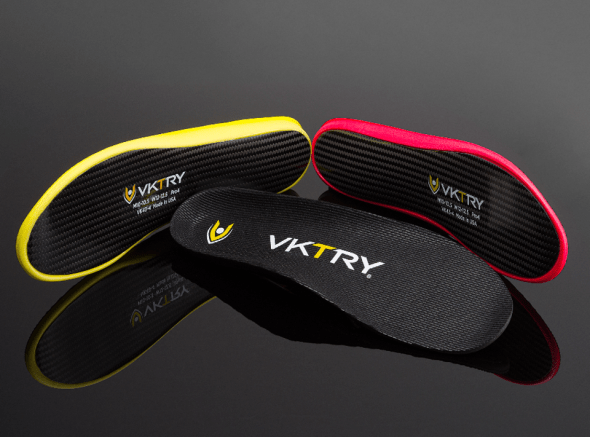
The carbon fiber is engineered with multiple layers of fibers in different lengths, makeups and directions to offer flexibility where needed and stability in other areas.
VKTRY was designed for use across multiple sports — major footwear brands from Nike to Asics have started employing carbon fiber in long-distance running shoes for linear benefits — and Wasik says they’ve seen adoption from football to baseball, but have found basketball and volleyball players especially enjoy the energy return for higher jumping ability and less force upon landing. “We hear some great stories from athletes who have suffered from sore knees or shin splints and the pain is gone,” he says.
The original bobsled design requiring the insole to fit in the tight confines of a spike helped create a product ideal for all athletes, Arciuolo says. “The challenge was not only getting something that worked in terms of propulsion, but also that fit in the shoe,” he says. The carbon fiber portion of the product weighs less than an ounce and is less than a millimeter thick. A proprietary polyurethane top cover provides additional comfort.

VKTRY isn’t a one-size fits all proposition, with Arciuolo calling it a “truly customized product.” It comes in five different “pro levels,” which are basically different flex levels. Lighter athletes with smaller feet require more flex than a 320-pound football player. To get the same propulsion performance, insoles require customization based on sport, weight and foot size, so an algorithm helps find the best flex level for each athlete. The insole is further customized by sport, using different thickness and sizes.
“The VK is the best combination of injury protection and performance I have ever seen in insoles,” Vitti says.
Endorsers of the brand also include Vladimir Guerrero Jr. of the Toronto Blue Jays, Anthony Miller of the Chicago Bears, Josh Norman of the Washington Redskins, Lexie Brown of the Minnesota Lynx, Myles Jones of Chaos Lacrosse Club, George Springer of the Houston Astros, CrossFit world champion Annie Thorisdottir and plenty more.
Creps says that “for the first time, athletes can experience stabilization, shock absorption and propulsion in a device that is specifically tailored to their size and weight. This is a game changer.”
Written by Tim Newcomb; Forbes
Steven Holcomb’s Olympic legacy to grow, for a final time


U.S. bobsledder Steven Holcomb is getting one last victory celebration.
A long overdue one.
More than 2 1/2 years after his death — and almost six years removed from the bobsled races in question — Holcomb and his team are about to finally be presented the silver medals that they should have received at the 2014 Sochi Olympics. Holcomb and teammates Steven Langton, Chris Fogt and Curt Tomasevicz were originally awarded bronze medals, which were eventually upgraded after a long probe of the Russian doping scandal that now overshadows those games.

The medal reallocation will take place at the Team USA Awards in Los Angeles. Langton, Fogt and Tomasevicz are all expected to attend, as is longtime U.S. bobsled coach Brian Shimer and other top American sliding officials. Holcomb, who was 37 when he died in his sleep at the Olympic Training Center in Lake Placid, New York in May 2017, will be represented by his family.
“I think the word that comes to mind most quickly is bittersweet,” said Jean Schaefer, Holcomb’s mother. “It’s certainly a great honor for Steven and I’m so very, very proud of him — as I have been so very proud of him his whole life. But there’s also a great sadness that he’s not here to enjoy the fruits of his efforts and to celebrate with his team.”

It took years to get to this point: Russia, which won the two- and four-man bobsled races at the 2014 Games on its home ice, was stripped of those titles in November 2017 after the long investigation into the state-sponsored doping program at that Olympics.
But it took the International Olympic Committee until this past March to formally reallocate the medals. Latvia was upgraded to gold in four-man, with Britain moving up to bronze. In two-man, Switzerland eventually was elevated to gold, with Latvia up to bronze.

The U.S., which left Sochi with bronzes from both races, is now recognized as the silver medalist in both. Holcomb and Langton were in the two-man sled; Holcomb drove Langton, Fogt and Tomasevicz in the four-man race.
“Holcomb made such an impact on so many people’s lives,” said Kaillie Humphries, the longtime Canadian bobsledder and two-time Olympic women’s champion who is now competing for the U.S. “He was the best.”
Holcomb, who had prescription sleeping pills and alcohol in his system on the night that he died and was so depressed by failing eyesight in 2007 that he attempted suicide, was by far the best bobsledder in the U.S. program — perhaps ever. He was a winner of at least 60 World Cup medals, more than a dozen World Cup championship trophies and the various awards from his career are scattered about the homes of his relatives.

His mother’s intention for the silver medals is that they be donated to the U.S. Olympic and Paralympic Committee archives. The USOPC was in possession of Holcomb’s bronze medals, as a gift from his family, when they had to be surrendered to the IOC in order to receive the new silvers.

“Steven once told me that his medals weren’t just medals for him or his team,” Schaefer said. “They were medals for his country. They represented America and he was very proud of that and I think he would be very proud to know that his medals reside where people can see them and enjoy them.”
Holcomb would have been a lock for the 2018 U.S. Olympic Team as well, where he could have added to his medal haul — he drove the U.S. to gold in the four-man race at the 2010 Vancouver Games, ending a 62-year drought for the Americans in bobsledding’s signature race.
His mother went to Pyeongchang last year instead, representing her son and his memory. The grieving process is not over, though Tuesday’s event is certain to bring back happy thoughts as well.
“I’m as OK as I can be,” Schaefer said. “I don’t know if a parent ever gets over the loss of a child, because it’s certainly not the natural order of things. And I have to say that the support of his teammates and the Olympic family is incredible. Just incredible. You feel the love all the time.”
She will feel it again Tuesday, one more time.

Lake Placid picks up a second weekend of IBSF World Cup races


LAKE PLACID — The state Olympic Regional Development Authority will be hosting the first two International Bobsleigh and Skeleton Federation World Cups this year at Mount Van Hoevenberg, instead of only one as previously planned.
The season-opening BMW IBSF Bobsled & Skeleton World Cup originally scheduled at Park City, Utah from Nov. 25 to Dec. 1 was moved to Lake Placid for the weekend of Dec. 7 and 8, the IBSF announced on Nov. 2. The second World Cup race will be held as planned at the Olympic Sports Complex from Dec. 13 to 15.
“Due to the short time for preparation and in order to guarantee high level quality ice, the schedule for those two World Cup weeks had to be amended,” the IBSF stated in a press release.
There will be two, two two-man bobsled World Cup races held during the first week and two, four-man bobsled races held during the second week. There will also be women’s bobsledding and skeleton racing for men and women. The IBSF had not changed the schedule on its website by press time.
The IBSF cites technical issues with the refrigeration pump system on the Park City track as the reason for the rescheduling.

Pic 2 Bobsledder Codie Bascue rides through Curve 14 at Mount Van Hoevenberg on the men’s first run during the IBSF World Cup in February. (Enterprise file photo — Lou Reuter)
“Though the track management has acted immediately and tried to repair the system, it cannot guarantee that it will be ready by the time of the World Cup,” the IBSF stated. “In order to avoid any risk of not hosting the event it was decided to move it to Lake Placid.”
In its release, IBSF officials thanked Park City track management “for the swift and professional proceeding in this matter,” Jeff Potter at ORDA “for his support in taking over the event” and John Rosen of USA Bobsled & Skeleton “for coordinating the matter.”
“The immediate cooperation between the two track managements of Park City and Lake Placid shows their great commitment for bobsleigh and skeleton sports and we want to thank both Race Organizers,” the IBSF stated.
The Lake Placid races were announced by ORDA Tuesday as part of its winter schedule. After the first two World Cups are done, the circuit heads to Europe for World Cup racing Dec. 30 to Jan. 5 in Winterberg, Germany.
ORDA will host the Viessmann FIL Luge World Cup/BMW Sprint Cup from Nov. 29 to Dec. 1 at Mount Van Hoevenberg, giving Lake Placid three straight weeks of World Cup racing on the American teams’ home track. Both USA Bobsled & Skeleton and USA Luge are based in Lake Placid.
Original source: Andy Flynn, AndirondackDaily